
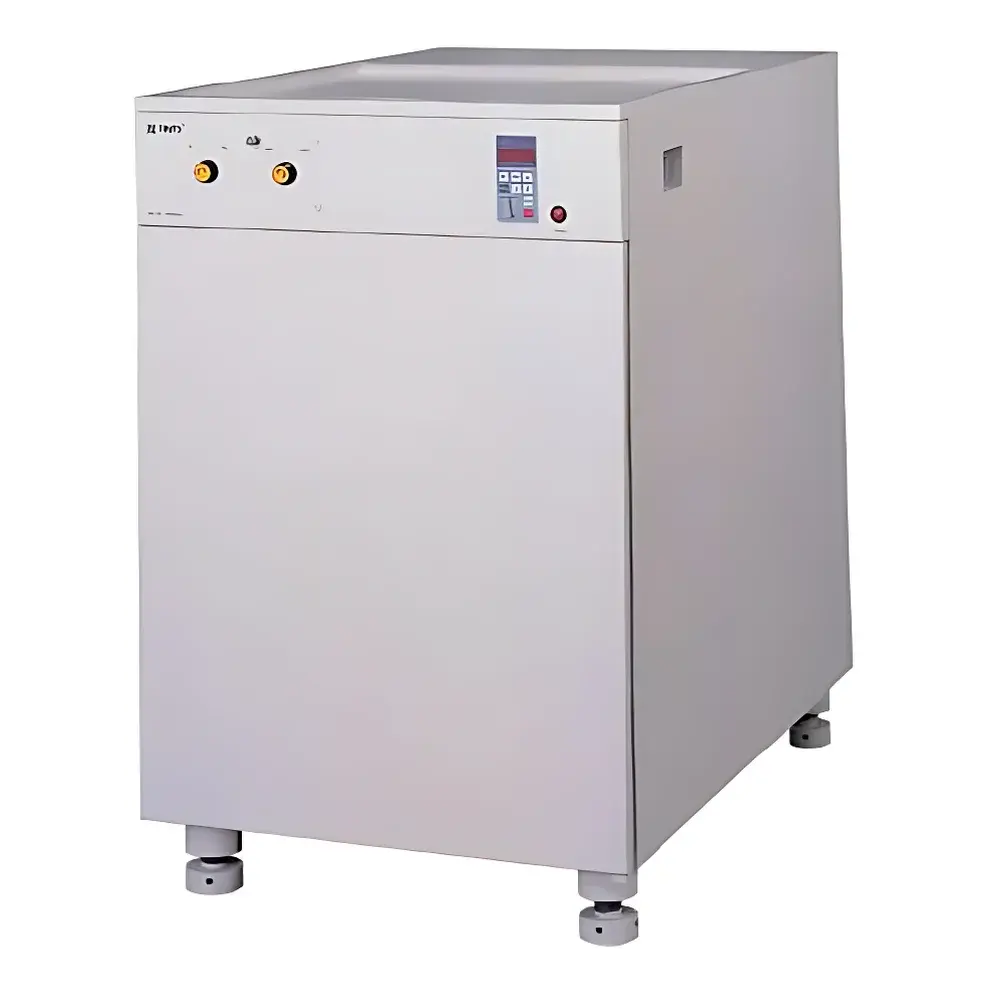
Tongtian TBE-1000A High-Speed Counter-Current Chromatograph
| Brand | Tongtian |
|---|---|
| Origin | Shanghai, China |
| Model | TBE-1000A |
| Power Supply | 220 V ± 20 V, 50 Hz ± 0.5 Hz |
| Motor Power | 750 W |
| Column Configuration | Triple-spiral coiled column assembly (patented) |
| Rotational Speed Range | 400–600 rpm (infinitely variable frequency-controlled) |
| Pump Flow Rate | 0.1–90 mL/min |
| UV Detector Wavelengths | 254 nm & 280 nm |
| Temperature Control Range | 15–40 °C (±0.5 °C accuracy |
| Temperature Control Flow Rate | 1–20 L/min |
| Tubing Volume | 1000 mL |
| Sample Injection Volume | 80 mL |
| Dimensions (W×D×H) | 830 × 570 × 1050 mm |
| Compliance | Designed for GLP-compliant natural product isolation workflows |
| Software Interface | RS-232/USB-enabled data logging and instrument control |
Overview
The Tongtian TBE-1000A High-Speed Counter-Current Chromatograph (HSCCC) is a liquid–liquid partition chromatographic system engineered for preparative-scale isolation of thermolabile, nonvolatile, and structurally complex compounds without solid-phase adsorption. Unlike conventional column chromatography, HSCCC operates on the principle of centrifugal partition chromatography (CPC), where two immiscible liquid phases—stationary and mobile—are retained in a rotating coiled column under precise hydrodynamic equilibrium. The TBE-1000A implements a patented triple-spiral coiled column architecture, enabling stable high-speed rotation (400–600 rpm) while minimizing mechanical vibration and acoustic noise. This design ensures consistent phase retention ratio (Rf), high reproducibility across runs, and robust performance under extended operational cycles—critical for method transfer from discovery to pilot-scale purification.
Key Features
- Triple-spiral coiled column assembly: Patented mechanical configuration maintains dynamic balance at elevated rotational speeds, eliminating column wobble and ensuring uniform stationary phase retention (>85% Rf stability over 120 min).
- Dual six-port switching valves: Enable real-time fraction collection, solvent system re-equilibration, and online UV monitoring at 254 nm and 280 nm without interrupting separation.
- Integrated temperature control module: Interfaces with external recirculating chillers to maintain column temperature between 15–40 °C (±0.5 °C), directly influencing partition coefficients and selectivity—especially vital for labile natural products and chiral separations.
- Variable-frequency motor drive: Supports bidirectional rotation and stepless speed adjustment, facilitating optimization of resolution vs. throughput for diverse solvent systems (e.g., hexane–ethyl acetate–methanol–water or chloroform–methanol–water).
- No solid support matrix: Eliminates irreversible adsorption, sample degradation, and column fouling—yielding quantitative recovery (>95% typical) and preserving native conformation of peptides, glycosides, and polyphenols.
- Low operational cost architecture: Requires no packed columns, silica gel, or specialized consumables; compatible with analytical-grade solvents and standard PTFE/PEEK fluidic components.
Sample Compatibility & Compliance
The TBE-1000A accommodates a broad spectrum of analytes including alkaloids, flavonoids, terpenoids, saponins, marine polyethers, antibiotics, radiolabeled tracers, and synthetic intermediates. Its solvent flexibility supports both normal-phase (e.g., petroleum ether–acetone–water) and reversed-phase (e.g., n-butanol–acetonitrile–water) systems. The system is routinely deployed in laboratories adhering to Good Laboratory Practice (GLP) and early-stage GMP environments. While not FDA 21 CFR Part 11–certified out-of-the-box, its analog/digital signal outputs (UV absorbance, flow rate, RPM, temperature) are compatible with validated third-party data acquisition platforms supporting audit trails, electronic signatures, and raw data archiving per ISO/IEC 17025 and USP requirements.
Software & Data Management
The TBE-1000A features embedded microcontroller-based operation with RS-232 and USB connectivity for remote parameter setting, real-time monitoring, and event-triggered fraction collection. Optional PC-based software (Tongtian HSCCC Control Suite v3.2) provides time-stamped chromatogram overlay, peak integration, Rf calculation, and method storage. All detector signals—including dual-wavelength UV traces and pump pressure logs—are timestamped and exportable as CSV or ASCII files for integration into LIMS or ELN systems. System logs record runtime parameters (speed, temperature setpoint, flow rate deviation >±2%), supporting traceability during regulatory audits.
Applications
- Isolation of bioactive constituents from botanical extracts (e.g., paclitaxel precursors from Taxus, ginsenosides from Panax ginseng)
- Purification of synthetic drug candidates and process impurities prior to NMR characterization
- Development of herbal monographs and fingerprinting protocols compliant with Chinese Pharmacopoeia (ChP) and European Pharmacopoeia (Ph. Eur.) standards
- Separation of enantiomers using chiral solvent systems (e.g., D-limonene–methanol–aqueous buffer)
- Recovery of heat-sensitive marine toxins (e.g., okadaic acid, brevetoxins) without decomposition
- Preparative isolation of radiolabeled metabolites for ADME studies (compatible with low-activity 3H/14C samples)
- Downstream processing of fermentation broths containing macrolide antibiotics (e.g., erythromycin A)
FAQ
What solvent systems are compatible with the TBE-1000A?
The system supports all biphasic and multiphasic liquid–liquid systems meeting the criteria of low interfacial tension (0.1 g/mL, and settling time <60 s. Common systems include ethyl acetate–methanol–water (EMW), chloroform–methanol–water (CMW), and heptane–acetonitrile–water (HAW).
Can the TBE-1000A be integrated with an AKTA system?
Yes—Tongtian and Cytiva (formerly GE Healthcare Life Sciences) jointly developed hybrid workflows where the TBE-1000A serves as a first-dimension orthogonal purification tool upstream of AKTA Explorer or Pure systems for further refinement.
Is method scaling from analytical to preparative feasible?
Absolutely. The triple-column geometry and constant phase ratio enable linear scale-up from 10 mg to >500 mg injections while maintaining resolution—validated in multiple peer-reviewed publications on scale-up of traditional Chinese medicine isolations.
Does the instrument support gradient elution?
No—HSCCC relies on isocratic partitioning; however, sequential solvent system switching via the dual six-port valves permits multi-step “gradient-like” fractionation without hardware modification.
What maintenance is required for long-term reliability?
Annual calibration of UV lamp intensity and flowmeter accuracy is recommended. PTFE tubing should be replaced every 12 months under continuous use; rotor seals require inspection after 5,000 operating hours. No column packing or frit replacement is necessary.





