
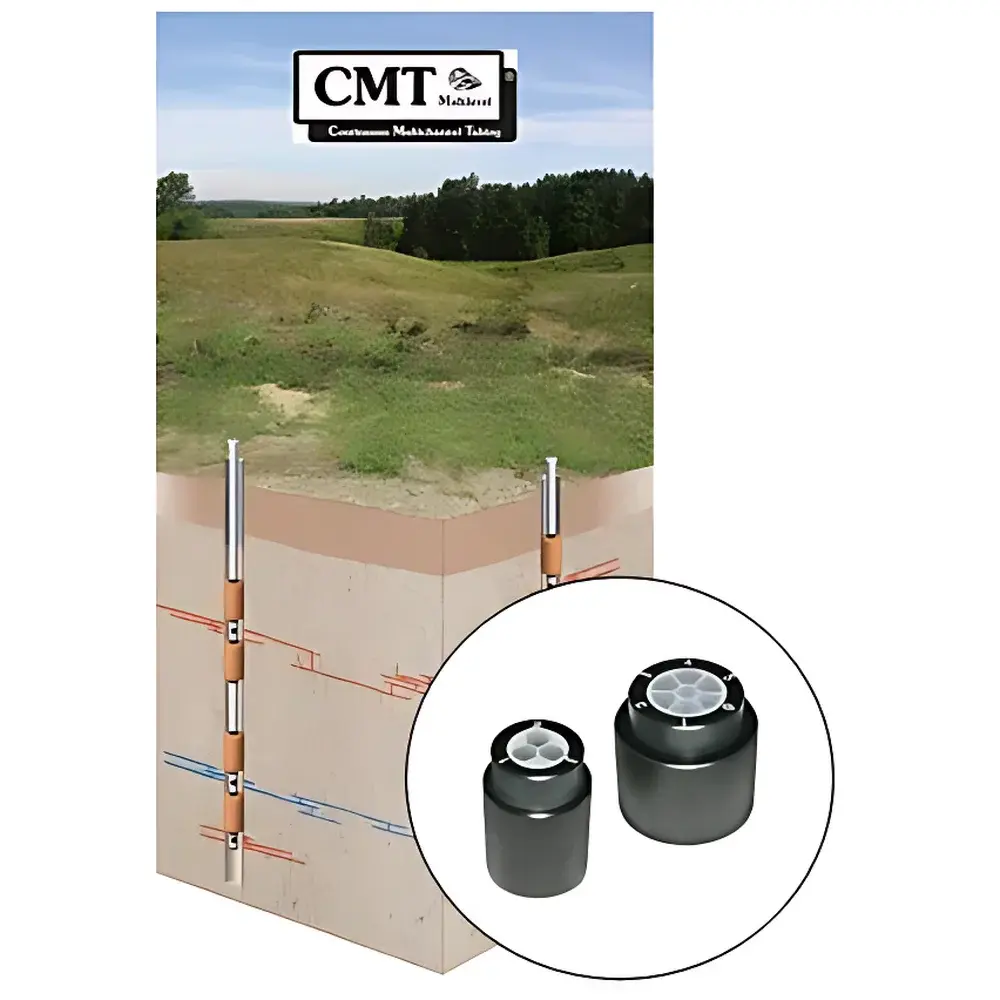
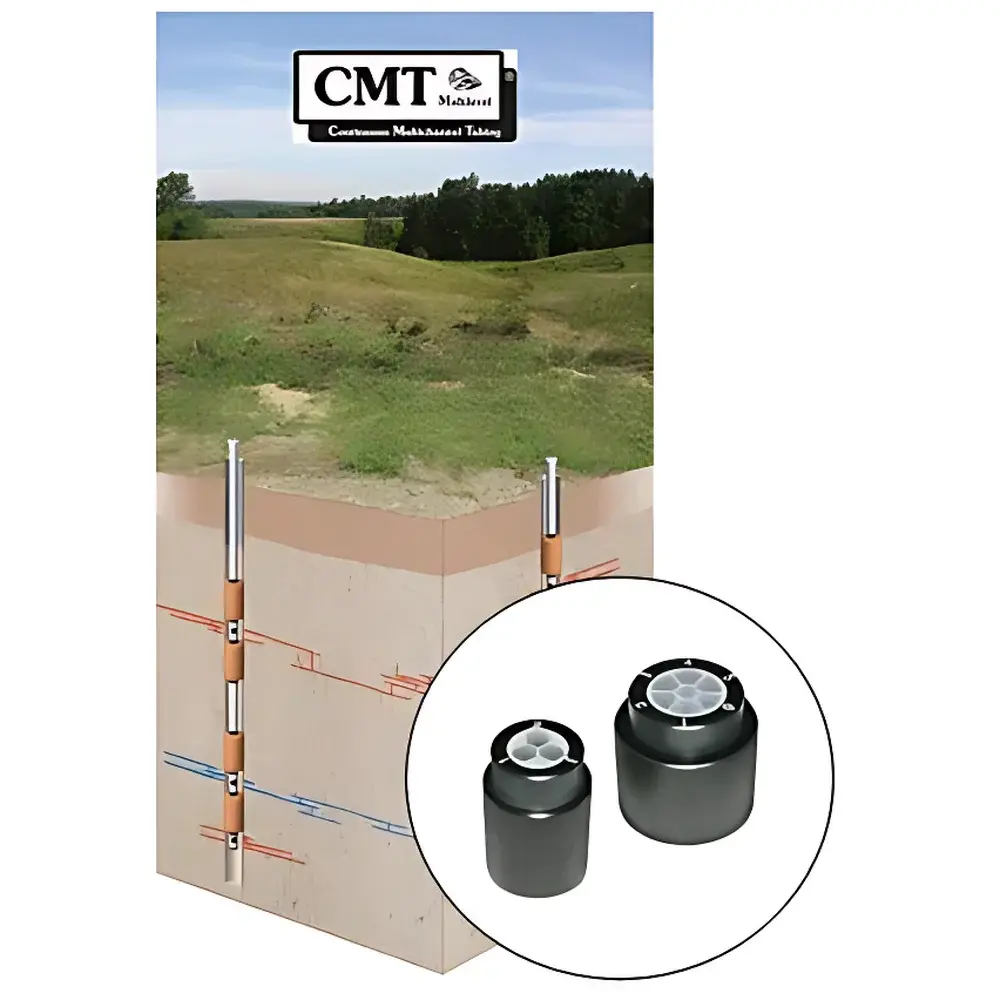
CMT 403 Multi-Level Groundwater Monitoring System
| Origin | Canada |
|---|---|
| Manufacturer Type | Authorized Distributor |
| Origin Category | Imported |
| Model | CMT 403 |
| Pricing | Available Upon Request |
Overview
The CMT 403 Multi-Level Groundwater Monitoring System is an engineered solution for high-resolution vertical profiling of groundwater conditions within a single borehole. Based on the nested monitoring tube principle, it employs physically isolated, depth-specific monitoring strings—configured for either 3 or 7 discrete sampling and measurement zones—to enable simultaneous, non-communicating hydraulic head measurement and discrete-depth water sampling across multiple aquifer units. The system relies on stratified gravel pack installation and hydraulic isolation via bentonite seals between intervals, ensuring minimal cross-contamination and representative in-situ characterization. Designed for deployment in unconsolidated sediments and shallow bedrock settings, the CMT 403 supports long-term, low-disturbance monitoring under variable hydraulic gradients and high-water-table conditions. Its architecture complies with standard practices outlined in ASTM D5092 (Standard Guide for Design and Installation of Groundwater Monitoring Wells) and EPA Guidance Manual for Monitoring Well Construction (EPA/600/R-91/035), facilitating regulatory acceptance in environmental site assessments and remediation programs.
Key Features
- Modular configuration supporting 3-channel or 7-channel monitoring arrays within a single borehole diameter (typically 10–15 cm)
- Depth-specific monitoring tubes constructed from chemically inert, UV-stabilized polyethylene (PE) or stainless steel, rated for long-term submersible operation
- Integrated pressure transducers or pneumatic transducers for continuous, high-precision water level measurement at each zone (resolution ≤ 0.1 cm H₂O)
- Bentonite-sand seal methodology for hydraulic isolation between adjacent monitoring intervals, minimizing vertical flow interference
- Compatible with standard groundwater sampling protocols including low-flow purging, passive diffusion samplers, and VOC-compatible bailers
- Field-deployable design enabling rapid installation using conventional direct-push or rotary drilling rigs
- Minimal surface footprint and reduced drilling costs compared to multiple conventional monitoring wells
Sample Compatibility & Compliance
The CMT 403 accommodates a wide range of analyte classes—including volatile organic compounds (VOCs), methyl tert-butyl ether (MTBE), perchlorate, chlorinated solvents (e.g., PCE, TCE), and dissolved metals—without risk of inter-zone contamination. All wetted components meet USP Class VI and NSF/ANSI Standard 61 requirements for potable water contact. Installation procedures align with ISO 5667-11 (Water quality — Sampling — Part 11: Guidance on sampling of groundwater) and support GLP-compliant data collection workflows. When paired with certified field analytical instrumentation (e.g., photoionization detectors or portable GC/MS), the system enables real-time screening and trend analysis compliant with EPA Method 8260D and ASTM D6888 for VOCs.
Software & Data Management
Data acquisition is supported via industry-standard telemetry interfaces (RS-485, SDI-12, or 4–20 mA outputs) compatible with Campbell Scientific CR-series loggers, Onset HOBO systems, or third-party SCADA platforms. Time-stamped pressure and temperature readings are stored locally and transmitted wirelessly to secure cloud repositories using encrypted MQTT or FTPS protocols. The system supports audit-trail-enabled data logging in accordance with FDA 21 CFR Part 11 requirements when integrated with validated software environments. Export formats include CSV, Excel (.xlsx), and time-series NetCDF, enabling direct import into hydrogeological modeling tools such as MODFLOW, FEFLOW, or GMS.
Applications
- Delineation of vertical contaminant plume geometry and migration pathways in complex hydrogeologic settings
- Quantification of inter-aquifer flow (leakage) and hydraulic conductivity contrasts across confining layers
- Long-term performance monitoring of containment barriers, permeable reactive barriers (PRBs), and pump-and-treat systems
- Calibration and validation of numerical groundwater flow and transport models
- High-frequency monitoring of NAPL dissolution dynamics and mass flux estimation at source zones
- Regulatory compliance reporting for RCRA Corrective Action, CERCLA, and provincial environmental protection acts (e.g., Ontario Regulation 153/04)
FAQ
What is the maximum recommended installation depth for the CMT 403 system?
Typical deployments range from 2 to 20 meters below ground surface; deeper installations up to 30 m are feasible with reinforced tubing and custom seal configurations.
Can the CMT 403 be retrofitted into existing monitoring wells?
Yes—provided the host well casing has sufficient internal diameter (≥10 cm) and structural integrity to accommodate the multi-tube assembly and grouting sequence.
Does the system support automated sampling at discrete depths?
It integrates seamlessly with programmable peristaltic or bladder-type samplers (e.g., Solinst Waterloo Multilevel Sampler or Geotech MLS-2) for timed, depth-specific sample retrieval.
How is data traceability ensured during regulatory audits?
Each sensor is factory-calibrated with NIST-traceable certificates; field calibration checks, maintenance logs, and raw timestamped datasets are retained in accordance with ISO/IEC 17025 documentation requirements.







