
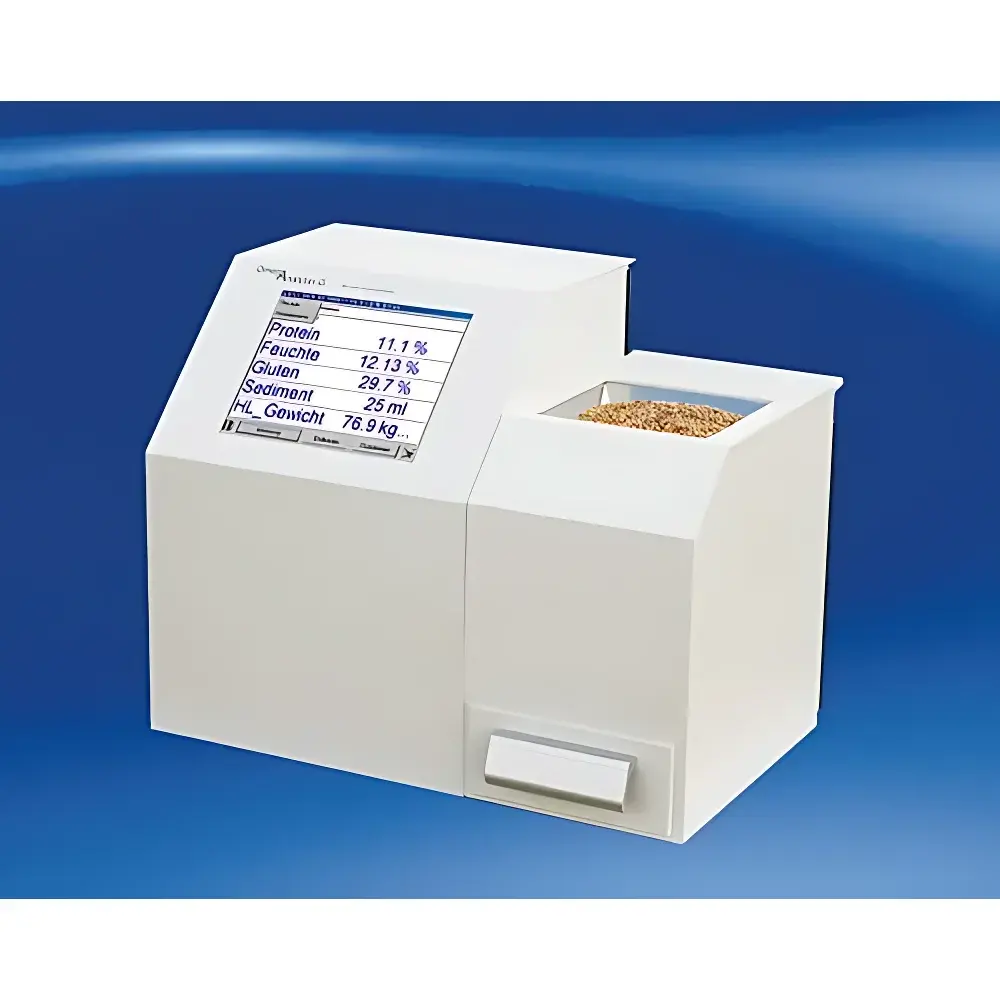
Bruins OmegaAnalyzer G Near-Infrared Grain Analyzer
| Brand | Bruins |
|---|---|
| Origin | Germany |
| Manufacturer Type | Authorized Distributor |
| Product Category | Imported Laboratory Instrument |
| Model | OmegaAnalyzer G |
| Instrument Type | Laboratory NIR Spectrometer |
| Principle | Grating Scanning |
| Wavelength Range | 730–1100 nm |
| Scan Speed | 50 s per measurement |
| Data Sampling Interval | 0.5 nm |
| Measurement Mode | Transmission |
| Chemometrics Software | RIMP |
Overview
The Bruins OmegaAnalyzer G is a dedicated near-infrared (NIR) transmission spectrometer engineered for rapid, non-destructive compositional analysis of whole-grain cereals and oilseeds in laboratory environments. Operating on the principle of grating-based full-spectrum scanning, the instrument acquires high-resolution spectral data across the 730–1100 nm wavelength range—optimized for detecting overtone and combination bands of C–H, N–H, and O–H functional groups. This spectral region enables quantitative prediction of key quality parameters including moisture, protein, oil, starch, crude fiber, wet gluten, sedimentation value, ash, amylose, and free fatty acids. Unlike reflectance-based systems, the OmegaAnalyzer G employs a fixed-pathlength transmission geometry with user-selectable sample cells (3–30 mm optical path), ensuring consistent light interaction with bulk grain samples and minimizing scattering variability inherent in heterogeneous particulate matrices.
Key Features
- Patented gravity-fed auto-sampling system: Enables hands-free, operator-independent loading of whole grains into the measurement cell—eliminating manual packing inconsistencies and improving inter-operator reproducibility.
- Dual-beam, linear grating monochromator: Provides high photometric stability and wavelength accuracy; protected by international patents for linearity and long-term calibration retention.
- Modular transmission cell design: Standard 12 mm pathlength cell included; optional cells (3, 4, 5, 6, 8, 10, 15, 18, 22, 25, 30 mm) accommodate diverse grain densities and particle sizes while maintaining optimal signal-to-noise ratio.
- Integrated auxiliary sensors: Optional built-in bulk density module automatically determines hectoliter weight (HLW); temperature probe provides real-time grain temperature compensation—both values embedded directly into analytical reports.
- Robust hardware architecture: IP54-rated enclosure (dust- and splash-resistant); compact footprint (585 × 420 × 480 mm); low-power operation (65 W, 220–240 V / 50 Hz).
- Network-ready platform: Ethernet interface supports remote diagnostics, firmware updates, and centralized data routing to LIMS or enterprise QA/QC servers without local workstation dependency.
Sample Compatibility & Compliance
The OmegaAnalyzer G is validated for intact, unground cereal and oilseed varieties—including wheat, durum wheat, barley, maize, soybean, brown rice, milled rice, paddy, oat, rye, triticale, sorghum, and rapeseed. Its multi-check configuration ensures uniform spectral response across varying kernel size, shape, and surface morphology. All measurements comply with ASTM E1655 (Standard Practices for Infrared Multivariate Quantitative Analysis) and ISO 12099:2017 (Animal feeding stuffs, cereals and milled cereal products — Guidelines for the application of near infrared spectroscopy). The RIMP chemometrics software supports audit trails, user access control, and electronic signatures in alignment with FDA 21 CFR Part 11 requirements when deployed under GLP/GMP-controlled workflows.
Software & Data Management
RIMP (Robust Instrumental Modeling Platform) is the embedded chemometrics suite, running natively on Windows OS with full touchscreen support. It features intuitive workflow navigation, real-time spectral visualization, and batch report generation with customizable templates (PDF/CSV/XLSX). Calibration models are stored in a vendor-neutral binary format, enabling seamless transfer between all Bruins NIR platforms (e.g., OmegaAnalyzer G, F, and S series). Users may import reference laboratory data (e.g., Kjeldahl protein, Soxhlet oil, AOAC moisture) to develop custom calibrations; Bruins provides one year of complimentary model refinement support and delivers three pre-validated application databases at installation. Data export includes raw spectra, second-derivative transforms, and residual plots—facilitating method transfer validation per ICH Q2(R2).
Applications
The OmegaAnalyzer G serves as a primary analytical tool in grain trading laboratories, breeding programs, flour milling QC departments, and feed formulation centers. Typical use cases include: incoming raw material verification against contractual specifications; real-time process monitoring during drying, tempering, or blending; varietal authenticity screening via spectral fingerprinting; and high-throughput phenotyping in cereal genomics studies. Its ability to analyze 16 subsamples per cycle—each independently quantified—supports statistical sampling protocols per ISO 6497 and ICC Standard No. 168. When paired with the optional density module, it fulfills official trade requirements for hectoliter weight determination alongside compositional metrics.
FAQ
What sample preparation is required prior to analysis?
None—whole, unground kernels are poured directly into the gravity feed hopper. No grinding, sieving, or homogenization is necessary.
Can calibration models developed on other Bruins instruments be used on the OmegaAnalyzer G?
Yes—RIMP’s cross-platform model compatibility ensures full portability of calibration files across the Bruins NIR product family.
Is temperature compensation available during measurement?
Yes—the optional integrated temperature probe records ambient grain temperature and applies physics-based correction to spectral baseline drift.
How is instrument performance verified over time?
A certified ceramic reference tile (traceable to NIST SRM 2036) is supplied for daily wavelength and photometric verification; automated self-diagnostics run at startup and during idle periods.
Does the system support integration with enterprise quality management systems?
Yes—via standard Ethernet TCP/IP, the OmegaAnalyzer G exports structured JSON or XML datasets compatible with LabVantage, STARLIMS, and TrackWise QMS platforms.




