
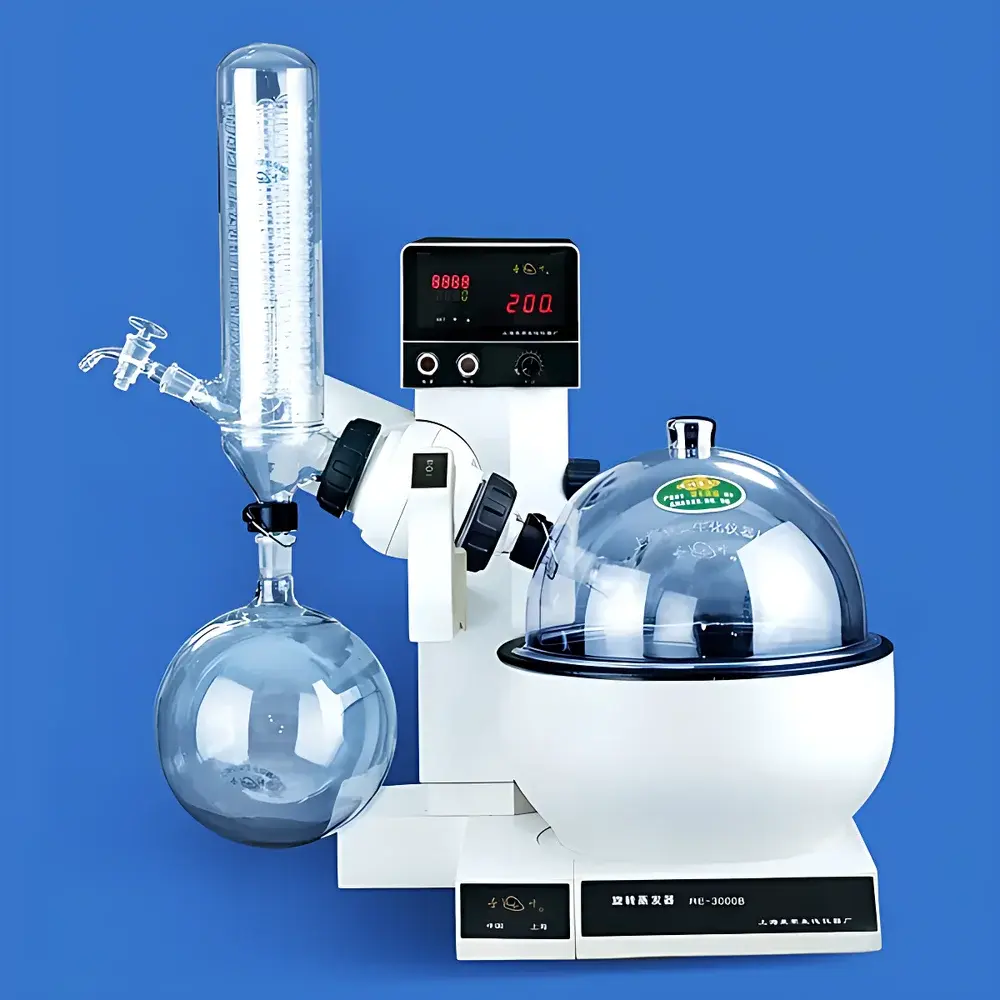
Shanghai Yarong RE-2000B Rotary Evaporator
| Brand | Jinye |
|---|---|
| Origin | Shanghai, China |
| Manufacturer Type | Direct Manufacturer |
| Country of Origin | China |
| Model | RE-2000B |
| Evaporation Flask Capacity | 50–2000 mL |
| Rotation Speed | 0–200 rpm |
| Temperature Control Range | Room temperature to 99 °C (PID digital temperature control with LED display) |
| Temperature Control Accuracy | ±1 °C |
| Condenser Cooling Surface Area | 0.15 m² |
Overview
The Shanghai Yarong RE-2000B Rotary Evaporator is a benchtop vacuum distillation system engineered for reliable solvent removal, concentration, and recovery under reduced pressure. Based on the fundamental principle of rotary evaporation—where simultaneous rotation, heating, and vacuum lower the boiling point of solvents—the RE-2000B enables gentle, efficient, and reproducible processing of thermally sensitive compounds. Its modular design integrates a digitally controlled water bath heater, precision variable-speed drive, vertical condenser with 0.15 m² effective cooling surface, and motorized lift mechanism—all housed in a robust stainless-steel and aluminum frame. Designed for routine operation in academic research labs, QC/QA environments, and pilot-scale process development, the unit complies with standard laboratory safety practices for low-pressure thermal processing and meets mechanical requirements outlined in ISO 8573-1 (compressed air purity) and IEC 61010-1 (safety requirements for electrical equipment for measurement, control, and laboratory use).
Key Features
- Digital PID temperature controller with LED display ensures stable bath temperature regulation within ±1 °C across the full 20–99 °C operating range; ambient start capability eliminates pre-heating delays.
- Stepless speed adjustment from 0 to 200 rpm via microprocessor-controlled DC motor delivers consistent rotational stability—even at low speeds critical for viscous or foaming samples.
- Motorized vertical lift system (stroke: ~120 mm) enables programmable or manual elevation of the evaporation flask away from the heating bath, enhancing operator safety and process repeatability.
- Standardized 24/29 and 29/32 ground-glass joints ensure compatibility with common laboratory glassware (e.g., 50 mL to 2000 mL round-bottom flasks, vertical condensers, vacuum adapters, and receiving flasks).
- Condenser features a dual-layer, high-efficiency vertical coil design with 0.15 m² effective cooling surface area, optimized for rapid vapor condensation using standard tap water or recirculating chillers (recommended inlet temperature: ≤15 °C).
- Integrated vacuum seal monitoring via adjustable PTFE stopcock and reinforced silicone vacuum tubing supports stable sub-atmospheric operation down to ≤10 mbar when paired with compatible vacuum pumps.
Sample Compatibility & Compliance
The RE-2000B accommodates a broad spectrum of organic solvents (e.g., ethanol, acetone, ethyl acetate, dichloromethane), aqueous solutions, and moderately viscous extracts. It is routinely deployed in workflows requiring compliance with USP , EP 2.2.27, and ASTM D1296 for solvent recovery validation. While not intrinsically GLP- or GMP-certified, its digital temperature and speed logging capability (via optional RS232/USB interface) supports audit-ready documentation when integrated into validated laboratory information management systems (LIMS). All wetted parts conform to USP Class VI biocompatibility standards, and the unit’s electrical architecture satisfies CE marking requirements per EN 61326-1 (EMC) and EN 61010-1 (safety).
Software & Data Management
The RE-2000B operates as a stand-alone instrument with embedded digital controls—no proprietary software required for basic operation. For laboratories requiring traceability, an optional communication module provides ASCII-based serial output (RS232 or USB virtual COM port) transmitting real-time values of setpoint temperature, actual bath temperature, rotation speed, and lift status. This data stream is compatible with third-party SCADA platforms (e.g., LabVIEW, Ignition, or custom Python-based acquisition scripts) and supports CSV export for trend analysis, calibration verification, and 21 CFR Part 11–compliant electronic record generation when paired with appropriate audit-trail-enabled software.
Applications
- Concentration of natural product extracts in phytochemistry and nutraceutical R&D
- Solvent exchange and intermediate purification in synthetic organic chemistry workflows
- Removal of volatile reaction byproducts during peptide synthesis and oligonucleotide processing
- Lyophilization pre-concentration steps in biopharmaceutical formulation development
- Batch-wise recovery of high-value solvents (e.g., THF, DMF) in fine chemical manufacturing QA labs
- Teaching applications in undergraduate chemistry laboratories for demonstrating phase equilibria and colligative properties under vacuum
FAQ
What vacuum level is recommended for optimal performance with the RE-2000B?
For most low-boiling solvents (bp < 100 °C at 1 atm), a working pressure between 10–50 mbar is typical; use a two-stage diaphragm pump or circulating chiller-cooled vacuum system for stable operation.
Can the RE-2000B be used with corrosive solvents such as concentrated HCl or HF?
No—standard configuration uses borosilicate glass and PTFE/silicone seals; aggressive halogenated or strongly acidic vapors require optional corrosion-resistant condenser coatings and specialized vacuum pump protection.
Is the heating bath fill volume adjustable, and what is the maximum recommended water level?
Yes—the bath accepts up to 5 L of water or silicone oil; maintain liquid level 2–3 cm below the flask shoulder to prevent overflow during rotation and ensure uniform heat transfer.
Does the unit include a vacuum controller or pressure sensor?
No—vacuum regulation requires external instrumentation; however, the system includes a calibrated vacuum gauge port (KF16) for integration with digital vacuum controllers.
What maintenance intervals are recommended for long-term reliability?
Inspect PTFE stopcocks and silicone tubing every 6 months; clean condenser coils quarterly with isopropanol; verify temperature sensor calibration annually using a NIST-traceable thermometer.



