
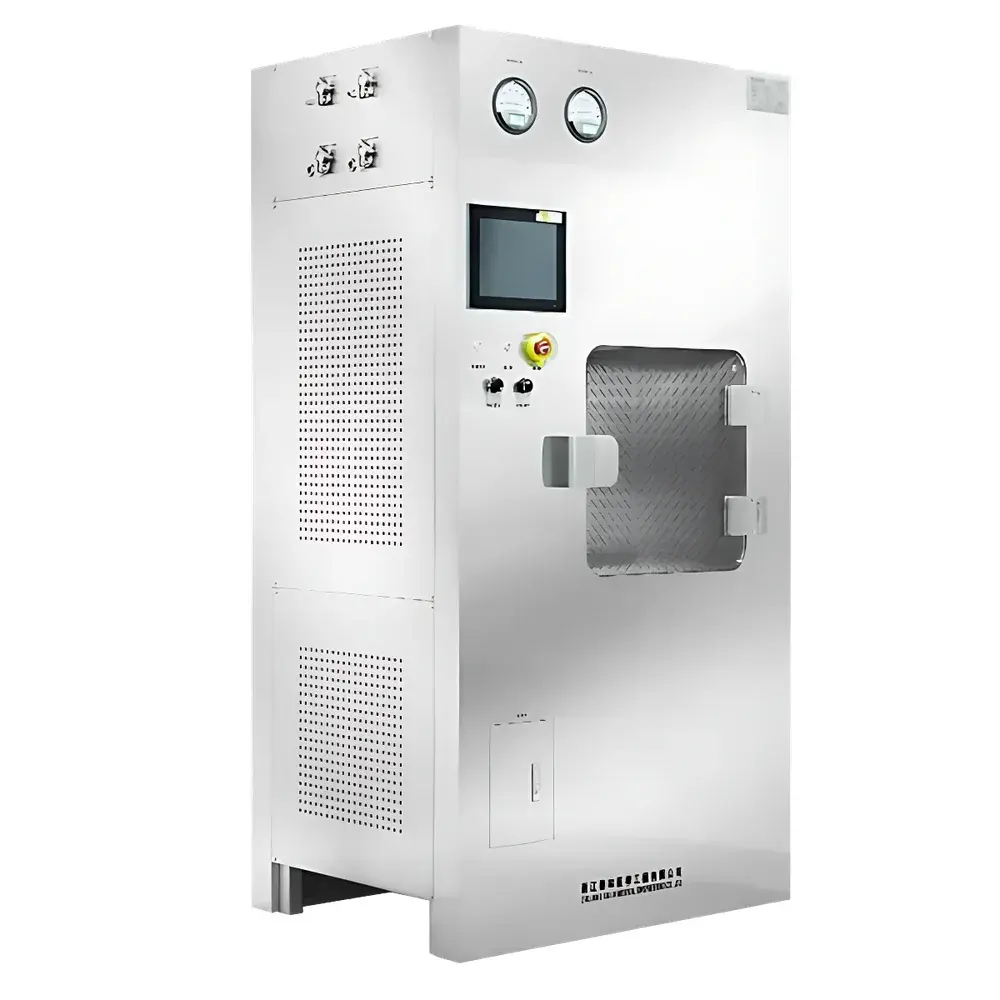
Tailin PBL Series Sterile Transfer Pass-Through Chamber
| Brand | Tailin |
|---|---|
| Origin | Zhejiang, China |
| Manufacturer Type | Manufacturer |
| Product Origin | Domestic |
| Model | PBL |
| Pricing | Upon Request |
Overview
The Tailin PBL Series Sterile Transfer Pass-Through Chamber is an engineered solution for controlled bioburden reduction in aseptic pharmaceutical manufacturing environments. It operates on the principle of vaporized hydrogen peroxide (VHP®) decontamination—specifically utilizing VHPS™ (Vaporized Hydrogen Peroxide Sterilization) technology—to achieve log⁶ microbial reduction on exposed surfaces of materials, equipment, and containers without thermal stress. Designed for integration into Grade A/B cleanroom classifications per ISO 14644-1 and EU GMP Annex 1, the chamber functions as a critical boundary control point between non-sterile and classified aseptic zones. Its core architecture incorporates a Siemens S7-series PLC-based control system that orchestrates sequential phases—including preconditioning, VHP injection, dwell, aeration, and pressure equalization—with full automation and audit-ready event logging. The system complies with fundamental requirements for sterile process simulation validation and supports alignment with FDA 21 CFR Part 11 data integrity expectations through electronic signature-capable operation logs.
Key Features
- VHPS™-based decontamination cycle using 35% w/w hydrogen peroxide vapor at ambient temperature and atmospheric pressure—validated for ≥6-log reduction of Geobacillus stearothermophilus spores on stainless steel, polypropylene, and glass surfaces.
- Dual-interlocked, pneumatically actuated stainless steel doors with tempered glass viewing panels and positive-pressure air seals—ensuring visual monitoring while maintaining ISO Class 5 (Grade A) integrity during material transfer.
- Integrated H14-grade HEPA filtration (≥99.995% @ 0.1 µm) on both supply and exhaust air paths during decontamination and aeration phases to prevent recontamination of treated items.
- Real-time environmental monitoring of internal temperature (±0.5 °C), relative humidity (±3% RH), and differential pressure (±1 Pa) via calibrated digital sensors with continuous data recording.
- Pre-qualified DQ/IQ/OQ/PQ documentation package compliant with ICH Q5A, ISO 14644-3, and EU GMP Annex 15—available for on-site execution with qualified third-party validation support.
Sample Compatibility & Compliance
The PBL chamber accommodates standard pharmaceutical transfer payloads including stainless steel tools, glass vials, plastic syringes, aluminum crimp caps, and pre-sterilized component trays—up to maximum dimensions of 600 × 600 × 600 mm (W × D × H). All interior wetted surfaces are electropolished 316L stainless steel (Ra ≤ 0.4 µm), passivated per ASTM A967, and compatible with repeated VHP exposure without corrosion or residue accumulation. The system meets mechanical safety requirements per EN 61000-6-2/6-4 (EMC), EN ISO 13857 (safety distances), and conforms to EU Machinery Directive 2006/42/EC. Design documentation includes risk assessments aligned with ISO 14971 and traceability matrices linking URS to functional specifications.
Software & Data Management
Control firmware runs on Siemens SIMATIC WinCC Runtime Advanced with embedded recipe management, parameter locking, and user-level access control (admin/operator/maintenance tiers). All cycle data—including sensor trends, alarm history, phase timestamps, and operator IDs—are stored locally on encrypted industrial SSD and exportable in CSV or PDF format. Audit trails record all configuration changes, manual overrides, and login/logout events with immutable timestamps. Optional OPC UA server integration enables connectivity to MES (e.g., Siemens Opcenter, Rockwell FactoryTalk) and LIMS platforms for centralized data aggregation and long-term trend analysis in accordance with ALCOA+ principles.
Applications
- Transfer of active pharmaceutical ingredients (APIs), excipients, and pre-filled syringes into Grade B background environments prior to aseptic filling.
- Introduction of non-heat-stable components—including polymer-based devices, lyophilized formulations, and diagnostic reagents—into Grade A laminar airflow hoods or RABS systems.
- Decontamination of maintenance tools, calibration standards, and environmental monitoring equipment entering isolators or restricted access barrier systems (RABS).
- Support of media fill simulations by enabling validated introduction of simulated product containers and stoppers without compromising sterility assurance levels.
FAQ
What is the typical VHP cycle duration for a full decontamination sequence?
Cycle time varies based on load configuration and environmental setpoints but typically ranges from 90 to 150 minutes—including 15 min preconditioning, 30–45 min VHP dwell, and 45–60 min catalytic aeration.
Does the system support remote monitoring or integration with building management systems (BMS)?
Yes—via Modbus TCP or optional ProfiNet interface; real-time status, alarms, and key process variables can be relayed to central BMS dashboards.
Can the chamber be validated for use with specific bioburden profiles or alternative challenge organisms?
Yes—Tailin provides protocol templates and supports client-led or joint validation studies using site-specific isolates or ATCC reference strains under GMP-compliant conditions.
Is IQ/OQ documentation provided in English and compliant with FDA/EU regulatory expectations?
Yes—all qualification documents are bilingual (English/Chinese), structured per ASTM E2500, and include test scripts, acceptance criteria, and deviation handling procedures.





