
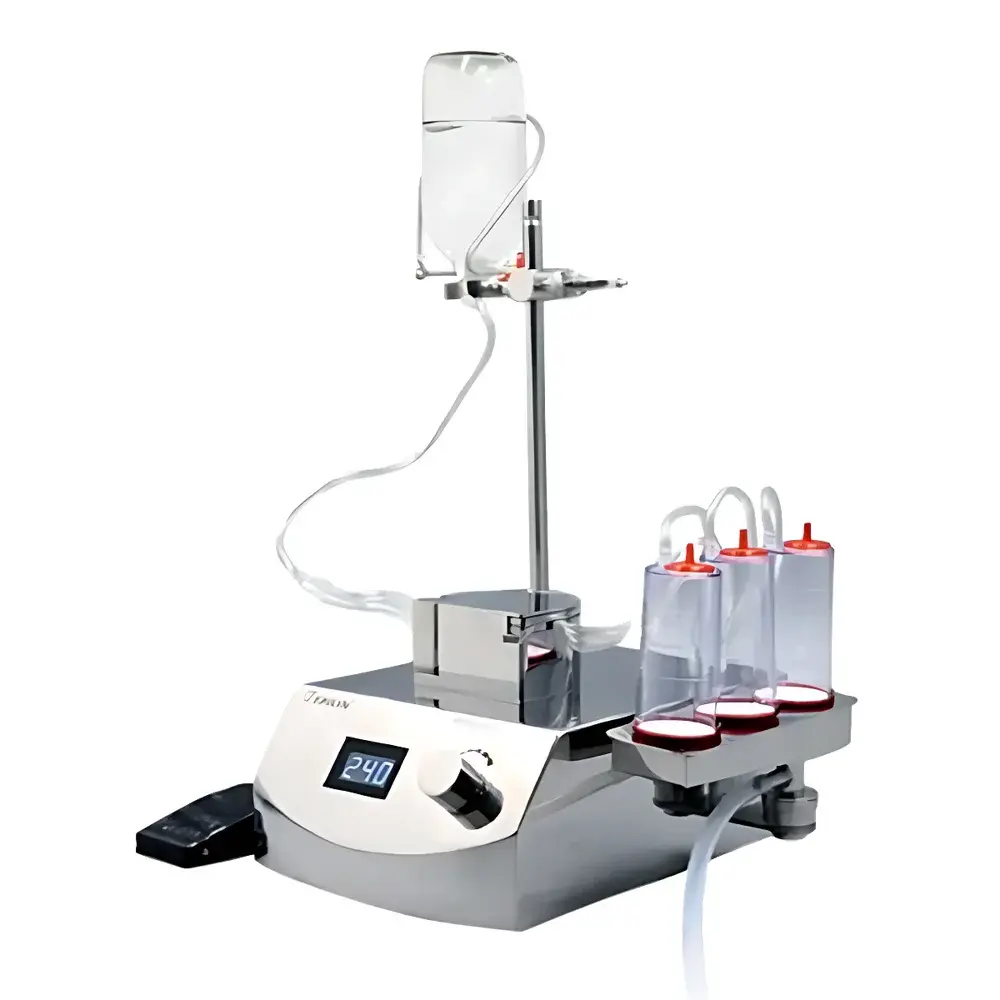
Tailin HTY-610 Sterile Filtration Manifold System
| Brand | Tailin |
|---|---|
| Origin | Zhejiang, China |
| Manufacturer Type | OEM Manufacturer |
| Origin Category | Domestic (China) |
| Model | HTY-610 |
| Pricing | Upon Request |
| Power Supply | 95–260 VAC, 50–60 Hz |
| Rated Power | 120 W |
| Speed Range | 0–240 rpm |
| Weight | 11 kg |
| Total Suspension Height | 43 cm |
| Dimensions (W×D×H) | 22.0 × 30.0 × 11.0 cm |
| Control | Digital Pulse Motor Drive |
| Speed Regulation | Stepless (Infinitely Variable) |
| Torque Stability | Constant Across Full Speed Range |
| Safety Features | Pump Head Overload Protection, Waterproof Footswitch Interface |
| Tube Handling | Linear Tubing Insertion, Manual Clamp Mechanism |
| Memory Function | Last-Used Speed Retention |
Overview
The Tailin HTY-610 Sterile Filtration Manifold System is an engineered solution for membrane filtration-based microbial recovery in pharmaceutical and biotechnology quality control laboratories. Designed in strict accordance with ISO 8573-7, USP , EP 2.6.1, and Chinese Pharmacopoeia Volume IV (2020 Edition) sterility testing requirements, the HTY-610 implements vacuum-assisted, closed-system filtration to isolate viable microorganisms from liquid or soluble solid preparations—including injectables, ophthalmic solutions, irrigation fluids, and lyophilized reconstituted products. Its core architecture centers on a digitally regulated brushless DC motor coupled with pulse-width modulation (PWM) drive electronics, ensuring consistent torque delivery across the full 0–240 rpm speed range—critical for maintaining uniform transmembrane pressure during prolonged filtration of viscous or particulate-laden samples. Unlike open-bench filtration setups, the HTY-610 integrates a rigid stainless-steel suspension frame and standardized 43 cm vertical clearance, enabling seamless compatibility with commercially available sterile filter housings (e.g., 47 mm or 50 mm diameter membranes) and standard microbiological culture vessels (e.g., 100 mL or 250 mL vented bottles). The system operates without internal air compressors or oil-lubricated pumps, eliminating risk of aerosol generation or hydrocarbon contamination.
Key Features
- Digital pulse motor control with real-time current feedback ensures repeatable rotational output and eliminates speed drift under variable load conditions.
- Stepless speed adjustment (0–240 rpm) with non-volatile memory retains the last operational setpoint upon power cycle—reducing procedural variability between analysts.
- Linear tubing insertion path and manually actuated clamping mechanism minimize operator-induced stress on silicone or PVC peristaltic tubing, extending service life and reducing leakage risk.
- Pump head overload protection automatically disengages drive torque when mechanical resistance exceeds safe thresholds—preventing gear wear and preserving calibration integrity.
- IP65-rated waterproof footswitch interface enables hands-free operation in wet environments while complying with IEC 61000-4-2 ESD immunity standards.
- Compact footprint (22.0 × 30.0 × 11.0 cm) and lightweight aluminum-chassis construction facilitate integration into laminar flow hoods, isolators, or shared QC benchtops without compromising structural rigidity.
Sample Compatibility & Compliance
The HTY-610 supports filtration of pharmacopeial-compliant sample volumes up to 2 L per test unit, accommodating both low-viscosity aqueous formulations and moderately viscous suspensions (e.g., antibiotic syrups, protein therapeutics). It interfaces directly with standard 0.22 µm or 0.45 µm pore-size mixed cellulose ester (MCE), polyethersulfone (PES), or nylon membranes. All wetted components are constructed from USP Class VI-certified materials; tubing pathways conform to ASTM D4169 performance protocols for sterile barrier integrity. The system meets GLP documentation requirements through traceable speed calibration logs and supports 21 CFR Part 11-compliant electronic records when paired with validated laboratory information management systems (LIMS).
Software & Data Management
While the HTY-610 operates as a standalone hardware platform, its digital motor controller provides RS-485 serial output for integration into centralized process monitoring networks. Optional firmware upgrades enable time-stamped speed-event logging (start/stop/pause), cumulative runtime tracking, and fault-code reporting (e.g., overcurrent, thermal cutoff). These data streams may be ingested by third-party audit-ready software platforms supporting ALCOA+ principles (Attributable, Legible, Contemporaneous, Original, Accurate, Complete, Consistent, Enduring, Available) for regulatory submissions.
Applications
- Sterility testing of finished drug products per USP , EP 2.6.1, and ChP IV sterility methods.
- Microbial limit testing (MLT) for non-sterile pharmaceuticals using membrane filtration enrichment.
- Environmental monitoring filter processing in cleanroom qualification studies (ISO 14644-1).
- Validation of filter compatibility and extractables/leachables assessment workflows.
- Process simulation studies for aseptic manufacturing line qualification (media fill support).
FAQ
Is the HTY-610 compliant with FDA 21 CFR Part 11 for electronic records?
Yes—when used with validated external software that captures and signs motor event logs via RS-485, the system satisfies Part 11 requirements for audit trails and electronic signatures.
Can the HTY-610 be used with organic solvents?
Only with chemically resistant tubing (e.g., fluoropolymer-lined silicone) and membrane types rated for solvent exposure; standard PVC tubing is incompatible with acetone, ethanol, or DMSO.
What maintenance intervals are recommended for the motor assembly?
No scheduled lubrication is required; annual verification of torque consistency and speed accuracy against NIST-traceable tachometer standards is advised.
Does the system include built-in vacuum regulation?
No—the HTY-610 is a pump-driven manifold only; users must connect an external vacuum source meeting ISO 8573-1 Class 2 purity specifications.
How is pump head calibration performed?
Calibration is conducted using a certified optical tachometer and calibrated load cell; procedures are documented in the Instrument Qualification Protocol (IQ/OQ) package supplied with each unit.







