
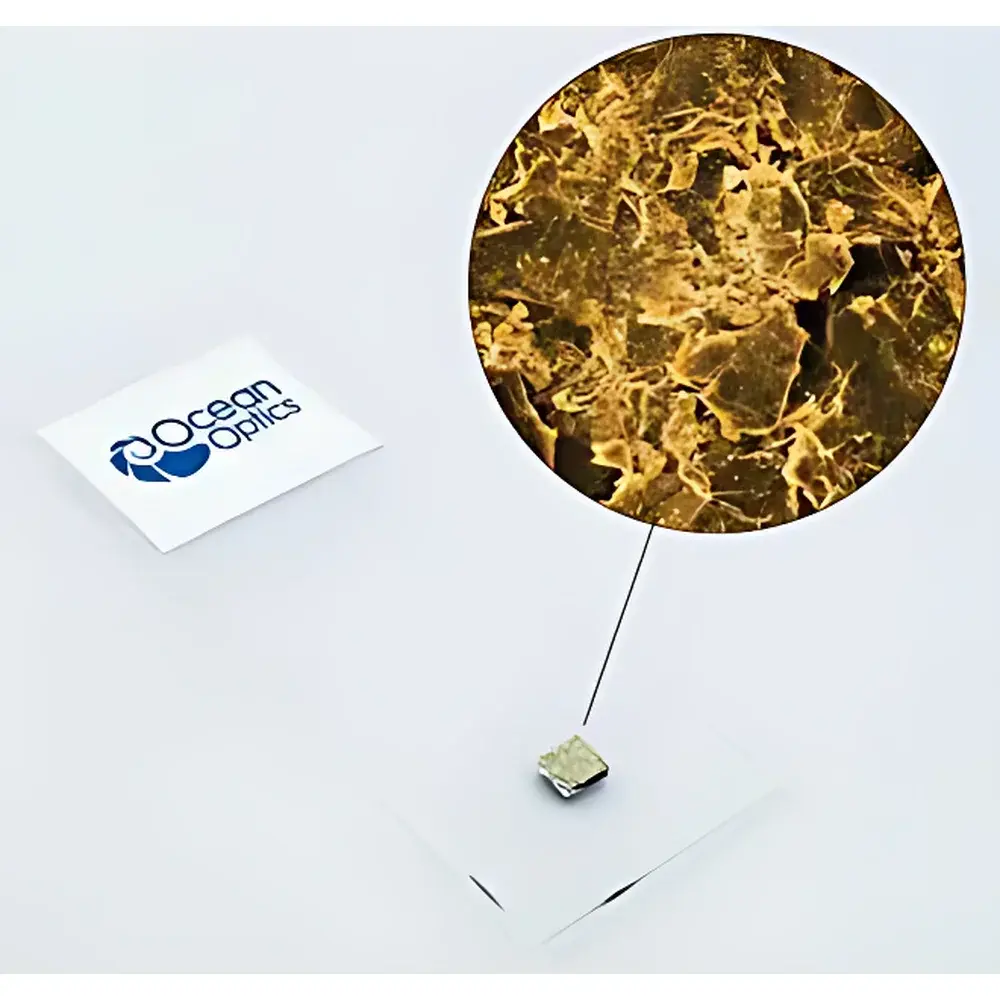
Ocean Optics Nano-Sponge SERS Substrate
| Brand | Ocean Optics |
|---|---|
| Origin | USA |
| Manufacturer Type | Original Equipment Manufacturer (OEM) |
| Import Status | Imported |
| Model | Nano-Sponge SERS Substrate |
| Pricing | Available Upon Request |
Overview
The Ocean Optics Nano-Sponge SERS Substrate is an engineered surface-enhanced Raman scattering (SERS) platform designed for high-fidelity, reproducible trace molecular detection across multiple excitation wavelengths—specifically optimized for 532 nm, 638 nm, and 785 nm laser sources. Unlike conventional paper-based or colloidal SERS substrates, this substrate utilizes a robust metal-on-glass architecture featuring a three-dimensional nano-sponge morphology composed of either gold (Au) or silver (Ag) nanostructures deposited on thermally stable borosilicate glass. The nano-sponge architecture provides high surface area, uniform hot-spot distribution, and exceptional electromagnetic field enhancement—enabling sub-ppm detection sensitivity while maintaining low intrinsic background fluorescence and minimal spectral interference. Its design adheres to fundamental plasmonic coupling principles, where localized surface plasmon resonance (LSPR) is tuned via nanomaterial composition and geometry to maximize Raman signal amplification at target excitation wavelengths.
Key Features
- Wavelength-optimized performance: Ag-based substrates deliver peak enhancement at 532 nm; Au-based variants are ideal for 785 nm systems; the Nano-Sponge SP variant exhibits superior response at 638 nm—demonstrating highest signal-to-noise ratio (SNR) and reproducibility in comparative testing.
- High laser power tolerance: Engineered for stability under continuous-wave (CW) illumination up to 100 mW (depending on spot size and integration time), with no observable degradation in enhancement factor or spectral baseline drift after repeated exposure.
- Extended shelf life: Nano-sponge architecture significantly improves oxidative stability over traditional colloidal or paper-supported SERS platforms. SP-series substrates retain >95% enhancement efficiency after 6 months of ambient storage (25 °C, 40–60% RH); functional performance remains measurable beyond 12 months under controlled conditions.
- Low intrinsic background: Glass-supported fabrication eliminates cellulose-related fluorescence and carbonaceous contaminants, resulting in flat, featureless baselines—critical for quantitative analysis of weakly scattering analytes such as nitroaromatic explosives or low-concentration pesticides.
- Batch-to-batch consistency: Fabricated using vacuum sputtering and controlled electrochemical templating, ensuring <±8% variation in enhancement factor (EF) across production lots—validated per ISO/IEC 17025-compliant internal QC protocols.
Sample Compatibility & Compliance
The Nano-Sponge SERS Substrate supports direct drop-cast, spin-coated, or microfluidic deposition of aqueous, organic, and viscous samples—including explosive residues (e.g., TNT, RDX), pesticide standards (e.g., chlorpyrifos, thiamethoxam), food adulterants (e.g., melamine, Sudan dyes), and pharmaceutical impurities. It complies with ASTM E2918-21 (Standard Guide for SERS Substrate Characterization) and supports GLP/GMP-aligned workflows when integrated with validated Raman spectrometers. While not intrinsically certified for FDA 21 CFR Part 11 compliance, its digital traceability—when used with Ocean Insight’s OceanView or SpectraSuite software—enables full audit trail generation for regulated environments.
Software & Data Management
Substrates are fully compatible with Ocean Optics’ spectral acquisition and processing ecosystem, including OceanView v3.5+ and SpectraSuite. Real-time baseline correction, multivariate curve resolution (MCR), and principal component analysis (PCA) can be applied directly to SERS spectra. When paired with Ocean Insight’s ID Raman series spectrometers (e.g., ID Raman Mini, ID Raman Discover), users benefit from automated wavelength-matched calibration routines and substrate-specific spectral libraries. All raw spectral data (.spc, .csv, .jdx) are exportable for third-party chemometric tools (e.g., MATLAB, Python scikit-learn, Unscrambler X) and support metadata tagging for sample origin, laser power, integration time, and substrate lot number.
Applications
- Explosives and chemical threat detection: Demonstrated LODs of 10⁻¹² g for picric acid and 5 × 10⁻¹¹ g for TNT in field-deployable configurations using handheld 638 nm Raman systems.
- Food safety screening: Quantitative detection of melamine at 1 ppm in liquid milk matrices and chlorpyrifos at 0.5 ppm in apple homogenates—validated against AOAC 2012.01 reference methods.
- Anti-counterfeiting: Integration of non-invasive Raman tags into fuels, lubricants, and pharmaceutical packaging enables unambiguous authentication without sample destruction.
- In-process monitoring: Real-time tracking of reaction intermediates in catalytic synthesis (e.g., Suzuki coupling) using flow-cell coupled SERS substrates with sub-second temporal resolution.
- Environmental trace analysis: Detection of polycyclic aromatic hydrocarbons (PAHs) and microplastic-associated additives in wastewater effluents at ng/L levels.
FAQ
Which excitation wavelength yields optimal performance for the Nano-Sponge SP substrate?
638 nm delivers the highest enhancement factor and lowest coefficient of variation (CV < 6%) across replicate measurements—outperforming both 532 nm and 785 nm in signal intensity and reproducibility for most organic analytes.
How should I store Au- versus Ag-based Nano-Sponge substrates?
Au substrates (RAM-SERS-AU) retain functionality for ≥6 months at ambient conditions; Ag substrates (RAM-SERS-AG) require desiccated, nitrogen-purged storage and are recommended for use within 30 days of opening to prevent surface oxidation.
Can these substrates be reused?
No—each substrate is intended for single-use to ensure analytical integrity. Residual adsorbates and localized photothermal damage compromise reproducibility upon re-excitation.
Is cleaning or regeneration possible?
Not recommended. Solvent rinsing or plasma treatment alters nanostructure morphology and plasmonic response. Replacement is required after each measurement cycle.
Do you provide NIST-traceable calibration standards for SERS quantification?
Yes—Ocean Optics offers certified Rhodamine 6G and crystal violet reference kits (Cat. No. SERS-CAL-01), enabling EF calculation and inter-laboratory method transfer per ISO 18115-2 guidelines.




