
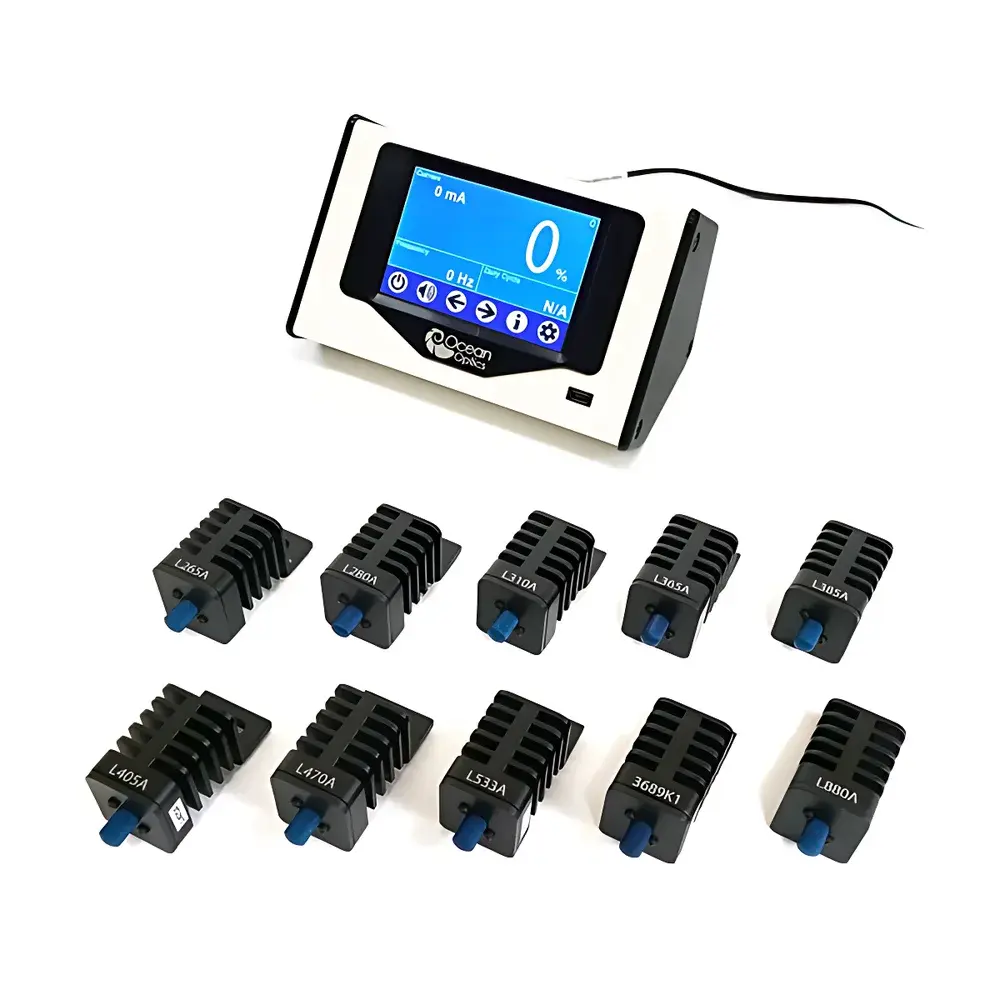
Ocean Optics LSMLED Series Fiber-Coupled LED Light Sources
| Brand | Ocean Optics |
|---|---|
| Model | LSM |
| Light Source Type | High-Stability Narrowband LED |
| Illumination Mode | Internal Illumination (Fiber-Coupled) |
| Optical Interface | SMA 905 |
| Dimensions (LSM) | 3.0 × 6.4 × 3.3 cm |
| Weight (LSM) | 120 g |
| Power Consumption (LSM) | ≤2 A max |
| Operating Temperature | 0–50 °C |
| Relative Humidity | ≤85% RH, non-condensing |
| Safety Compliance | CE |
| Dimensions (LDC-1 Controller) | 14.7 × 7.3 × 8.9 cm |
| Weight (LDC-1) | 800 g |
| Power Supply | 15 VDC, 30 W max |
| Display | 3.5″ 480×320 touchscreen |
| Modulation Modes | Internal DC, sine, triangle, square wave |
| Max Drive Current | 350–2000 mA (model-dependent) |
| Typical CW Output Power (into 400 µm, 0.39 NA fiber) | 0.18–20.55 mW |
| Pulsed Output Power (same fiber) | 0.22–20.55 mW |
| Center Wavelength (CWL) Range | 265–880 nm |
| FWHM | 1–44 nm (model-dependent) |
Overview
The Ocean Optics LSMLED Series comprises compact, fiber-coupled, high-stability LED light sources engineered for precision optical excitation in spectroscopic, fluorescence, and photometric applications. Unlike broadband arc lamps or lasers, the LSMLED family delivers narrow spectral output—defined by peak center wavelength (CWL) and full width at half maximum (FWHM)—enabling selective excitation of fluorophores, quantum dots, or photochemical systems with minimal thermal load or spectral crosstalk. Each LSM module integrates a thermally stabilized LED die directly coupled to an SMA 905 connector, ensuring efficient launch into standard silica optical fibers (e.g., 400 µm core, 0.39 NA). The system architecture separates the light-emitting unit from its dedicated LDC-1 controller, allowing flexible placement of the lightweight (120 g), low-power (≤2 A) source head in space-constrained or vibration-sensitive environments—including inside spectrometer housings, microfluidic platforms, or custom optical benches.
Key Features
- Fiber-coupled design optimized for >75% coupling efficiency into 400 µm, 0.39 NA multimode fibers—minimizing alignment complexity and signal loss.
- Thermal management architecture maintains spectral stability (<±0.1 nm drift over 8 h at 25 °C ambient) and intensity reproducibility (RSD <1.5% over 12 h under constant-current operation).
- LDC-1 controller provides fully programmable drive modes: continuous-wave (CW), pulsed (1 Hz–10 kHz), and analog-modulated (sine/triangle/square, 0.1 Hz–10 kHz), all accessible via intuitive 3.5″ resistive touchscreen interface.
- External triggering support via 0–5 V TTL-compatible input enables synchronization with gated detectors, lock-in amplifiers, or time-resolved spectrometers—critical for lifetime measurements or pump-probe configurations.
- CE-compliant electrical design ensures safe integration into laboratory instrumentation meeting IEC 61010-1 requirements for measurement, control, and laboratory use.
- Modular scalability: Multiple LSM units can be independently controlled via LDC-1 or daisy-chained using RS-232 (optional firmware), supporting multi-wavelength excitation protocols without hardware reconfiguration.
Sample Compatibility & Compliance
The LSMLED Series is compatible with standard UV-Vis-NIR optical components and detection systems, including Ocean Insight spectrometers (e.g., Flame, Maya2000 Pro), PMTs, CCD/CMOS array detectors, and OEM sensing modules. Its narrowband emission profiles align with common fluorescence standards (e.g., NIST-traceable dye excitation bands) and support method development compliant with ASTM E275 (Standard Practices for Describing and Measuring Performance of UV-Visible Spectrophotometers) and ISO 17025 (General Requirements for the Competence of Testing and Calibration Laboratories). While not classified as medical devices, LSMLED units are routinely deployed in GLP-regulated environments for assay development and QC testing where instrument traceability, stable irradiance, and audit-ready operational logs are required. The LDC-1 controller supports timestamped parameter logging (drive current, modulation settings, runtime) exportable via USB—facilitating internal documentation and regulatory review.
Software & Data Management
No proprietary software installation is required for basic operation: all configuration and real-time monitoring occur through the embedded LDC-1 touchscreen UI. For automated workflows, Ocean Insight provides open ASCII-based serial command protocol documentation (RS-232), enabling integration with LabVIEW, Python (PySerial), MATLAB, or custom C++ applications. Commands support remote setting of drive current (0–100% of max rated value), modulation frequency/amplitude, waveform selection, and external trigger enable/disable states. All operational parameters—including cumulative runtime, thermal sensor readings, and last-used configuration—are stored non-volatilely in LSM module memory and retrievable on demand. Firmware updates are delivered via USB mass storage mode, requiring no host PC beyond initial update initiation.
Applications
- Fluorescence Excitation: Selective excitation of DAPI (LSM-365A), FITC (LSM-470A), Cy3 (LSM-533A), and Alexa Fluor 633 (LSM-635A) in microscopy, flow cytometry, and plate-reader systems.
- UV Photocatalysis Monitoring: Real-time tracking of TiO₂ or ZnO-mediated degradation kinetics using LSM-265A or LSM-280A under controlled 265–280 nm irradiation.
- Portable Spectroscopy: Compact excitation source for handheld Raman or absorption analyzers where low power draw (<3 W per module) and shock resistance are critical.
- Optical Sensor Calibration: Stable, repeatable irradiance reference for responsivity calibration of photodiodes, integrating spheres, and radiometric sensors across UV to NIR.
- Time-Resolved Measurements: Nanosecond-scale pulse generation (via external trigger) synchronized with ICCD or SPAD detectors for fluorescence lifetime imaging (FLIM) prototyping.
FAQ
What is the maximum optical power achievable with the LSM-365A into a 400 µm, 0.39 NA fiber?
Typical CW output is 12 mW; pulsed output reaches up to 14.28 mW under 2000 mA peak current (10% duty cycle, 1 kHz).
Can multiple LSM modules be controlled simultaneously from one LDC-1?
No—each LDC-1 controls only one LSM unit. However, multiple LDC-1 controllers can be operated in parallel via independent USB/RS-232 interfaces.
Is the LSMLED series suitable for use in vacuum or inert-gas gloveboxes?
The LSM module has no moving parts or outgassing materials, but its SMA 905 connector and housing are not rated for vacuum. Operation in nitrogen-purged enclosures is acceptable if condensation is prevented.
Does the system support analog voltage-controlled intensity modulation?
Yes—the LDC-1 accepts 0–5 V analog input on its “EXT MOD” port to linearly scale LED current between 0% and 100% of set maximum.
Are spectral output data (e.g., radiometric power vs. wavelength) available for each unit?
Yes—Ocean Insight provides calibrated spectral irradiance files (CSV format) for each LSM model, traceable to NIST-standard reference detectors and measured using an OL750 scanning monochromator.




