
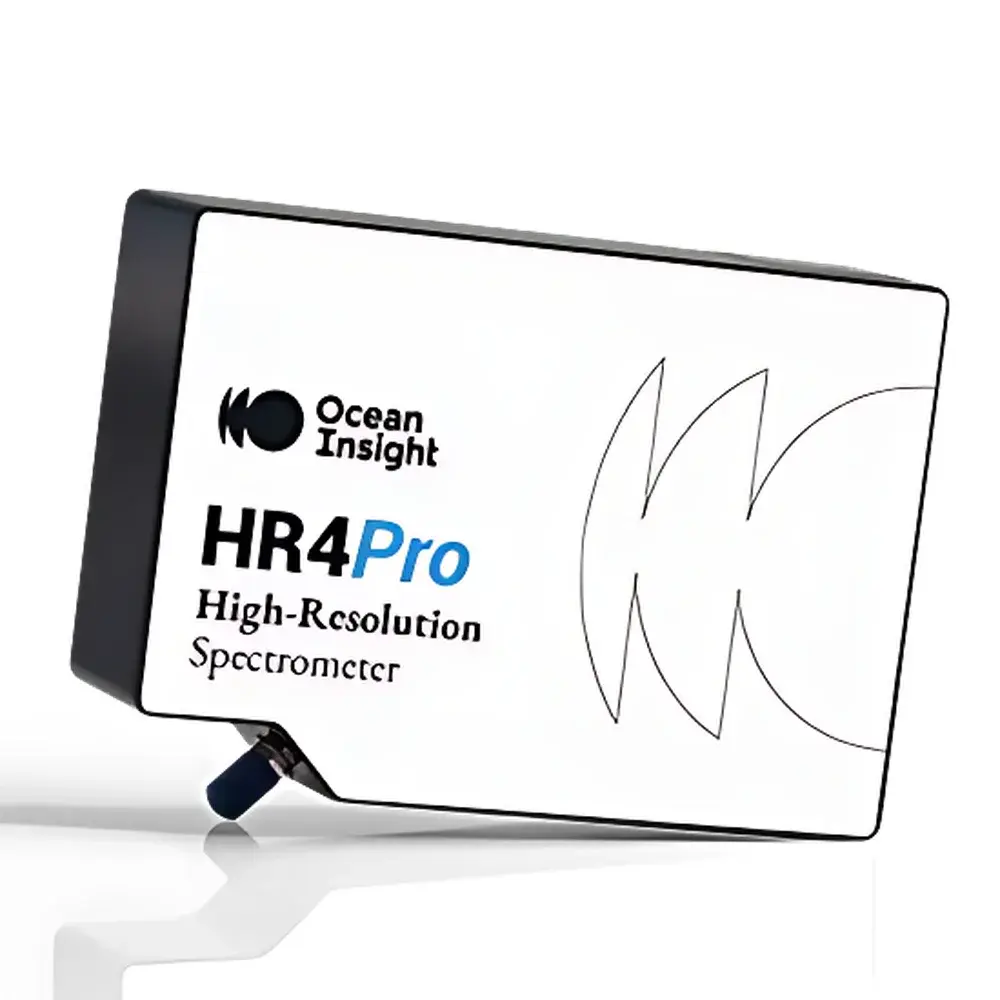
Ocean Optics HR4Pro High-Resolution Fiber Optic Spectrometer
| Brand | Ocean Optics |
|---|---|
| Origin | Shanghai, China |
| Manufacturer Type | Manufacturer |
| Product Category | Domestic |
| Model | HR4Pro |
| Spectral Range | 190 nm – 1100 nm |
| Detector | Linear Silicon CCD Array |
| Optical Resolution (FWHM) | 0.42 nm (typical), 0.72 nm (typical) |
| Sensitivity | 6 counts (RMS dark noise) |
| Signal-to-Noise Ratio | 250:1 (full signal), 290:1 (full signal), 300:1 (full signal) |
| Dynamic Range | 2000:1, 2500:1, 1500:1 (single acquisition) |
| Stray Light | <0.05% at 600 nm |
| Slit Options | 5 µm, 10 µm |
| Grating Options | H13, H38, H48, HC1 |
| A/D Resolution | 14-bit |
| Integration Time | 3.8 ms – 10 s |
| Thermal Drift | 0.03–0.06 pixels/°C |
| Dimensions | 148.6 mm × 104.8 mm × 45.1 mm |
| Weight | 570 g |
| Interface | USB 2.0 (480 Mbps), RS-232, I²C |
| Fiber Connector | SMA 905 |
Overview
The Ocean Optics HR4Pro High-Resolution Fiber Optic Spectrometer is a compact, benchtop-grade dispersive spectrometer engineered for precision spectral characterization across ultraviolet, visible, and near-infrared wavelengths (190 nm – 1100 nm). Based on Czerny-Turner optical architecture with optimized collimating and focusing optics, the HR4Pro employs a linear silicon CCD detector array and selectable holographic or ruled diffraction gratings to achieve high spectral fidelity and reproducible resolution down to 0.42 nm FWHM (Full Width at Half Maximum) — depending on configuration, slit width, and grating selection. Its thermally stabilized optical bench reduces wavelength drift to as low as 0.03 pixels/°C, enabling reliable operation in non-climate-controlled laboratory, field-deployable, and industrial process monitoring environments. Unlike modular OEM spectrometers requiring external alignment, the HR4Pro ships fully pre-aligned and factory-calibrated, minimizing setup time while maintaining traceability to NIST-traceable standards.
Key Features
- High-resolution optical design: Configurable resolution from ~0.42 nm to ~0.9 nm FWHM via interchangeable slits (5 µm or 10 µm) and grating options (H13, H38, H48, HC1), supporting demanding applications such as atomic emission line separation and narrowband LED characterization.
- Thermal stability enhancement: Proprietary mechanical and optical mounting architecture delivers up to 10× improved thermal wavelength stability versus comparable compact spectrometers — critical for long-duration acquisitions or ambient-temperature process control.
- Low stray light performance: Optimized baffling and grating coatings reduce stray light to <0.05% at 600 nm and <0.10% at 435 nm, ensuring accurate quantification of weak emission features adjacent to intense spectral peaks.
- Flexible synchronization: Hardware-triggered acquisition (TTL-compatible) enables precise temporal coordination with pulsed lasers, flash lamps, or automated sample handlers — essential for time-resolved spectroscopy and gated detection.
- Rugged, integrable form factor: Compact footprint (148.6 × 104.8 × 45.1 mm) and lightweight construction (570 g) facilitate seamless integration into OEM analytical platforms, portable instrumentation, or multi-sensor process nodes without compromising optical throughput or signal integrity.
- Multi-interface connectivity: Native USB 2.0 (480 Mbps) for high-speed data streaming, plus optional RS-232 and I²C support for embedded system interfacing and remote configuration in distributed sensor networks.
Sample Compatibility & Compliance
The HR4Pro accepts standard SMA 905 fiber-optic input, compatible with multimode fibers (e.g., 200 µm, 400 µm, or 600 µm core diameters) and common illumination sources including deuterium/halogen lamps, LEDs, laser diodes, and plasma emitters. It supports both free-space and fiber-coupled measurement geometries, making it suitable for transmission, reflectance, fluorescence, and emission spectroscopy configurations. The spectrometer complies with CE marking requirements for electromagnetic compatibility (EMC Directive 2014/30/EU) and low-voltage safety (LVD Directive 2014/35/EU). While not certified for intrinsic safety or explosion-proof use, its passive optical design and low-power consumption (<2 W) align with general-purpose laboratory instrumentation safety practices under IEC 61010-1. Calibration files include wavelength and intensity correction data traceable to NIST SRM 2035 (mercury-argon lamp) and SRM 2036 (tungsten halogen lamp), supporting GLP-compliant documentation workflows.
Software & Data Management
Ocean Insight’s OceanView software provides full instrument control, real-time spectral visualization, and batch data export in CSV, TXT, and HDF5 formats. Advanced features include spectral averaging, dark subtraction, smoothing algorithms (Savitzky-Golay), peak identification with centroid fitting, and user-defined region-of-interest (ROI) integration. For regulated environments, OceanView supports audit trail logging, electronic signatures, and configurable user roles — facilitating compliance with FDA 21 CFR Part 11 when deployed with validated installation and operational qualification (IQ/OQ) protocols. SDKs for Python, MATLAB, LabVIEW, and C/C++ enable custom automation, integration with LIMS systems, and incorporation into GMP-aligned manufacturing analytics pipelines.
Applications
- Atomic emission spectroscopy for elemental analysis in plasma diagnostics and arc/spark sources
- UV-Vis-NIR characterization of semiconductor materials, thin-film coatings, and photovoltaic absorber layers
- LED and laser diode spectral profiling, including center wavelength, FWHM, and side-mode suppression ratio (SMSR)
- In-line process monitoring of chemical reactions, solvent composition, and concentration gradients using absorption or fluorescence signatures
- Environmental gas sensing via differential optical absorption spectroscopy (DOAS) with broadband light sources
- Biomedical optical diagnostics, including tissue reflectance and oxygen saturation estimation in research settings
FAQ
What spectral calibration standards are used for factory calibration?
Factory calibration is performed using NIST-traceable mercury-argon and tungsten-halogen standard lamps (SRM 2035 and SRM 2036), providing wavelength accuracy ±0.2 nm and radiometric linearity within ±0.5% over the calibrated range.
Can the HR4Pro operate in continuous acquisition mode at maximum speed?
Yes — with minimum integration time of 3.8 ms and USB 2.0 streaming bandwidth, the HR4Pro supports sustained frame rates up to ~200 spectra per second, limited only by host PC buffering and processing capability.
Is temperature compensation available in firmware?
The HR4Pro includes onboard temperature sensors and optional real-time pixel-wavelength correction tables, which can be activated via OceanView or SDK to compensate for thermal drift during extended measurements.
How is stray light quantified, and what test method is applied?
Stray light is measured per ASTM E275-21 Annex A2 using a 600 nm bandpass filter with OD6 blocking outside the passband; reported values represent the ratio of out-of-band signal to in-band signal at specified wavelengths.
Does the HR4Pro support external triggering with variable delay?
Yes — TTL-compatible trigger input supports rising/falling edge detection, programmable delay (0–65535 µs in 1 µs steps), and burst-mode acquisition sequences for time-gated experiments.
Related Products






