
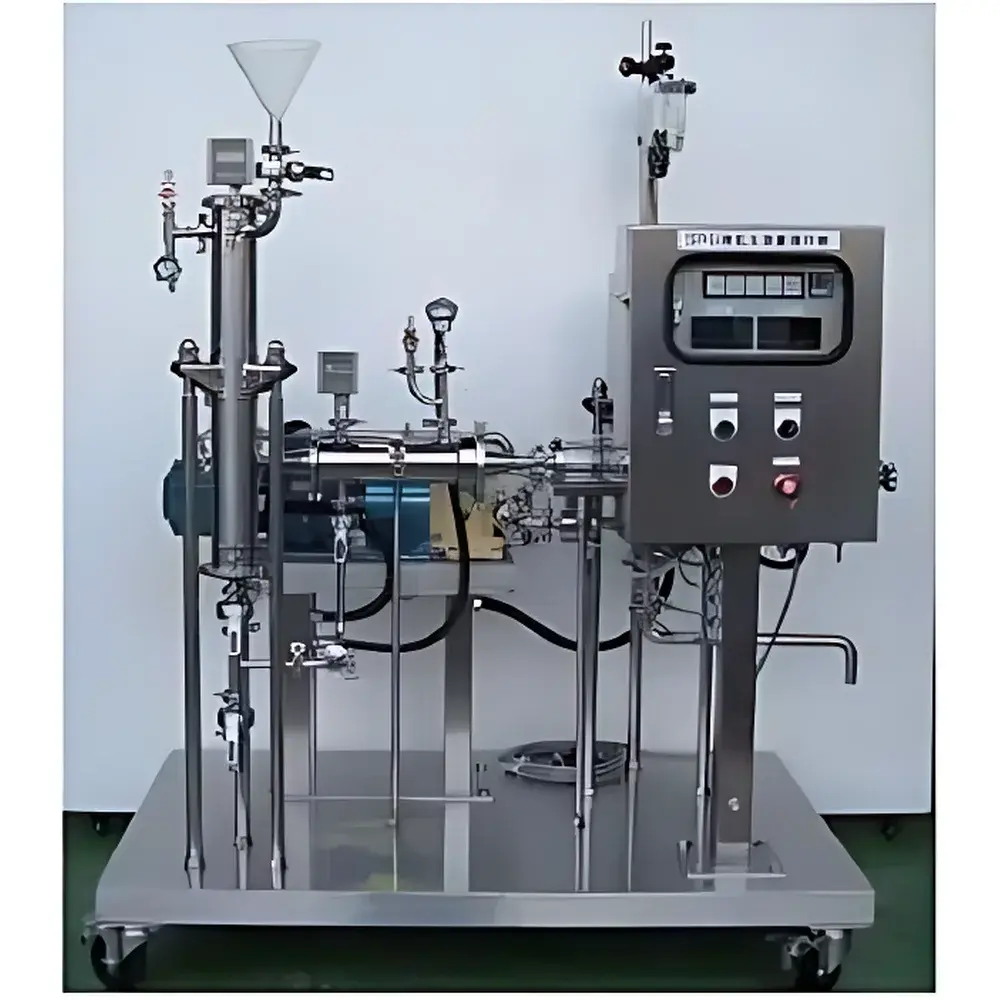
SPG Membrane Emulsification Pilot-Scale System
| Origin | Imported |
|---|---|
| Manufacturer Type | Authorized Distributor |
| Model | SPG |
| Pricing | Available Upon Request |
Overview
The SPG Membrane Emulsification Pilot-Scale System is an engineered platform for controlled, scalable production of monodisperse emulsions and colloidal dispersions via Shirasu Porous Glass (SPG) membrane technology. Unlike conventional high-shear or ultrasonic methods—which induce broad droplet size distributions and thermal degradation—the SPG process relies on precise interfacial shear and uniform pore extrusion under laminar flow conditions. This enables deterministic droplet formation governed by membrane pore geometry, transmembrane pressure differential, and phase viscosity ratio. The system operates on the principle of cross-flow membrane emulsification: the dispersed phase is forced through uniformly sized, interconnected micropores in a rigid SPG ceramic membrane, while the continuous phase flows tangentially to sweep newly formed droplets away before coalescence. This architecture ensures exceptional batch-to-batch reproducibility, narrow polydispersity index (PDI < 0.15 typical), and minimal mechanical stress on sensitive actives—making it ideal for pharmaceutical nanoemulsions, functional food delivery systems, and catalyst precursor suspensions.
Key Features
- Two configurable pilot-scale configurations: Standard (2 L dispersed / 6 L continuous phase) and High-Capacity (5 L dispersed / 25 L continuous phase), supporting seamless scale-up from lab to pre-commercial batches.
- Modular SPG membrane cartridge design with standardized L250 mm × 7 units or L500 mm × 30 units—enabling rapid membrane replacement, cleaning validation, and geometric scalability without re-engineering fluid dynamics.
- Stainless-steel 316L wetted parts compliant with ASME BPE-2021 surface finish standards (Ra ≤ 0.4 µm) and compatible with CIP/SIP protocols.
- Integrated digital pressure control (0–500 kPa range, ±2 kPa accuracy) and mass-flow regulated continuous phase delivery for stable capillary number (Ca) maintenance across operating conditions.
- Temperature-controlled jacketed vessels (ambient to 80 °C, ±0.5 °C stability) with PT100 RTD feedback loops to preserve thermolabile formulations during extended operation.
Sample Compatibility & Compliance
The system accommodates a wide range of dispersed and continuous phase combinations—including aqueous polymer solutions (e.g., alginate, chitosan), lipid melts (medium-chain triglycerides, lecithin blends), and organic solvent systems (ethyl acetate, dichloromethane). SPG membranes are chemically inert across pH 1–13 and resistant to common solvents, enabling compatibility with GMP-grade excipients and regulatory-compliant cleaning agents. The platform supports documentation packages aligned with FDA 21 CFR Part 11 requirements—including electronic audit trails, user access levels, and raw data export in CSV/Excel formats. All hardware components meet ISO 9001:2015 manufacturing certification, and vessel designs conform to PED 2014/68/EU for pressure equipment safety.
Software & Data Management
A dedicated Windows-based control interface provides real-time monitoring of transmembrane pressure, dispersed phase flow rate, temperature gradients, and total processed volume. The software logs timestamped operational parameters at 1 Hz resolution, with automatic event tagging for membrane fouling detection (pressure rise >5% over baseline within 30 s). Data files are stored in encrypted SQLite databases with SHA-256 hash verification and support optional integration with LIMS platforms via OPC UA protocol. Batch reports include calculated interfacial parameters (Weber number, Capillary number), estimated droplet diameter (based on pore diameter and phase viscosity ratio), and compliance metadata required for regulatory submissions under ICH Q5A and USP .
Applications
- Pharmaceutical development: Production of sub-200 nm oil-in-water nanoemulsions for IV delivery, sustained-release microspheres (PLGA, PCL), and vaccine adjuvant systems (e.g., MF59 analogues).
- Functional food engineering: Encapsulation of omega-3 fatty acids, carotenoids, and probiotics with enhanced oxidative stability and gastric survivability.
- Materials science: Synthesis of uniform polymer latexes, silica nanospheres, and metal-organic framework (MOF) precursors with controlled nucleation kinetics.
- Agrochemical formulation: Generation of stable pesticidal suspensions and herbicidal microemulsions meeting ISO 16433 and CIPAC MT 187 specifications.
FAQ
What SPG membrane pore sizes are supported?
Standard configurations utilize SPG membranes with nominal pore diameters of 0.1 µm, 0.5 µm, 1.0 µm, and 2.0 µm—each certified via mercury intrusion porosimetry and traceable to NIST SRM 1963. Custom pore sizing is available upon request.
Can the system be validated for GMP manufacturing?
Yes. IQ/OQ documentation templates are provided, and the system is designed for full PQ execution per ASTM E2500-13. All sensors carry factory calibration certificates with uncertainty statements.
Is remote monitoring supported?
The system includes Ethernet connectivity and supports secure remote access via TLS 1.2-encrypted VNC sessions, with optional integration into corporate SCADA environments.
What maintenance intervals are recommended?
SPG membranes require alkaline cleaning (0.1 M NaOH, 60 °C, 2 h) every 5–10 batches depending on feedstock fouling potential; stainless-steel vessels undergo quarterly leak testing per EN 13445-5 Annex C.



