
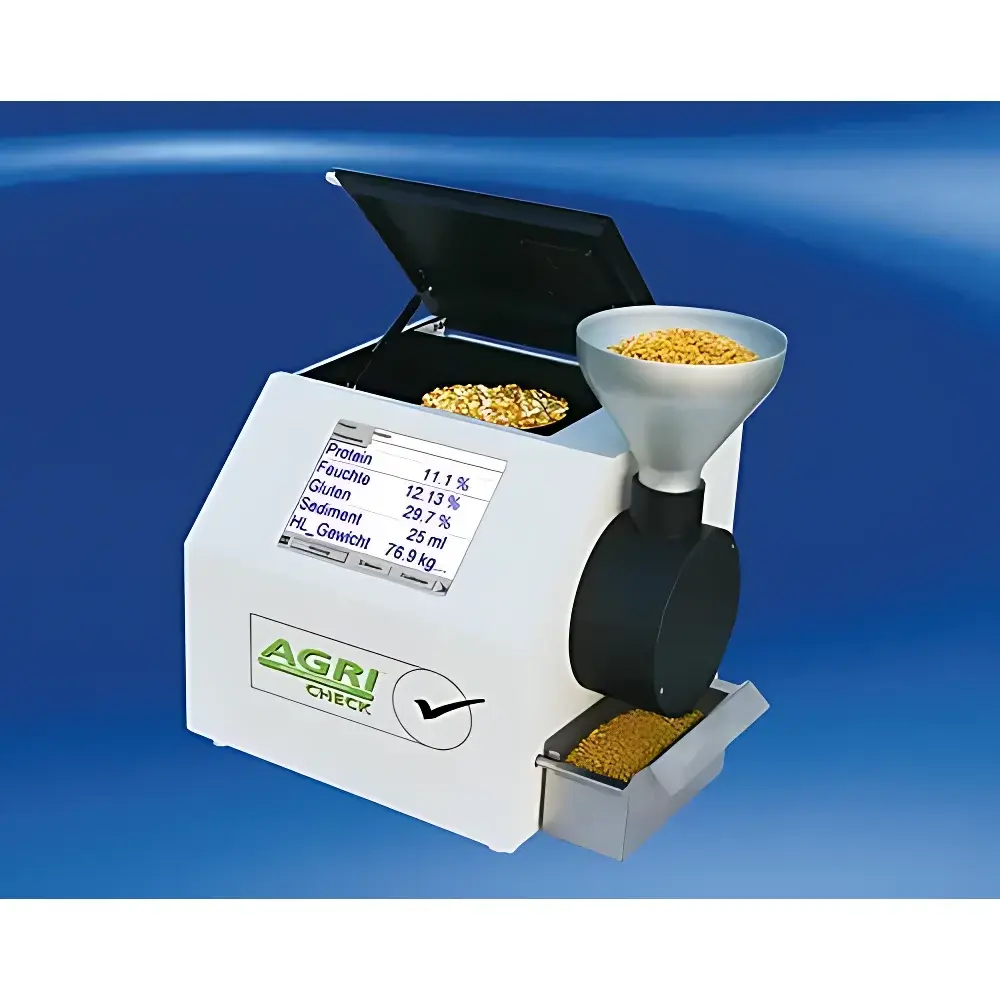
Bruins AgriCheck XL Whole-Grain Near-Infrared Spectrometer
| Brand | Bruins |
|---|---|
| Origin | Germany |
| Model | AgriCheck XL |
| Instrument Type | Laboratory NIR Spectrometer |
| Principle | Grating-based Scanning Monochromator |
| Wavelength Range | 730–1100 nm |
| Wavelength Resolution | 0.5 nm |
| Scan Time | ~45 s |
| Sampling Interval | 0.5 nm |
| Measurement Mode | Transmission |
| Chemometrics Software | RIMP |
| Sample Handling | Rotating Sample Tray & Auto-sampling (16 sub-samples) |
| Sample Volume | 30–100 mL (small-batch) or ~650 mL (standard) |
| Dimensions | 385 × 420 × 385 mm |
| Weight | 21 kg |
| Power Supply | 220–240 V / 50 Hz |
| Power Consumption | 45 W |
| Environmental Protection | Dust- and Moisture-Resistant |
| Compliance | CE, RoHS |
| Optional Accessories | Integrated Grain Density Module, Temperature Probe, Thermal Receipt Printer, Barcode Scanner, External Keyboard/Mouse |
Overview
The Bruins AgriCheck XL is a high-performance, laboratory-grade near-infrared (NIR) spectrometer engineered specifically for rapid, non-destructive analysis of whole grains and oilseeds in their intact form. Utilizing a patented dual-beam grating scanning monochromator architecture, the instrument delivers high photometric stability and spectral linearity across its full operational range of 730–1100 nm. Unlike dispersive or filter-based NIR systems, the AgriCheck XL employs true full-spectrum scanning with a fixed 0.5 nm data sampling interval—ensuring consistent spectral fidelity critical for robust chemometric modeling. Its transmission-mode optical path enables reliable quantification of heterogeneous, high-moisture samples—including freshly harvested grain (up to 60% moisture), malt, and pre-harvest cereals—without grinding or drying. Designed for agricultural research stations, malting facilities, seed breeding programs, and QC laboratories, the AgriCheck XL bridges the gap between field readiness and regulatory-grade analytical rigor.
Key Features
- Patented linear grating scanning monochromator with dual-beam compensation for long-term photometric stability and minimal baseline drift
- Rotating sample tray system enabling reproducible measurement of low-flow, high-moisture, or irregularly shaped grains (e.g., wet barley, green malt, paddy rice)
- Auto-sampling module supporting up to 16 independent sub-samples per batch for statistical representativeness and heterogeneity assessment
- Flexible sample capacity: optimized for both small-volume screening (30–100 mL) and standard throughput (~650 mL), accommodating breeding trials and routine QC workflows
- Integrated environmental sensors (optional temperature probe) and physical property modules (optional grain density measurement) for automated contextual parameter inclusion in reports
- Industrial-grade enclosure rated for dust and moisture resistance (IP54-equivalent), suitable for agro-industrial lab environments
- Windows-based RIMP chemometrics software with intuitive touchscreen interface, real-time spectral preview, and audit-ready operation logs
Sample Compatibility & Compliance
The AgriCheck XL is validated for direct analysis of intact kernels across >15 cereal and leguminous species—including wheat, durum wheat, barley, maize, soybean, brown/white rice, oats, rye, triticale, sorghum, and millet. Its transmission geometry accommodates variable kernel size, density, and surface reflectivity without sample homogenization. Method development follows AOAC Official Method 2011.24 and ISO 12099:2017 guidelines for NIR calibration and validation. All RIMP calibration models are developed under GLP-aligned protocols, with full traceability to reference methods (e.g., Kjeldahl for protein, Soxhlet for oil, AACC 44-15A for moisture). The system supports 21 CFR Part 11-compliant user authentication, electronic signatures, and audit trails when configured with networked deployment and centralized server management.
Software & Data Management
RIMP software provides a complete chemometric workflow: spectral preprocessing (SNV, MSC, derivatives), PLS regression model building and validation, outlier detection, and uncertainty estimation. Preloaded application databases cover over 30 analytes—including moisture, crude protein, oil, starch, fiber, wet gluten, sedimentation value, ash, amylose, and free fatty acids—across major grain types. Calibration transfer between AgriCheck XL units is fully supported via encrypted .rdb file exchange. Data export complies with ASTM E1382-22 (spectral data interchange format) and can be integrated into LIMS via CSV, XML, or ODBC. Remote diagnostics, firmware updates, and method synchronization are enabled through optional Ethernet connectivity and Bruins’ secure cloud portal.
Applications
- Pre-harvest quality forecasting using field-collected grain samples
- Rapid varietal screening in cereal breeding programs for protein/oil/starch traits
- In-process monitoring of malt modification during germination and kilning
- Receiving inspection at grain elevators and flour mills to verify contractual specifications
- Regulatory compliance testing for export documentation (e.g., EU Regulation No 228/2013 on cereal quality parameters)
- Research into grain dormancy, sprout damage, and mycotoxin co-correlation via spectral fingerprinting
FAQ
Does the AgriCheck XL require sample grinding or drying prior to analysis?
No. It is explicitly designed for intact-grain transmission measurement; grinding or drying is neither required nor recommended for standard operation.
Can calibration models developed on other Bruins NIR instruments be used directly on the AgriCheck XL?
Yes. All RIMP application databases are cross-platform compatible across the Bruins AgriCheck series due to identical optical design and spectral acquisition protocols.
What level of technical support is included with purchase?
Bruins provides one year of complimentary calibration support—including custom model development using customer-supplied reference data and spectra—as well as remote software assistance and firmware updates.
Is the grain density module truly integrated, or does it require external hardware?
The density measurement function is fully embedded within the instrument’s mechanical and software architecture; no add-on scales or auxiliary devices are needed.
How is measurement repeatability ensured across operators and shifts?
The rotating sample tray and auto-sampler eliminate manual positioning variability, while RIMP enforces standardized acquisition parameters, operator ID logging, and automatic spectral quality checks before result release.





