
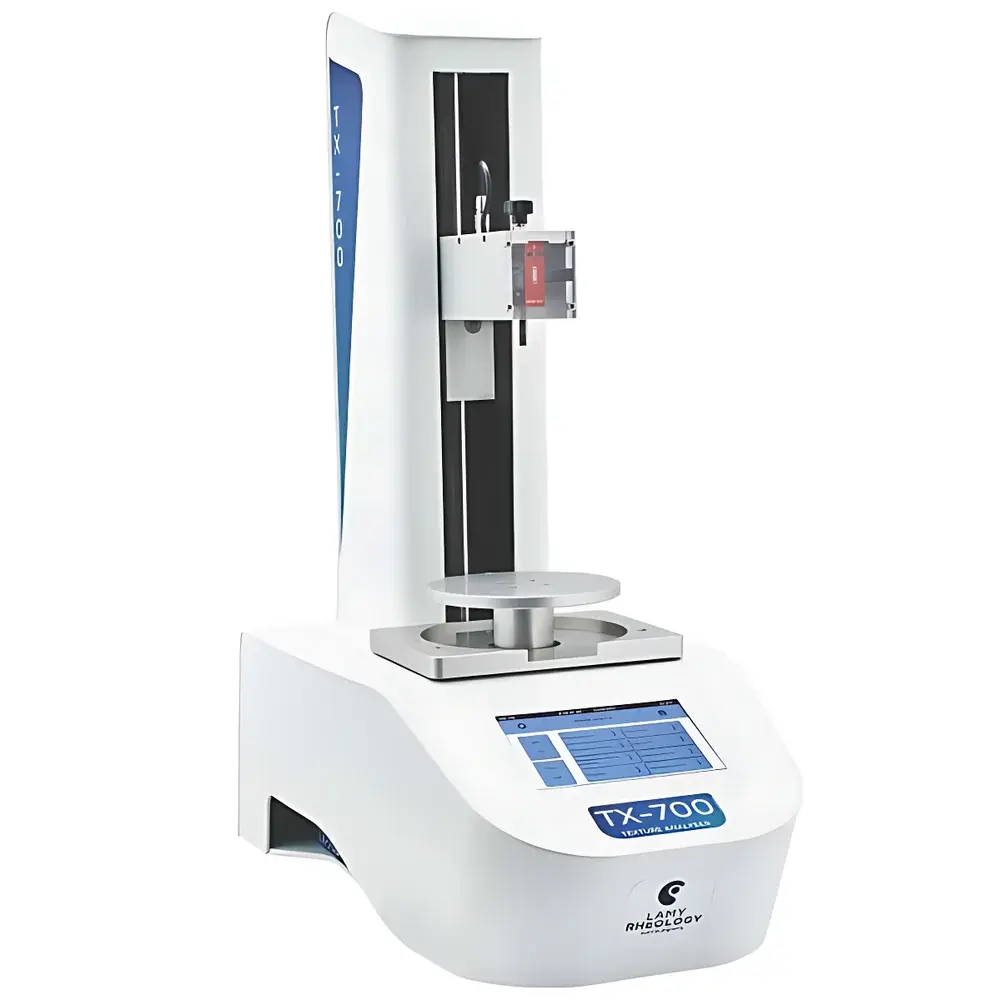
Lamy Rheology TX-700 Texture Analyzer
| Brand | Lamy Rheology |
|---|---|
| Origin | France |
| Model | TX-700 |
| Force Capacity Options | 10 N (1 kg), 20 N (2 kg), 50 N (5 kg), 250 N (25 kg), 500 N (50 kg) |
| Force Resolution | 0.001 N (0.1 g) up to 250 N |
| Accuracy | ±0.01 N at 500 N |
| Speed Range | 0.1–10 mm/s (±0.2%) |
| Travel Height | 240 mm (0.1 mm resolution) |
| Temperature Range (with PT100) | –50 °C to +300 °C |
| Display | 7-inch color touchscreen (force, speed, distance, temperature, time, sensitivity, date/time, unit selection: g/N) |
| Safety | 4-digit operator ID lock |
| Languages | French, English, Spanish, Russian |
| Operating Modes | Compression, Relaxation, Tension, TPA Cycle, Penetration, Relative Compression |
| Analog Output | 4–20 mA |
| Interfaces | RS232, USB (PC & printer), PLC-compatible |
| Power Supply | 90–240 V, 50/60 Hz |
| Dimensions | 610 × 340 × 650 mm |
| Weight | 22 kg |
Overview
The Lamy Rheology TX-700 Texture Analyzer is a high-precision universal testing instrument engineered for objective mechanical characterization of solid and semi-solid materials across research, quality control, and production environments. Based on the fundamental principle of controlled-force or controlled-distance uniaxial deformation—compliant with ASTM STP 1358, ISO 11357-3, and USP guidelines—the TX-700 quantifies textural parameters including hardness, adhesiveness, cohesiveness, springiness, chewiness, fracturability, and yield stress through standardized probe–sample interactions. Its modular architecture integrates a high-stiffness load frame, motorized crosshead with sub-micron positional repeatability, and a thermally stabilized PT100 temperature sensor enabling real-time thermal correlation during testing. Designed for GLP/GMP-aligned workflows, the system supports audit-trail-capable method storage, user-access control, and full traceability of test conditions—including operator ID, timestamp, environmental parameters, and calibration metadata.
Key Features
- 7-inch high-resolution color touchscreen interface with intuitive graphical navigation, real-time force–distance–time curve visualization, and on-device method programming and recall
- Multi-range interchangeable load cells (10 N to 500 N) with factory-calibrated accuracy (±0.01 N at full scale for 500 N configuration) and resolution down to 0.001 N
- Precise speed control across 0.1–10 mm/s (±0.2% linearity), programmable acceleration/deceleration profiles, and 240 mm travel height with 0.1 mm positional resolution
- Integrated PT100 temperature probe supporting wide-range thermal monitoring (–50 °C to +300 °C), critical for temperature-dependent texture profiling (e.g., chocolate tempering, gelatin melt behavior)
- Adjustable sample platform (160 mm rotating stage; 120 × 220 mm insertion area) accommodating diverse geometries and container formats
- Dual-mode operation: force-controlled and distance-controlled protocols compliant with ISO 179, ASTM D790, and EN 15142 for comparative mechanical analysis
- Hardware-level safety features including 4-digit operator authentication, emergency stop circuitry, and programmable force/distance limits per method
- Analog 4–20 mA output for integration into industrial SCADA or PLC-based process monitoring systems
Sample Compatibility & Compliance
The TX-700 supports over 35 application-specific probes and fixtures—each manufactured from 316 stainless steel or certified optical-grade acrylic—to ensure chemical inertness, dimensional stability, and regulatory compliance. Validated configurations include Warner-Bratzler shear cells (for meat tenderness per USDA FSIS Method 10.1), Bloom gel strength probes (ASTM D1321), spherical and cylindrical penetrators (ISO 11357-3), three-point bending rigs (ASTM D790), tensile grips (ASTM D882), and syringe extrusion modules (USP and for semi-solids). All probes are traceably calibrated against NIST-traceable deadweight standards. The system meets IEC 61000-6-2/6-4 EMC requirements and carries CE marking under the EU Machinery Directive 2006/42/EC. For regulated industries, optional software packages (PN 311005) provide 21 CFR Part 11-compliant electronic signatures, audit trails, and role-based access control.
Software & Data Management
Data acquisition and analysis are managed via embedded firmware with optional PC-based software (PN 311005), supporting automated report generation in PDF/XLSX formats with embedded metadata (operator, method ID, calibration certificate number, environmental log). Raw force–displacement–time datasets are exportable in ASCII CSV or binary .tdms format for third-party statistical analysis (e.g., JMP, MATLAB, Python pandas). The system logs all method modifications, calibration events, and sensor diagnostics with timestamped entries. USB and RS232 ports enable direct connection to laboratory networks, LIMS, or ERP systems; printer output supports GLP-compliant hardcopy archiving. Firmware updates are delivered via secure HTTPS download with SHA-256 signature verification.
Applications
The TX-700 delivers reproducible texture metrics across sectors requiring quantitative physical property validation. In food science, it measures crumb firmness (bread), spreadability (butter), gumminess (cheese), and injection force (syrup-filled confectionery). Pharmaceutical applications include tablet hardness (USP ), capsule shell rupture strength, ointment extrudability (USP ), and hydrogel swelling kinetics. Cosmetic R&D leverages its precision for lipstick break resistance (ISO 16128), cream tackiness, and mascara film flexibility. Industrial use cases span polymer film puncture resistance (ASTM D5748), elastomer compression set, paint sag resistance, and catalyst pellet friability. Each probe–method combination is documented in Lamy’s Application Note Library (v.4.2), referencing relevant ISO, ASTM, and internal SOP references.
FAQ
What force ranges are available—and how is sensor interchangeability implemented?
The TX-700 accommodates five calibrated load cells (10 N, 20 N, 50 N, 250 N, 500 N), each mechanically locked into the crosshead via a keyed bayonet mount. Automatic sensor recognition occurs on installation, loading corresponding calibration coefficients and range-limited safety thresholds.
Is temperature-controlled testing possible beyond ambient conditions?
Yes—the integrated PT100 sensor provides real-time sample surface temperature feedback. For active thermal control, the TX-700 is compatible with external Peltier stages (e.g., Lamy TC-200) and cryo-chambers (–40 °C to +150 °C), with synchronized data logging across all channels.
How does the system ensure data integrity for regulatory submissions?
With optional Part 11 software (PN 311005), the TX-700 enforces electronic signatures, immutable audit trails, and encrypted database storage. All raw data files include embedded CRC-32 checksums and digital certificates issued by Lamy’s internal PKI infrastructure.
Can custom probe geometries be validated for proprietary methods?
Yes—Lamy offers probe qualification services per ISO/IEC 17025, including dimensional metrology (CMM-certified), material certification (EN 10204 3.1), and functional validation against reference standards.
What maintenance intervals are recommended for GLP compliance?
Annual recalibration by an ISO/IEC 17025-accredited lab is required; daily verification using certified check weights (included) and quarterly mechanical inspection of guide rails and drive belt tension are documented in the system’s built-in maintenance log.






