
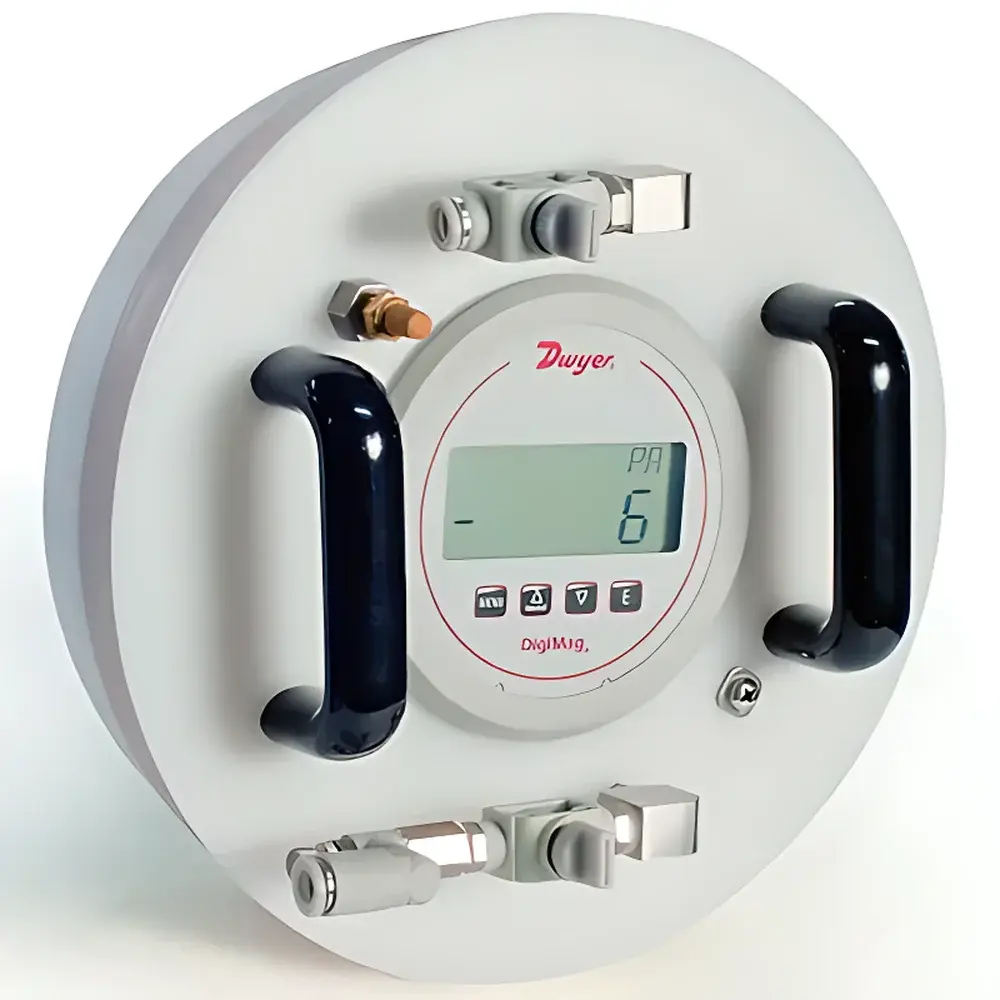
Tailin HTY-GIT-MINI Glove Integrity Tester
| Brand | Tailin |
|---|---|
| Origin | Zhejiang, China |
| Manufacturer Type | Manufacturer |
| Region of Origin | Domestic (China) |
| Model | HTY-GIT-MINI |
| Pricing | Upon Request |
| Input Pressure | 0.2–0.6 MPa |
| Inflation Pressure | 500–1000 Pa |
| Test Duration | 5–8 min |
| Pressure Resolution | 1 Pa |
| Detection Sensitivity (Minimum Detectable Hole Size) | 500 µm |
| Instrument Weight | 2.5 kg |
| Dimensions (L×W×H) | 265 × 265 × 125 mm |
| Test Port Diameter | Ø255 mm (custom sizes available) |
| Power Supply | 9 V battery |
Overview
The Tailin HTY-GIT-MINI Glove Integrity Tester is a compact, battery-powered pressure decay instrument engineered for rapid, on-site integrity verification of elastomeric gloves and sleeves integrated into sterile isolation systems—including isolators, Restricted Access Barrier Systems (RABS), and gloveboxes. It operates on the principle of controlled pressurization followed by quantitative monitoring of pressure decay over time under sealed conditions. By applying a defined inflation pressure (500–1000 Pa) to the glove interior and measuring the rate of pressure loss over a standardized test interval (5–8 minutes), the device provides an objective, repeatable metric—pressure drop per unit time—that correlates directly with leak severity. Designed in strict alignment with ISO 14644-7:2015 (“Cleanrooms and associated controlled environments — Part 7: Separative devices (clean air hoods, gloveboxes, isolators and mini-environments)”), the HTY-GIT-MINI supports compliance-driven validation and routine operational qualification of critical barrier interfaces in aseptic pharmaceutical manufacturing.
Key Features
- Portable, self-contained design (2.5 kg; 265 × 265 × 125 mm) enables deployment directly inside Grade A/B cleanrooms without external power or compressed air infrastructure.
- Integrated digital differential pressure gauge with 1 Pa resolution ensures precise real-time monitoring during pressurization and decay phases.
- Standardized Ø255 mm test port—mechanically compatible with most isolator glove ports—allows non-invasive, no-disassembly connection; custom port diameters available upon request.
- 9 V battery operation eliminates electrical hazards and simplifies cleaning protocols, fully supporting ISO 14644-3 surface compatibility requirements for disinfectant-resistant equipment.
- Manual, operator-initiated workflow: pressurization via external compressed air or nitrogen supply (0.2–0.6 MPa input), followed by passive decay measurement—no software dependency or network connectivity required.
- Test execution aligns with industry-standard pressure decay methodology referenced in EU GMP Annex 1 (2022), PDA Technical Report No. 27 (Revised), and ASTM F2096–21 (Standard Test Method for Detecting Gross Leaks in Packaging by Internal Pressurization).
Sample Compatibility & Compliance
The HTY-GIT-MINI is validated for use with standard butyl, nitrile, and chloroprene elastomeric gloves and sleeves commonly installed in RABS and isolator systems. Its low-pressure test regime (≤1 kPa) avoids mechanical stress that could compromise glove material integrity during repeated testing. The device meets functional requirements specified in ISO 14644-7 Clause 7.3.2 for “integrity testing of flexible barrier components” and supports documentation traceability for regulatory audits under FDA 21 CFR Part 211, EU GMP Annex 1, and WHO TRS 961. While the instrument itself does not generate electronic records, its analog pressure readout and manual timing protocol are fully compatible with paper-based or hybrid quality management systems operating under ALCOA+ data integrity principles.
Software & Data Management
The HTY-GIT-MINI is a standalone hardware-only solution with no embedded firmware, touchscreen interface, or data export capability. All measurements are displayed in real time on the integrated digital pressure indicator and recorded manually by operators into batch records, logbooks, or electronic quality management systems (eQMS). This architecture eliminates validation burden associated with computerized system qualification (CSV) and ensures full compatibility with facilities maintaining legacy or non-networked cleanroom environments. For users requiring structured documentation, Tailin provides optional test record templates aligned with Annex 1 §8.78 (integrity test documentation) and ICH Q5A(R2) bioburden control expectations.
Applications
- Routine pre-use and post-use integrity screening of isolator gloves prior to aseptic processing campaigns.
- Investigation of suspected glove breaches following visual inspection or environmental monitoring excursions.
- Supporting periodic requalification of RABS barrier performance as part of continuous process verification (CPV) programs.
- Verification of glove replacement integrity after maintenance interventions or scheduled change-outs.
- Training and competency assessment for cleanroom personnel performing manual barrier integrity checks.
FAQ
What gas sources are compatible with the HTY-GIT-MINI?
Compressed air or nitrogen with regulated input pressure between 0.2 MPa and 0.6 MPa may be used; nitrogen is recommended for inert environments.
Does the instrument require calibration certification?
Yes—the integrated pressure sensor must be verified annually against NIST-traceable standards; calibration certificates are provided upon request.
Can the HTY-GIT-MINI detect sub-500 µm defects?
No—its detection limit is 500 µm per ISO 14644-7 Annex D guidance; smaller leaks require helium mass spectrometry or vacuum decay methods.
Is the test port compatible with all major isolator brands?
The standard Ø255 mm port fits common Bausch + Stroebel, Getinge, and Tofflon isolator glove flanges; dimensional verification is advised for non-standard installations.
How is test pass/fail determined?
Pass criteria are defined by the glove manufacturer or internal SOPs based on maximum allowable pressure decay (e.g., ≤10 Pa/min over 5 min); Tailin supplies reference thresholds aligned with ISO 14644-7 Annex D examples.




