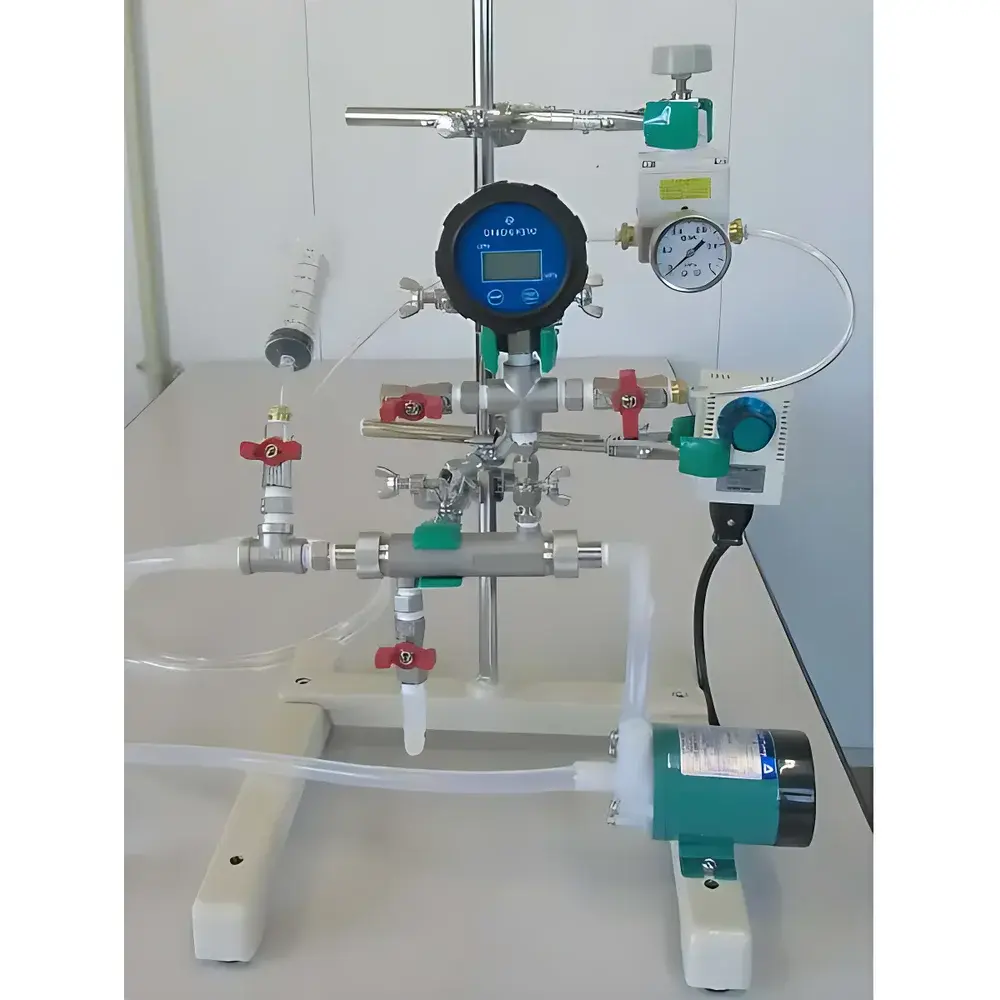
SPG MN-125 Internal-Pressure Micro/Nano Bubble Generator
| Brand | SPG |
|---|---|
| Origin | Japan |
| Model | MN-125 |
| Maximum Operating Pressure | 0.3 MPa |
| Membrane Tube Diameter | φ10 mm |
| Total Length | 125 mm |
| Effective Membrane Length | 95 mm |
| Membrane Pore Size | 1 µm (customizable) |
| Membrane Material | SUS304 or SUS316 Stainless Steel |
| Sealing Material | FKM O-rings |
| Gas Inlet Connection | 6 mm OD tubing |
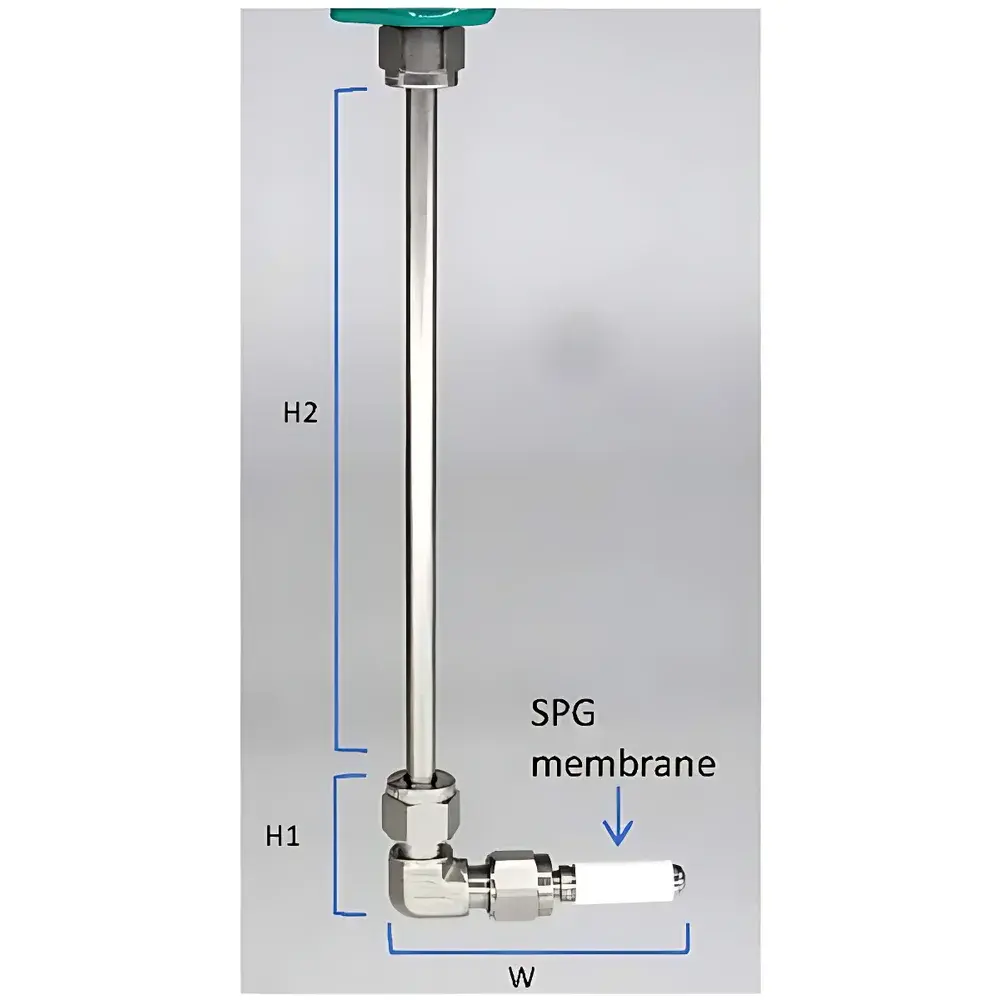
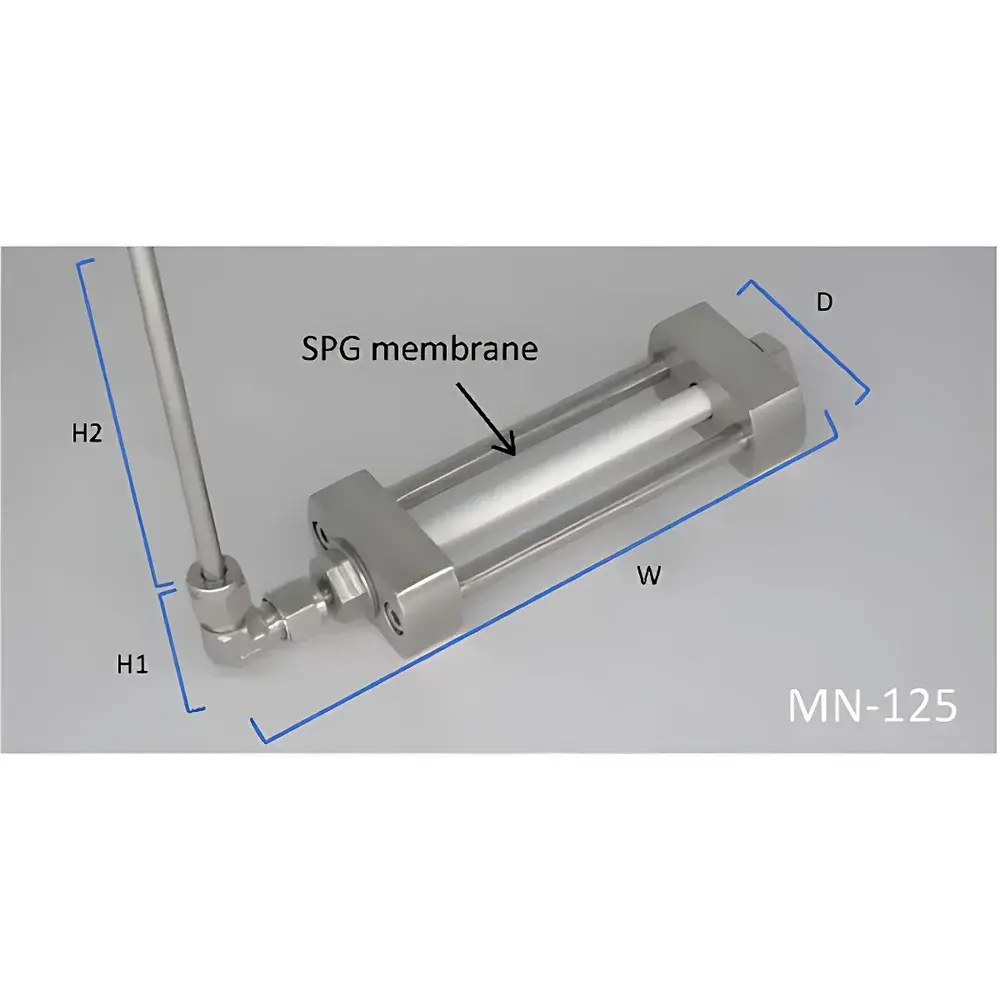
| Dimensions (W × D × H₁ × H₂) | 185 mm × 50 mm × 38 mm × (20–500 mm, adjustable stainless steel shaft length) |
| Optional accessories | secondary pressure regulators, stainless steel tubing, isolation valves, calibrated pressure transducers |
Overview
The SPG MN-125 Internal-Pressure Micro/Nano Bubble Generator is an engineered membrane-based dispersion system designed for the controlled, reproducible generation of microbubbles (1–50 µm) and nanobubbles (<1 µm) in aqueous and low-viscosity liquid media. It operates on the principle of internal-pressure-driven gas permeation through a sintered stainless-steel microporous membrane (SPG®—Shirasu Porous Glass-derived technology adapted for metallic substrates), where pressurized gas is forced radially outward through uniform sub-micron pores into a surrounding liquid phase under laminar flow conditions. This mechanism enables high surface-area-to-volume gas–liquid interfacial contact, facilitating enhanced mass transfer, prolonged bubble residence time, and stable colloidal dispersion—critical for applications in advanced oxidation, aquaculture oxygenation, functional beverage formulation, wastewater pretreatment, and laboratory-scale nanobubble stability studies. The MN-125 variant is optimized for batch volumes up to 3 L, offering a compact footprint while maintaining full compatibility with standard benchtop reactor setups and inline process integration.
Key Features
- SPG®-derived sintered stainless-steel membrane (SUS304 or SUS316) with nominal pore size of 1 µm—certified for chemical resistance, thermal stability (up to 80 °C), and mechanical integrity under cyclic pressure loading.
- Internal-pressure configuration ensures precise control over bubble size distribution via regulated gas feed pressure (0–0.3 MPa), eliminating reliance on external shear or cavitation.
- Modular shaft design: stainless-steel support rod (H₂) length adjustable from 20 mm to 500 mm, enabling vertical immersion depth optimization for varying vessel geometries and liquid levels.
- Fully demountable construction with FKM O-ring seals compliant with FDA 21 CFR 177.2600 for incidental food contact; suitable for GMP-aligned pilot environments.
- No moving parts or consumable nozzles—minimal maintenance, no clogging risk when operated within specified pressure and particulate limits (pre-filtration ≤5 µm recommended).
Sample Compatibility & Compliance
The MN-125 is validated for use with deionized water, saline solutions (≤3.5% NaCl), buffered aqueous systems (pH 4–10), and low-viscosity (25 mPa·s), abrasive slurries, or liquids containing suspended solids >5 µm without upstream filtration. All wetted materials conform to ASTM A240/A240M (SUS316) and ISO 8502-9 (surface cleanliness). Device architecture supports traceability requirements per ISO/IEC 17025:2017 Annex A (equipment verification) and aligns with USP guidelines for purified water systems requiring dissolved gas control.
Software & Data Management
As a standalone hardware module, the MN-125 does not include embedded firmware or digital interfaces. However, it is fully compatible with third-party industrial control systems (e.g., PLCs with 4–20 mA or 0–10 V analog I/O) when integrated with optional pressure transducers and secondary regulators. When deployed in GLP/GMP workflows, users may document operational parameters—including inlet pressure, gas type, liquid volume, and runtime—in electronic lab notebooks (ELNs) compliant with 21 CFR Part 11 audit trail requirements. Calibration certificates for optional pressure instrumentation are provided per ISO/IEC 17025-accredited laboratories.
Applications
- Oxidative water treatment: ozone or oxygen nanobubble delivery for contaminant degradation (e.g., phenol, pharmaceutical residues) without residual oxidant byproducts.
- Aquaculture: dissolved oxygen enhancement in recirculating aquaculture systems (RAS) with reduced energy input versus conventional diffusers.
- Food & beverage R&D: stabilization of functional gas-infused beverages (e.g., hydrogen-enriched water, nitrogen-infused teas) via narrow bubble size distribution.
- Materials science: templating of porous metal–organic frameworks (MOFs) and silica aerogels using nanobubble-mediated nucleation.
- Biomedical research: ultrasound contrast agent development and drug-loaded microbubble synthesis under sterile, low-shear conditions.
FAQ
What gases are compatible with the MN-125 generator?
Nitrogen, oxygen, ozone, carbon dioxide, argon, and compressed air are routinely used. Hydrogen and other flammable gases require additional safety interlocks and ATEX-rated ancillary components.
Is pore size customization available beyond 1 µm?
Yes—SPG offers membranes with nominal pore sizes of 0.5 µm, 2 µm, and 5 µm upon request; selection depends on target bubble size, liquid surface tension, and required gas flux density.
Does the unit include pressure regulation and monitoring hardware?
No—the MN-125 is supplied as a core generator only. Primary and secondary pressure regulators, stainless-steel tubing, isolation valves, and calibrated pressure gauges are available as configurable accessories.
Can the MN-125 be sterilized in place (SIP)?
Autoclaving is not recommended due to FKM seal limitations. Steam sterilization at ≤121 °C for ≤15 min is permissible only with SUS316 membrane and fluorosilicone O-rings (special order); validation per EN 285 must be performed by end users.
What is the expected service life of the membrane under continuous operation?
With proper pre-filtration and avoidance of chloride-rich or acidic media below pH 4, typical membrane service life exceeds 12 months at 0.2 MPa operating pressure and 8 h/day duty cycle.
Related Products