
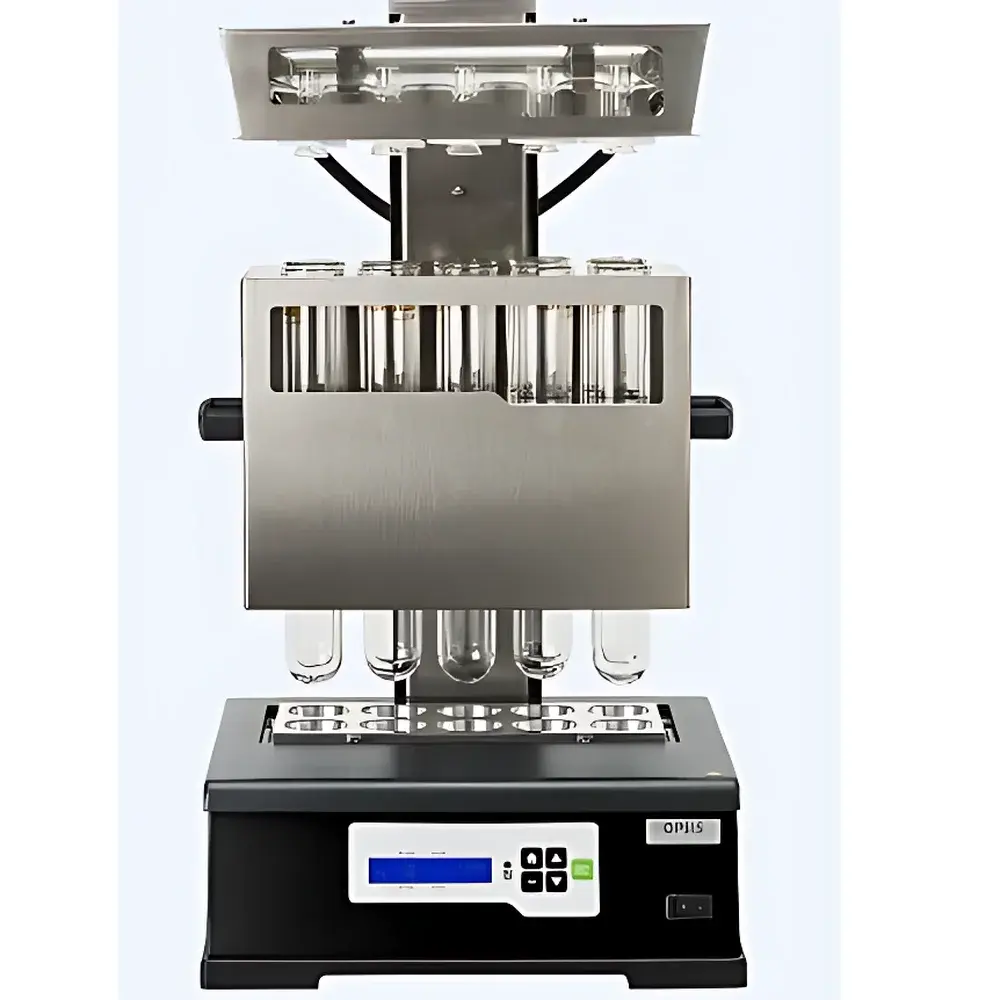
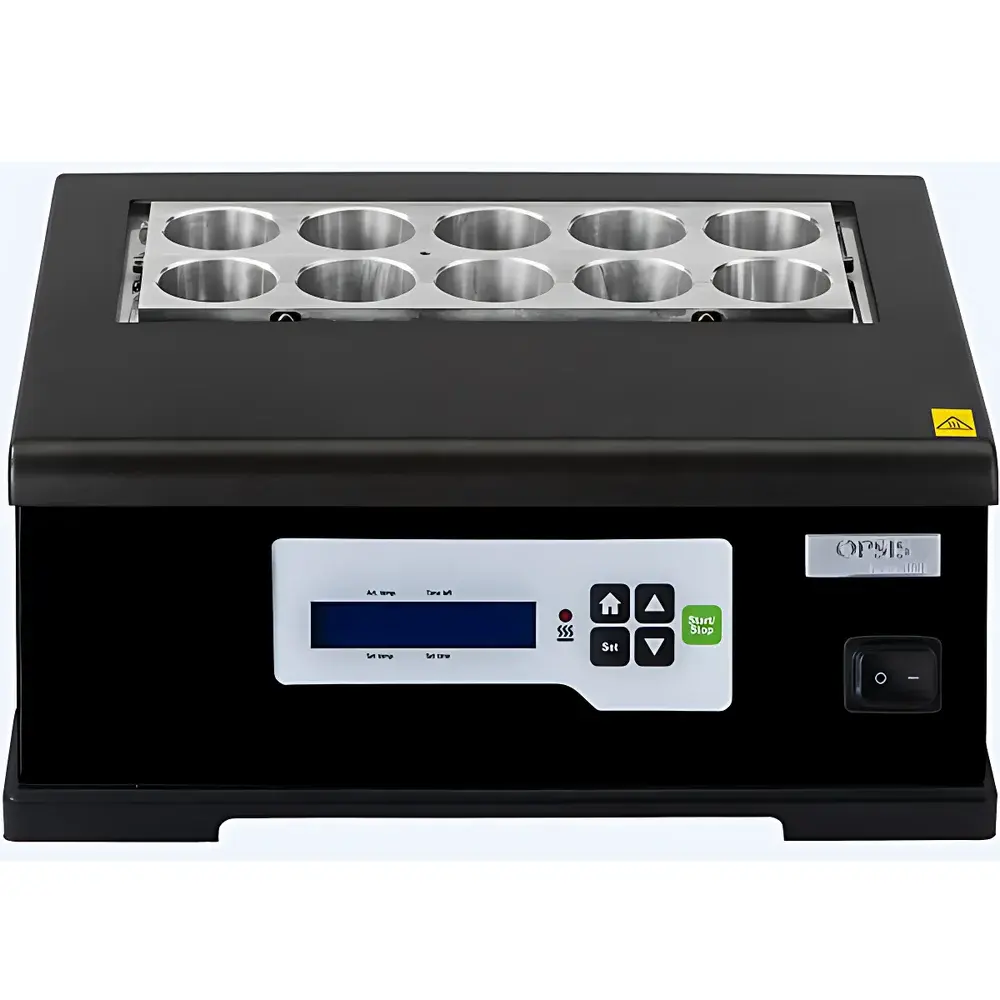
OPSIS DI-310 20-Position Fully Automated Block Digestion System
| Brand | OPSEUS/OPSIS |
|---|---|
| Origin | Sweden |
| Manufacturer Status | Authorized Distributor |
| Origin Category | Imported |
| Model | DI-310 |
| Instrument Type | Electric Block Digestion System |
| Automation Level | Fully Automatic |
| Digestion Positions | 20 |
| Temperature Range | Ambient to 450 °C |
| Temperature Control Accuracy | ±0.5 °C |
| Heating Principle | Electric Resistive Heating |
| Reagent Channels | 20 |
| Power Supply | 220 V / 50 Hz, 1200 W |
| Max. Overtemperature Protection | 500 °C (alarm + auto-hold) |
| Programmable Ramp Profiles | Yes |
| Digestion Time Range | 1–999 min |
| Integrated Lift Mechanism | Motorized Sample Rack Elevation/Depression |
| Sensor Diagnostics | Auto-detection, calibration status monitoring, and fault alerting |
| Compliance Standards | AOAC, EPA, DIN, ISO |
Overview
The OPSEUS DI-310 is a fully automated, 20-position electric block digestion system engineered for high-throughput, reproducible sample preparation in compliance-critical environments such as environmental testing laboratories, food safety QA/QC departments, and regulatory pharmaceutical R&D facilities. Based on precise resistive heating of borosilicate glass or quartz digestion tubes within a thermally uniform aluminum block, the DI-310 implements programmable temperature ramping and dwell profiles—enabling standardized wet digestion of organic matrices (e.g., soils, tissues, cereals, dairy products) prior to elemental analysis by ICP-OES, ICP-MS, or AAS. Its architecture integrates mechanical automation with fail-safe thermal management, eliminating manual rack handling while maintaining full traceability and operator safety under corrosive acid fume conditions.
Key Features
- Motorized lift mechanism for fully automatic elevation and depression of the 20-position digestion rack—reducing ergonomic strain and minimizing operator exposure to hot surfaces and acidic vapors.
- Ergonomically optimized loading height (approx. 85 cm) ensures safe, repeatable placement of digestion tube carriers without bending or overhead lifting.
- Digital PID temperature control with ±0.5 °C accuracy across the full 0–450 °C range; real-time display of setpoint, actual block temperature, and remaining digestion time.
- Integrated sensor diagnostics: automatic detection of thermocouple integrity, offset drift compensation, and on-screen alerts for calibration deviation or open-circuit faults.
- Overtemperature cutoff at 500 °C with audible/visual alarm and immediate power cutoff—compliant with IEC 61010-1 safety requirements for laboratory equipment.
- Corrosion-resistant construction: fluoropolymer-sealed reagent ports, PTFE-coated lift guides, borosilicate glass exhaust hood, and stainless-steel housing rated for continuous H2SO4, HNO3, and HCl vapor exposure.
- Programmable multi-step heating protocols (up to 5 ramps per method), including pre-digestion hold, oxidation ramp, and charring stabilization phases.
Sample Compatibility & Compliance
The DI-310 accommodates standard 16 × 150 mm or 20 × 100 mm digestion tubes—compatible with both open-vessel Kjeldahl and EPA Method 3050B/3051A workflows. Its design meets AOAC 985.27, EPA 3050B (acid digestion of sediments and soils), ISO 11047 (determination of heavy metals in animal feed), and DIN EN 13656 (trace element analysis in biological materials). All firmware logic supports GLP/GMP audit trails when paired with optional networked data logging modules. Exhaust management options include passive venting through a certified fume hood or integration with an OPSEUS FAS-200 acid gas absorption unit—ensuring VOC and NOx emissions remain below OSHA PEL thresholds during extended batch runs.
Software & Data Management
The embedded controller provides standalone method storage (≥100 user-defined programs) with timestamped execution logs, including start/stop times, peak temperatures, and thermal deviation events. Optional USB export enables CSV-formatted records for LIMS ingestion. When connected to OPSEUS LabLink™ software (Windows-based), the system supports 21 CFR Part 11-compliant electronic signatures, role-based access control, and automated report generation—including QC flagging for out-of-specification ramp rates or overshoot events. Audit trail files are digitally signed and immutable post-generation.
Applications
- Preparation of environmental samples (soils, sludges, sediments) for total recoverable metals analysis per EPA SW-846 Methods 3050B and 3051A.
- Routine Kjeldahl nitrogen determination in agricultural commodities, dairy products, and wastewater per AOAC 984.13 and ISO 5983-1.
- Acid digestion of biological tissues and clinical specimens prior to trace element quantification by ICP-MS in clinical toxicology labs.
- High-volume digestions in contract testing laboratories requiring ISO/IEC 17025 method validation documentation and instrument qualification (IQ/OQ/PQ) support packages.
FAQ
Does the DI-310 support gradient temperature programming?
Yes—users can define up to five sequential temperature ramps per method, including hold times, rate-limited increases (e.g., 5 °C/min), and plateau stabilization periods.
Is the lift mechanism serviceable without tools?
The motorized rack elevator uses modular brushless DC actuators with quick-release couplings; field replacement requires only a 2.5 mm hex key and <5 minutes downtime.
Can the system be integrated into a LIMS environment?
Via optional RS-232/USB-to-Ethernet gateway, raw log data and method metadata are exportable in ASTM E1384-compliant format for direct LIMS ingestion.
What maintenance intervals are recommended for routine operation?
Visual inspection of PTFE seals and exhaust hood integrity every 200 cycles; thermocouple verification with NIST-traceable dry-block calibrator annually or after 1,000 operating hours.
Is remote monitoring supported?
With LabLink™ software and network-enabled controller firmware, real-time status (temperature, program phase, alarms) is accessible via secure HTTPS dashboard from any authorized workstation.



