
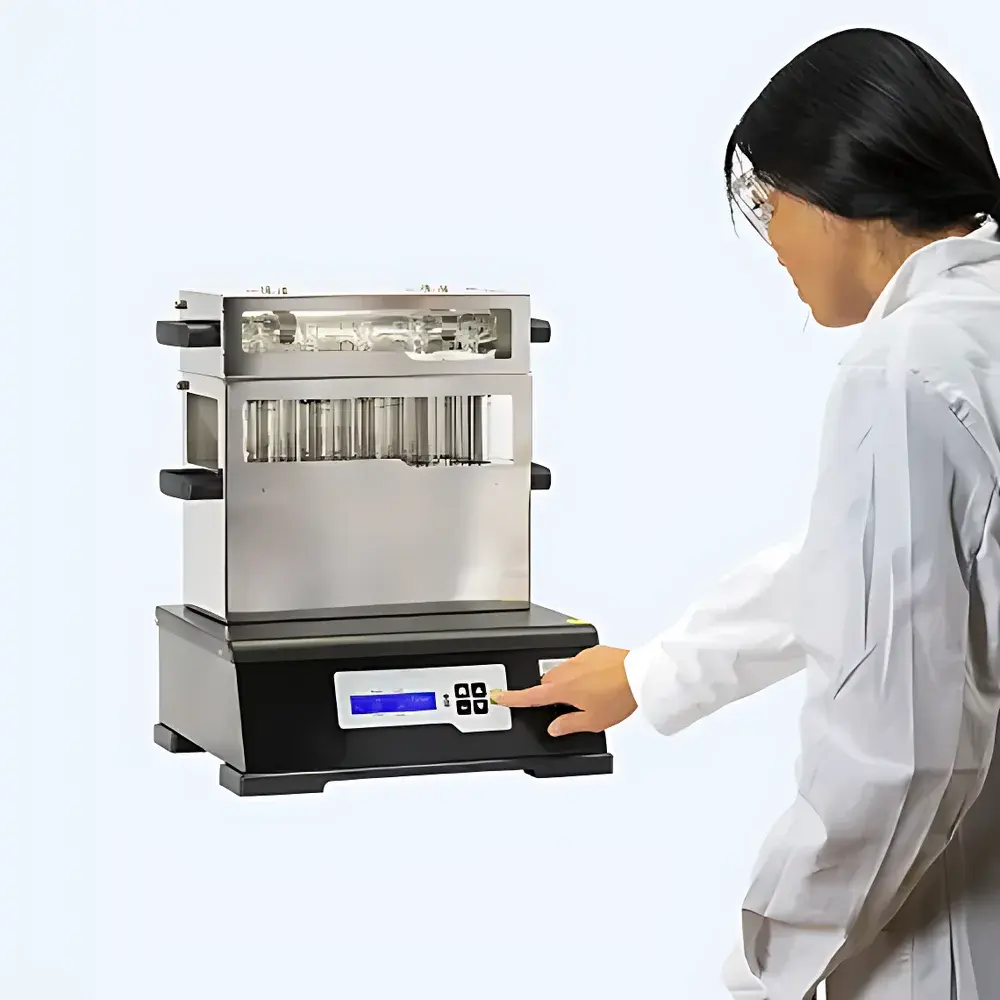
OPSIS DI-210 Automated Kjeldahl Digestion System (200 Series)
| Brand | OPSEUS/OPSIS |
|---|---|
| Country of Origin | Sweden |
| Manufacturer Type | Authorized Distributor |
| Origin Category | Imported |
| Model Series | 200 Series |
| Instrument Type | Electric Heating Digestion Instrument |
| Automation Level | Fully Automatic |
| Digestion Positions | 10 |
| Maximum Heating Temperature | 450 °C |
| Temperature Control Accuracy | ±0.5 °C |
| Heating Principle | Electrical Resistive Heating |
| Reagent Channels | 1 |
Overview
The OPSEUS DI-210 Automated Kjeldahl Digestion System (200 Series) is a precision-engineered, fully automated electric digestion unit designed for high-throughput, reproducible sample preparation in classical Kjeldahl nitrogen analysis. Built to ISO 5983, AOAC 984.13, and ASTM D5142 standards, it employs controlled resistive heating to thermally decompose organic matrices in acidic media—typically concentrated H₂SO₄ with catalysts—converting bound nitrogen into ammonium sulfate. The system operates on the principle of programmable gradient heating, eliminating thermal shock and minimizing foaming or splashing during digestion. Its robust architecture ensures uniform thermal distribution across all 10 digestion tubes, enabling complete mineralization of complex samples—including cereals, feedstuffs, dairy products, environmental sediments, wastewater sludge, and chemical intermediates—within ≤60 minutes per batch. The integrated safety design isolates electrical control circuitry from the heating zone, and the system features automatic cooldown and shutdown upon cycle completion.
Key Features
- Fully automated operation with pre-programmable multi-step temperature ramps (0–999 min per stage), preventing violent boiling and ensuring consistent digestion kinetics
- High-precision temperature regulation (±0.5 °C) across the full 0–450 °C range, with auto-electronic calibration of Pt100 sensors at power-on—no manual calibration required
- 10-position digestion block with uniform heat transfer; compatible with standard 15 mL digestion tubes or up to 5 g solid samples
- Dual safety systems: overtemperature cut-off with audible alarm and fail-safe thermal fusing
- 24/7 continuous operational capability with real-time digital monitoring via backlit LCD display showing setpoint, actual temperature, elapsed time, and sample ID
- RS232 and USB interfaces support direct data logging to LIMS or PC-based acquisition software; optional printer connectivity
- Modular hardware and firmware architecture enables field-upgradable control logic and language packs (English, German, French, Spanish, Chinese)
- Electrical isolation between heating elements and control electronics minimizes electromagnetic interference and enhances long-term reliability
Sample Compatibility & Compliance
The DI-210 supports a broad spectrum of sample types relevant to food safety (e.g., ISO 8968, AOAC 991.20), environmental testing (EPA 300.0, ISO 14852), and pharmaceutical QC (USP ). It is validated for digesting heterogeneous matrices such as whole grains, protein-rich animal feeds, municipal biosolids, industrial effluents, and polymer additives. Exhaust ports are standardized for integration with certified acid gas scrubbers (e.g., NaOH or H₂O₂ traps), complying with OSHA PEL and EU Directive 2004/108/EC on electromagnetic compatibility and workplace emissions. All firmware operations meet GLP audit-trail requirements, with timestamped event logs covering parameter changes, cycle starts/stops, and fault conditions.
Software & Data Management
The embedded microprocessor stores up to 20 user-defined digestion methods, each with independent ramp profiles, dwell times, and cooling protocols. Data export is supported via ASCII text files or CSV format through serial/USB link. When connected to compliant laboratory informatics systems, the DI-210 satisfies FDA 21 CFR Part 11 requirements for electronic records and signatures—provided the host software implements role-based access control, audit trail generation, and secure user authentication. Optional PC software enables remote method deployment, batch reporting, and trend analysis of digestion efficiency metrics (e.g., time-to-clarity, color stability).
Applications
- Protein quantification in cereal flours, soybean meal, and infant formula per AOAC 981.10 and ISO 20483
- Non-protein nitrogen (NPN) determination in dairy by-products and urea-fortified feeds
- Volatile basic nitrogen (VBN) assessment in chilled seafood and meat products (ISO 20483:2013)
- Total Kjeldahl nitrogen (TKN) in wastewater influent/effluent and agricultural runoff (EPA Method 351.2)
- Sulfur dioxide, formaldehyde, and volatile acidity analysis in wine and fruit juice matrices (OIV-MA-AS313)
- Cyanide and phenol recovery studies in contaminated soils under EPA SW-846 Methods 9010/9065
FAQ
What sample throughput can be achieved with the DI-210?
Up to 10 samples per run, with typical digestion cycles completed in under 60 minutes—enabling ≥240 samples per 24-hour period when operated continuously.
Is the system compatible with third-party Kjeldahl distillation units?
Yes; the DI-210 produces standardized digests suitable for interfacing with all major distillation modules (e.g., Büchi K-375, Gerhardt Vapodest 50, FOSS KT 500), provided tube geometry and cooling protocols align.
Does the DI-210 support GLP-compliant documentation?
Yes—when paired with validated host software, it provides full electronic audit trails, user authentication, and immutable cycle logs meeting ISO/IEC 17025 and FDA 21 CFR Part 11 requirements.
Can digestion programs be edited remotely?
Method editing requires local access via front-panel interface; however, saved methods may be uploaded/downloaded via USB or RS232 for centralized management and version control.
What maintenance is required for long-term accuracy?
No routine sensor recalibration is needed—the Pt100 probes self-calibrate at startup. Annual verification of thermal uniformity across positions using NIST-traceable reference thermometers is recommended.
Related Products



