
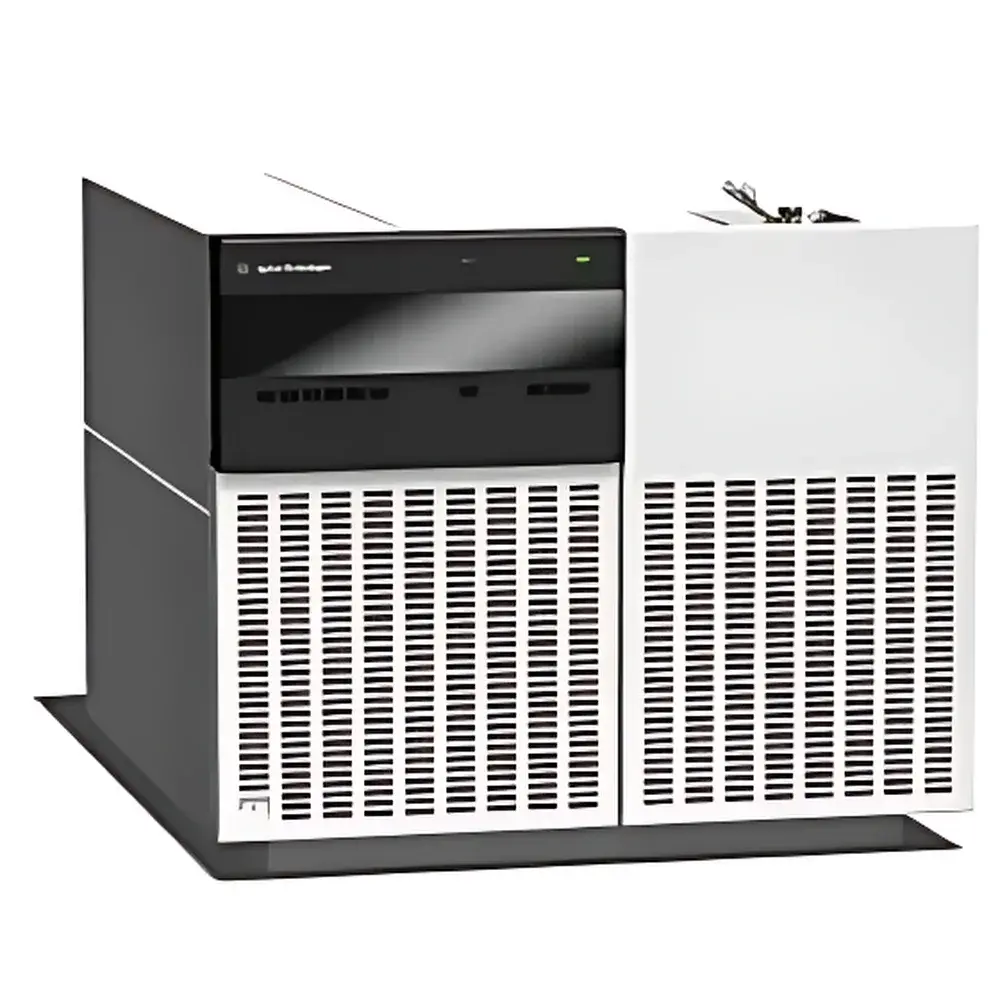
Agilent 5975T Portable Gas Chromatography-Mass Spectrometry System
| Brand | Agilent Technologies |
|---|---|
| Origin | USA |
| Model | 5975T |
| Mass Range | 1.8–1050 amu |
| Dynamic Range | 6 orders of magnitude |
| Mass Resolution | Unit mass resolution (tunable via tuning) |
| Maximum Scan Rate | 12,500 amu/s |
Overview
The Agilent 5975T Portable Gas Chromatography-Mass Spectrometry System is an engineered field-deployable analytical platform that delivers laboratory-grade GC/MS performance in a compact, ruggedized mobile configuration. Based on Agilent’s proven 5975-series quadrupole mass spectrometer architecture and integrated with Low Thermal Mass (LTM) gas chromatography technology, the 5975T operates on fundamental principles of electron ionization (EI) mass spectrometry coupled with high-efficiency capillary separation. Its design prioritizes rapid thermal cycling—enabled by direct resistive heating of fused-silica columns at rates up to 1200 °C/min—thereby reducing analysis cycle times without compromising chromatographic resolution or spectral fidelity. Unlike conventional benchtop GC/MS systems, the 5975T maintains full vacuum integrity during transport and power-down via patented vacuum hold technology, allowing instrument readiness within minutes of startup. This capability is critical for time-sensitive environmental monitoring, emergency response, and regulatory compliance verification where analytical confidence cannot be deferred.
Key Features
- Ruggedized portable chassis with shock-isolated mounting base, certified for vehicular operation and vibration resistance per MIL-STD-810G
- Low Thermal Mass (LTM) GC module enabling sub-second column heating/cooling cycles and <30-second method re-equilibration
- Quadrupole mass analyzer with EI source, optimized for NIST library matching and structural elucidation of unknowns
- Inert, heated quartz quadrupole rod assembly ensuring long-term mass calibration stability under variable ambient conditions
- 70 L/s turbomolecular pumping system with oil-free backing pump—designed for continuous operation in unconditioned field environments
- Industry-leading signal-to-noise ratio of 400:1 (measured at 1 pg octafluoronaphthalene, OFN, m/z 272)
- Vacuum retention technology preserves <1×10⁻⁵ Torr base pressure for ≥72 hours after shutdown
Sample Compatibility & Compliance
The 5975T supports direct coupling with multiple field-compatible sampling interfaces—including micro-adsorption air samplers, thermal desorption tubes, and heated direct-insertion probes—enabling trace-level detection of volatile and semi-volatile organic compounds (VOCs/SVOCs) in air, water, soil headspace, and wipe extracts. It complies with EPA Methods TO-14A, TO-15, and 8260D for VOC analysis; ASTM D7011 for hydrocarbon fingerprinting; and ISO 16000-6 for indoor air quality assessment. The system’s data acquisition and reporting architecture supports audit trails, electronic signatures, and metadata tagging in accordance with FDA 21 CFR Part 11 and GLP/GMP documentation requirements when configured with compliant software modules.
Software & Data Management
Instrument control, data acquisition, and post-run processing are managed through Agilent MassHunter Workstation Software (vB.08.x or later), which includes Decoupled Report Software (DRS) for automated deconvolution of co-eluting peaks and Retention Time Locking (RTL) for cross-method and cross-instrument retention time alignment. DRS enables reliable identification of target analytes in complex matrices—such as urban air particulates or chlorinated drinking water extracts—without manual peak integration. RTL libraries support method transfer between mobile and laboratory-based 5975-series instruments, ensuring data continuity across operational tiers. All raw data files (.D format) are stored with embedded acquisition parameters, calibration history, and operator logs to satisfy traceability mandates.
Applications
- Real-time screening of airborne nitrosamines at industrial facilities or tobacco processing sites
- On-site quantification of regulated VOCs (e.g., benzene, trichloroethylene, vinyl chloride) in municipal drinking water sources
- Rapid identification of chemical warfare agent simulants and toxic industrial chemicals (TICs) during hazmat response
- Forensic analysis of ignitable liquid residues in fire debris using passive headspace adsorption
- Environmental site assessment of landfill leachate plumes via portable thermal desorption–GC/MS
FAQ
Does the 5975T require continuous power to maintain vacuum?
No—the system employs vacuum hold technology that sustains operational vacuum (<1×10⁻⁵ Torr) for up to 72 hours after power-off, minimizing warm-up time upon restart.
Can the 5975T perform quantitative analysis compliant with regulatory standards?
Yes—when operated with certified calibration standards, validated methods, and MassHunter’s 21 CFR Part 11-compliant audit trail module, it meets EPA, ISO, and ASTM quantitative reporting requirements.
Is the LTM GC module compatible with standard 0.25 mm ID capillary columns?
Yes—it accepts industry-standard fused-silica columns (up to 30 m length, 0.53 mm ID max) with proprietary LTM cartridge adapters for rapid column exchange in field conditions.
What maintenance intervals are recommended for field deployment?
Ion source cleaning every 200–300 sample injections; turbomolecular pump bearing inspection annually; and full system calibration quarterly or after major transport events.
How is data security ensured during remote operation?
All communication between the 5975T and host workstation occurs over encrypted TLS 1.2 channels; raw data files are write-protected and checksum-verified upon export.





