
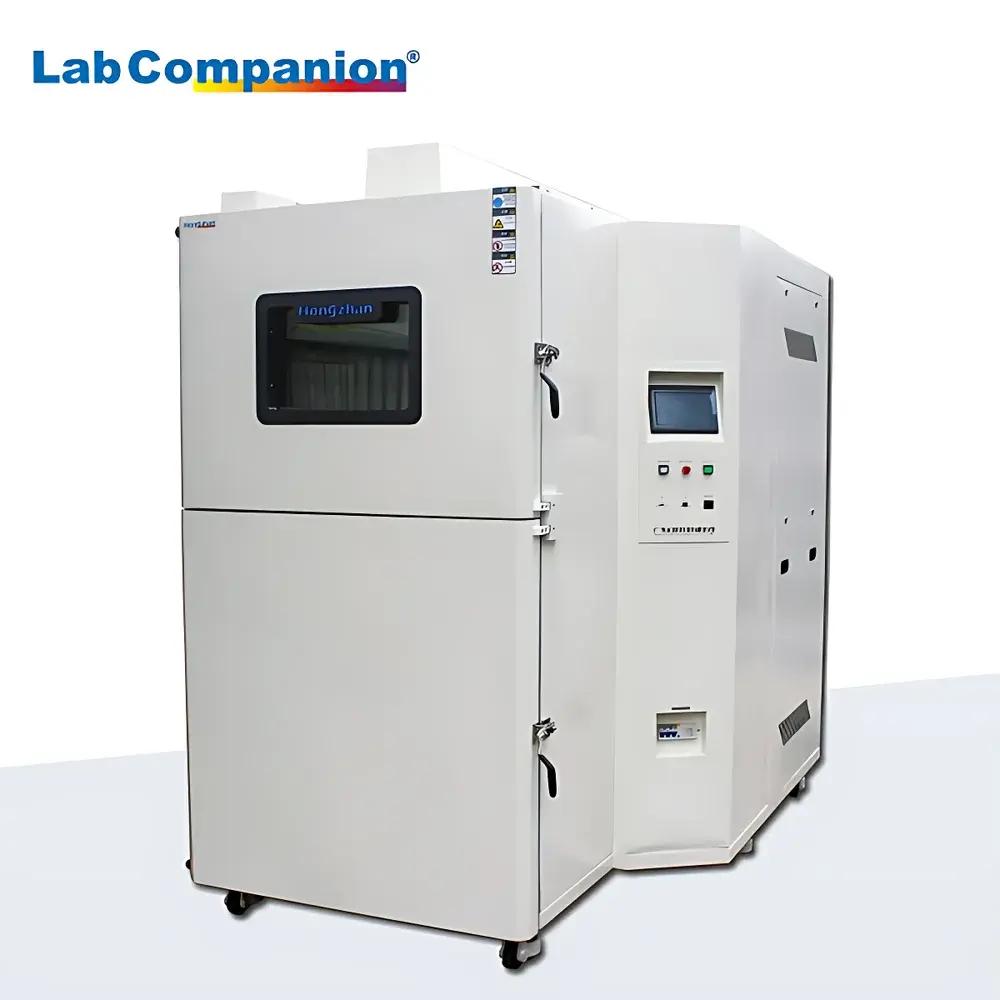
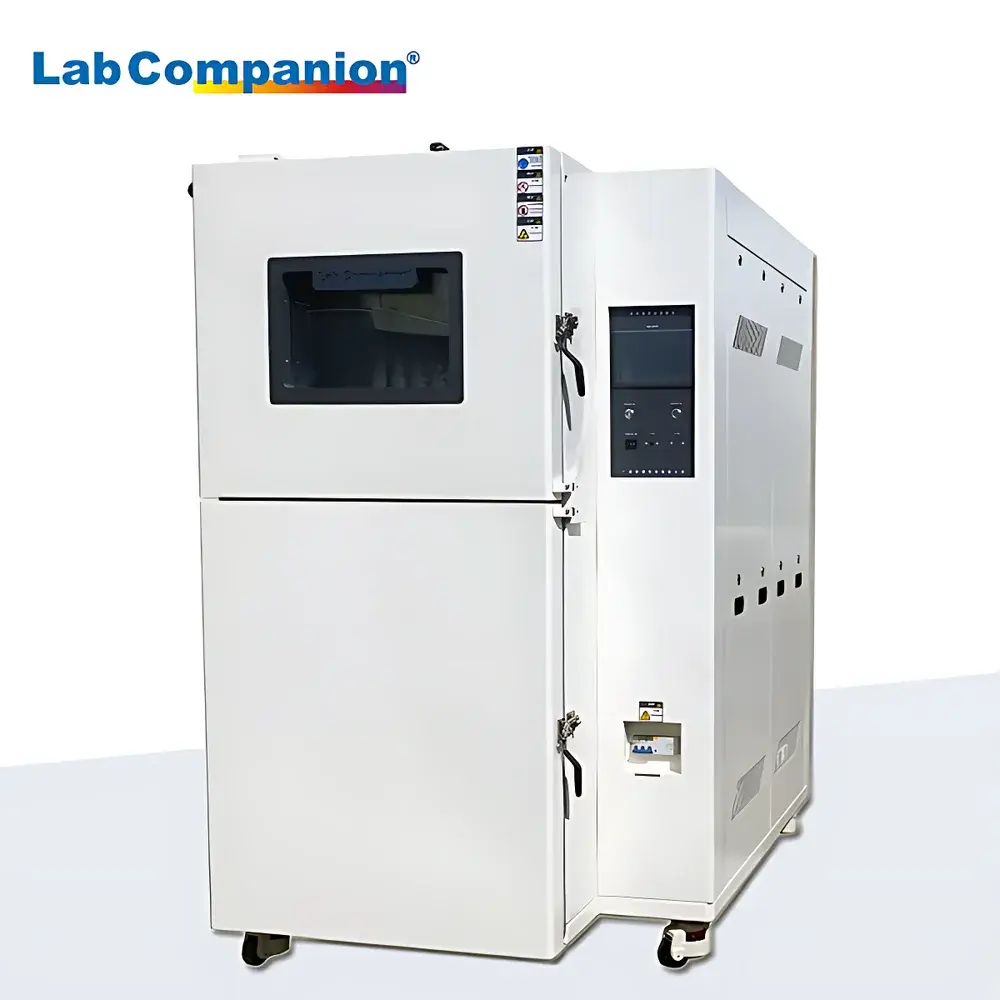
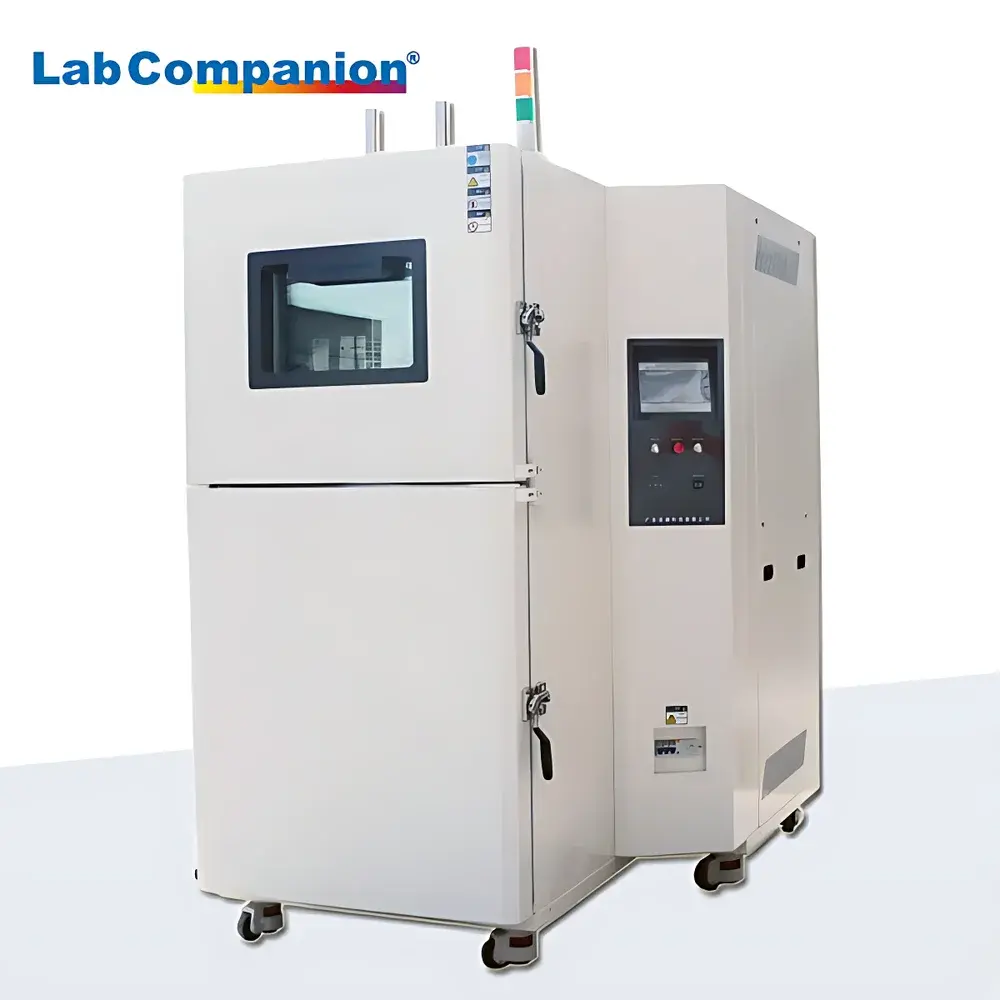
LabCompanion CTL-50W Two-Zone Thermal Shock Test Chamber
| Brand | LabCompanion |
|---|---|
| Origin | Guangdong, China |
| Manufacturer Type | Direct Manufacturer |
| Model | CTL-50W |
| Price | USD 14,000 (FOB Guangdong) |
| High-Temperature Zone Range | +60 °C to +200 °C |
| Low-Temperature Zone Range | 0 °C to −70 °C |
| Test Specimen Temperature Range | −40 °C to +150 °C |
| Temperature Uniformity | ±2 °C |
| Temperature Stability | ±2 °C |
| Ramp Rate (Heating) | R.T. → +200 °C in ~40 min |
| Ramp Rate (Cooling) | R.T. → −70 °C in ~60 min |
| Transfer Time | ≤5 s |
| Temperature Recovery Time | ≤5 min |
| Internal Dimensions (W×H×D) | 300×460×350 mm |
| External Dimensions (W×H×D) | 2250×1200×1950 mm |
| Construction | Exterior – Powder-coated cold-rolled steel |
| Refrigeration System | Air-cooled or water-cooled (W-suffix model) |
| Temperature Sensor | Armored Pt100 RTD |
| Controller | Siemens PLC-based embedded control system (PlatinumV1.0) + 7-inch color TFT touch HMI |
| Data Interface | USB port (CSV logging of setpoints, actual values, timestamps |
| Power Supply | AC 380 V, 50 Hz, 3-phase + PE |
| Total Installed Capacity | 19.7 kVA |
| Compliance Standards | GB/T 2423.1–2023 (Cold), GB/T 2423.2–2023 (Dry Heat), GJB 150.3A–2009 (High Temp), GJB 150.4A–2009 (Low Temp), GJB 150.5A–2009 (Temperature Shock) |
Overview
The LabCompanion CTL-50W Two-Zone Thermal Shock Test Chamber is an engineered environmental simulation system designed for rapid, repeatable, and highly controlled thermal cycling between extreme high- and low-temperature environments. Unlike single-chamber ramp-and-soak systems, the two-box architecture physically isolates hot and cold zones—enabling true step-change thermal shock exposure with minimal thermal inertia interference. This configuration adheres to the fundamental principle of MIL-STD-810G Method 503.5 and IEC 60068-2-14:2021, where specimens undergo abrupt transitions between pre-conditioned temperature extremes to accelerate failure modes related to coefficient-of-thermal-expansion (CTE) mismatch, solder joint fatigue, interfacial delamination, and seal integrity degradation. The CTL-50W is calibrated and validated for operation across a specimen exposure range of −40 °C to +150 °C, with independent zone control enabling precise dwell times, programmable transfer sequences, and reproducible shock profiles essential for reliability qualification testing in aerospace, automotive electronics, semiconductor packaging, and medical device manufacturing.
Key Features
- Independent dual-zone design: Separate high-temperature (+60 °C to +200 °C) and low-temperature (0 °C to −70 °C) chambers eliminate cross-contamination and ensure stable thermal baselines prior to transfer.
- High-speed pneumatic basket transfer mechanism: Achieves ≤5-second movement between zones with mechanical repeatability verified per ISO 17025-accredited calibration procedures.
- Temperature recovery time ≤5 minutes post-transfer: Maintains test integrity by rapidly re-stabilizing zone temperatures after specimen ingress/egress.
- Siemens S7-1200 PLC core with PlatinumV1.0 embedded firmware: Provides deterministic real-time control, built-in alarm logic, and configurable safety interlocks including over-temperature, compressor fault, and door-open detection.
- 7-inch industrial-grade resistive touch HMI: Supports multi-language UI (English, Chinese, Korean), graphical trend display, and password-protected parameter editing.
- Eco-compliant insulation: 120 mm thick non-hazardous glass fiber blanket meets RoHS Directive 2011/65/EU and avoids ozone-depleting substances.
- Robust structural construction: 1.2 mm 304 stainless steel interior chamber resists corrosion from condensate and cleaning agents; powder-coated cold-rolled steel exterior ensures long-term mechanical stability in lab or production-floor environments.
Sample Compatibility & Compliance
The CTL-50W accommodates test specimens up to 300 × 460 × 350 mm (W×H×D) with a maximum mass load of 15 kg—sufficient for PCB assemblies, MEMS sensors, battery modules, and small enclosures. Its thermal performance complies with multiple internationally recognized standards: GB/T 2423.1–2023 (cold testing), GB/T 2423.2–2023 (dry heat), GJB 150.3A–2009 (high-temperature exposure), GJB 150.4A–2009 (low-temperature exposure), and GJB 150.5A–2009 (temperature shock). All factory calibrations are traceable to CNAS-accredited reference standards. Optional IQ/OQ documentation packages are available upon request to support GLP/GMP-regulated validation workflows, including temperature mapping reports (per ISO 17025), uncertainty budgets, and audit-ready electronic logs.
Software & Data Management
Data acquisition and remote supervision are enabled via dual interfaces. The front-panel USB port logs timestamped CSV files containing setpoint history, real-time chamber temperatures (hot/cold/specimen), power status, and alarm events—formatted for direct import into Excel or statistical process control (SPC) platforms. For networked deployment, the integrated RJ45 Ethernet interface supports TCP/IP communication using Modbus TCP protocol. When paired with the optional PlatinumV1.0 PC Monitoring Software, users gain centralized access to up to 32 chambers from a single workstation, with features including scheduled test execution, email/SMS alerting, PDF report generation (with digital signature), and full 21 CFR Part 11-compliant audit trails—including user login/logout records, parameter change logs, and electronic signature capture for critical operations.
Applications
This thermal shock chamber serves as a core tool in accelerated life testing (ALT) and qualification programs for components subject to wide ambient fluctuations. Typical use cases include: evaluation of solder joint reliability in automotive ECUs under cyclic thermal stress; validation of hermetic seals in implantable medical devices per ISO 10993-12; screening of polymer encapsulants for CTE-induced cracking in optoelectronic modules; qualification of Li-ion battery cells against thermal runaway propagation; and verification of conformal coating adhesion on flex-rigid PCBs following JEDEC JESD22-A104E protocols. Its deterministic transfer timing and tight temperature uniformity make it suitable for both development-stage failure analysis and production-line incoming inspection.
FAQ
What is the difference between a two-box and a single-box thermal shock chamber?
Two-box systems maintain thermally isolated hot and cold zones, enabling faster, more repeatable shock transitions and eliminating thermal lag associated with chamber ramping. Single-box units rely on forced-air redistribution, resulting in longer recovery times and reduced profile fidelity.
Can the CTL-50W be configured for water-cooled operation?
Yes—the “W” suffix denotes water-cooled refrigeration, recommended for installations where ambient air cooling capacity is limited or continuous high-duty-cycle operation is required.
Is the USB data logging function compatible with third-party analysis software?
Yes—CSV output is plain-text and schema-agnostic; columns include UTC timestamp, hot-zone temperature, cold-zone temperature, basket temperature (if equipped), setpoint, and event flags—fully interoperable with MATLAB, Python pandas, JMP, and Minitab.
Does the controller support custom test profiles with variable dwell times and cycle counts?
Yes—up to 99 programmable steps per profile, with independent dwell duration (1 s–999 h), ramp rate limiting, loop nesting, and conditional branching based on temperature thresholds or elapsed time.
What documentation is provided for regulatory compliance in FDA-regulated environments?
Standard delivery includes factory calibration certificates, electrical safety test reports (IEC 61010-1), and a declaration of conformity. Optional 21 CFR Part 11 validation packages include URS, FRS, DQ/IQ/OQ protocols, and electronic signature implementation reports.



