
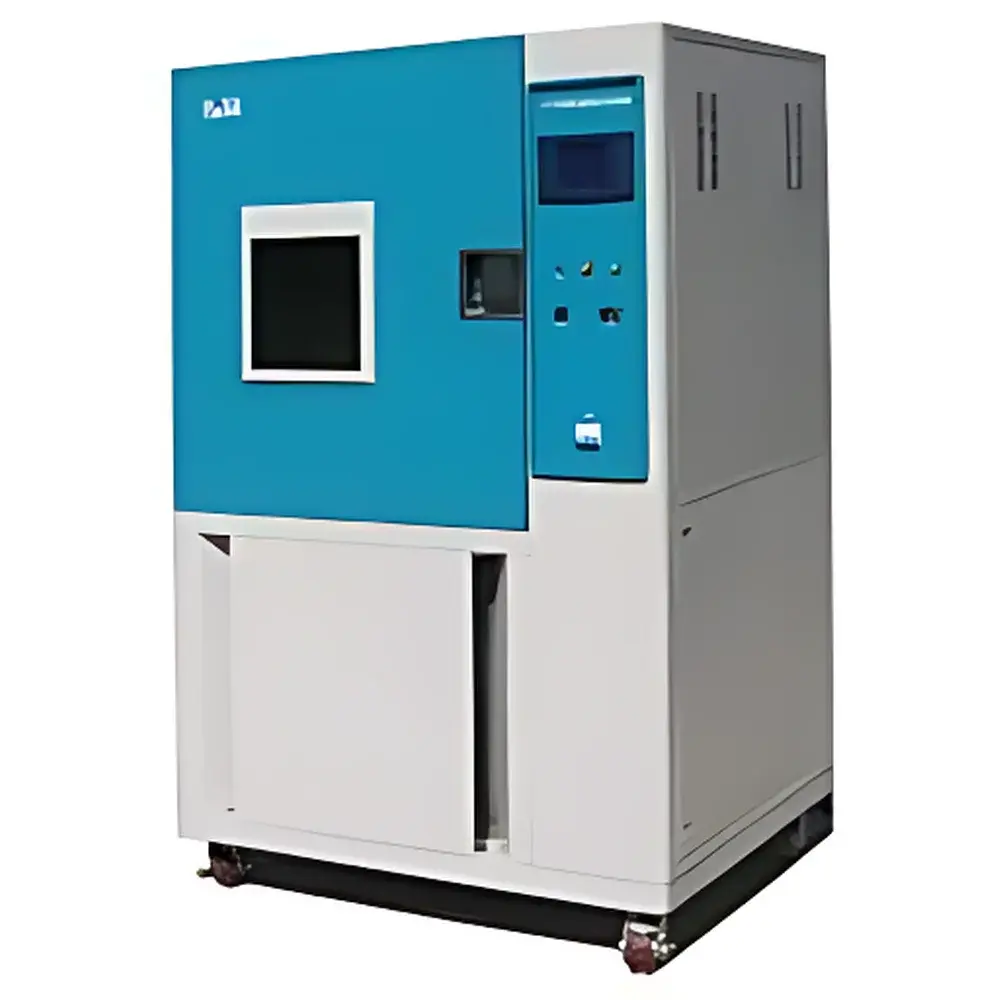
LabCompanion HLT/HA36 Environmental Stress Screening Chamber (Temperature & Humidity Cycling Test Chamber)
| Brand | LabCompanion |
|---|---|
| Origin | Guangdong, China |
| Manufacturer Type | Direct Manufacturer |
| Model | HLT/HA36 |
| Temperature Range | −20 °C to +125 °C (optional −40 °C / −70 °C) |
| Humidity Range | 25–98 %RH |
| Interior Dimensions (W×D×H) | 400 × 300 × 300 mm |
| Temperature Uniformity | ≤ ±2 °C |
| Temperature Stability | ≤ ±0.5 °C |
| Humidity Accuracy | ±3.0 %RH (>75 %RH), ±5.0 %RH (≤75 %RH) |
| Ramp Rates | Heating (RT → +125 °C) < 40 min |
| Refrigeration System | Air-Cooled Dual-Stage Cascade |
| Control Interface | Programmable Touchscreen Controller (IPC500 optional) |
| Compliance | GB/T 2423.1–4, GB 10586–89, GB 10592–89, IEC 60068-2 |
Overview
The LabCompanion HLT/HA36 Environmental Stress Screening Chamber is an engineered precision system designed for controlled temperature and humidity cycling in accordance with international environmental testing standards. It operates on the principle of forced-air convection combined with dual-stage cascade refrigeration and surface-evaporation or pressure-jet humidification, enabling reproducible simulation of thermal and hygrothermal stress conditions across defined operational profiles. This chamber supports accelerated life testing, qualification screening, and reliability validation of electronic components, aerospace subsystems, medical devices, and industrial instrumentation under dynamically varying climatic loads. Its architecture integrates thermodynamic isolation via high-efficiency polyurethane insulation, redundant safety interlocks, and real-time thermal load compensation—ensuring stable chamber performance even during rapid transitions between extreme setpoints.
Key Features
- Compact footprint with integrated castor wheels for laboratory mobility and repositioning without structural anchoring
- Intuitive programmable controller interface with optional IPC500 LCD touchscreen for multi-step profile definition, data logging, and alarm management
- Wide operational envelope: standard temperature range −20 °C to +125 °C (extendable to −40 °C or −70 °C); humidity range 25–98 %RH (low-humidity variant available: 5–98 %RH)
- Energy-optimized control logic that autonomously detects internal heat dissipation from DUTs and modulates compressor staging and fan speed accordingly
- Acoustically damped enclosure design achieving <55 dB(A) operating noise—suitable for shared lab environments and ISO Class 5+ cleanroom-adjacent placement
- Dual-stage air-cooled cascade refrigeration system with R404A/R23 refrigerant pair, delivering consistent cooling performance without external water supply dependency
- Stainless steel inner chamber (SUS304) with seamless welds and electropolished finish for corrosion resistance and ease of decontamination
Sample Compatibility & Compliance
The HLT/HA36 accommodates a broad spectrum of test specimens—including PCB assemblies, sensor modules, battery packs, polymer enclosures, and sealed optical housings—within its 36 L working volume. Its chamber geometry and airflow distribution meet ISO 16750-4 and MIL-STD-810H requirements for uniform thermal exposure. All models are certified to GB/T 2423.1 (cold), GB/T 2423.2 (dry heat), GB/T 2423.3 (damp heat, cyclic), and GB/T 2423.4 (damp heat, two-cycle) test methods. The system supports full traceability through configurable audit trails and meets GLP/GMP documentation prerequisites when paired with optional data recorder or micro-printer accessories. Safety compliance includes independent over-temperature cutoff, phase-loss detection, ground-fault interruption, and low-water-level shutoff for humidification circuits.
Software & Data Management
While the base unit features embedded firmware for standalone operation, LabCompanion provides optional PC-based software (LabEnviroLink™) supporting ASTM E2925-compliant test sequencing, remote monitoring via Ethernet or RS485, and export of time-stamped CSV datasets. All logged parameters—including chamber air temperature, relative humidity, setpoint deviation, compressor status, and alarm events—are timestamped with millisecond resolution and stored in non-volatile memory. The system supports FDA 21 CFR Part 11 readiness when configured with user authentication, electronic signature workflows, and immutable audit logs—enabling direct integration into regulated quality management systems (QMS) used in pharmaceutical device manufacturing and aerospace component certification.
Applications
- Qualification testing of avionics hardware per DO-160 Section 4 (temperature) and Section 10 (humidity)
- Accelerated moisture absorption studies on epoxy-molded IC packages and conformal-coated circuit boards
- Thermal shock preconditioning prior to HALT/HASS execution
- Stability assessment of diagnostic reagents and biopolymer formulations under variable RH conditions
- Validation of hermetic seal integrity in MEMS sensors using humidity soak-and-ramp protocols
- Material compatibility testing of elastomeric gaskets, adhesives, and thermal interface materials across −40 °C to +125 °C cycles
FAQ
What standards does the HLT/HA36 comply with for environmental testing?
It conforms to GB/T 2423.1–4, GB 10586–89, GB 10592–89, and IEC 60068-2 series standards for temperature and humidity testing.
Can the chamber operate continuously at −70 °C with 98 %RH?
No—extreme low-temperature operation (<−40 °C) is incompatible with high-humidity conditions due to condensation and frost formation risks; humidity capability is typically limited to ≤75 %RH below −20 °C.
Is remote monitoring supported out of the box?
Standard configuration includes RS485 Modbus RTU; Ethernet connectivity and cloud telemetry require optional LabEnviroLink™ software license and hardware module.
What maintenance intervals are recommended for the cascade refrigeration system?
Compressor oil and filter replacement every 24 months; refrigerant leak check and charge verification annually; evaporator coil cleaning quarterly in high-particulate environments.
Does the unit support custom test profiles with dwell, ramp, and hold segments?
Yes—the programmable controller supports up to 99 segments per profile, including linear ramps, fixed-setpoint holds, and repeat loops with conditional branching based on chamber sensor feedback.



