
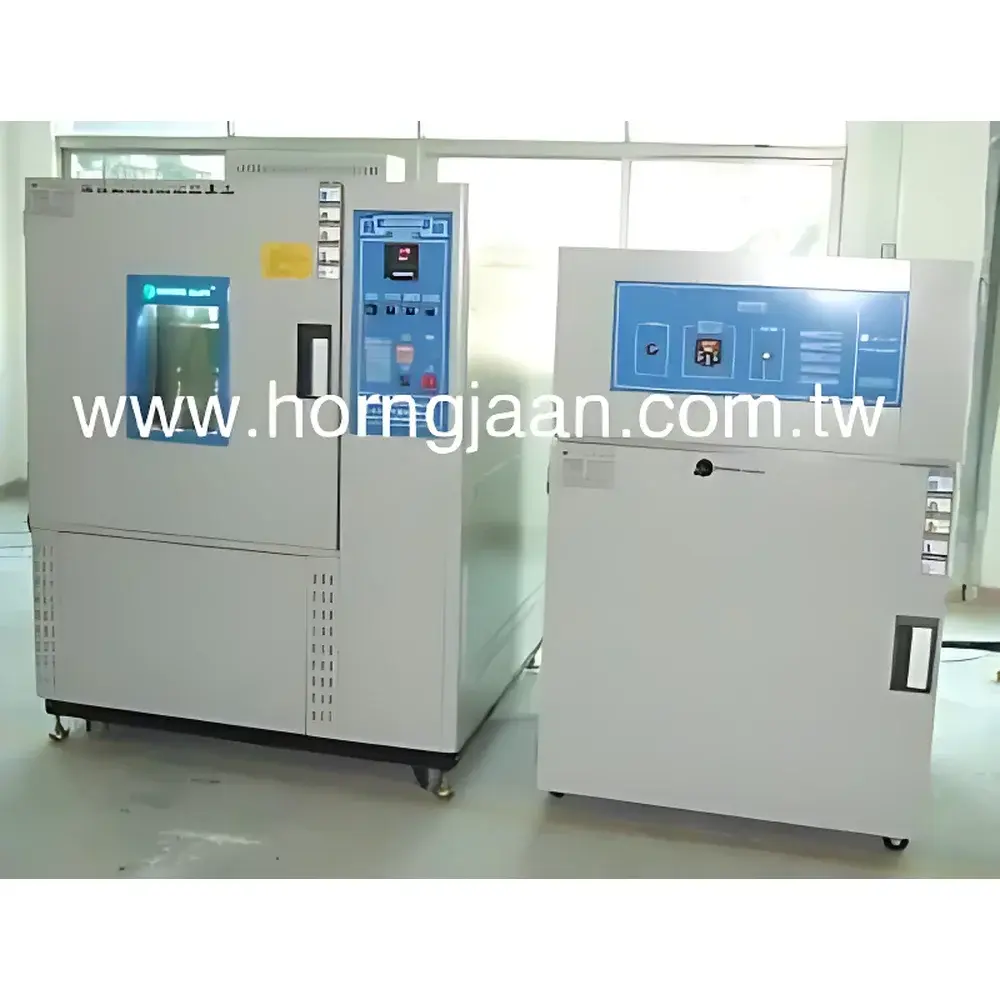
LabCompanion WGD Series Temperature and Humidity Controlled Environmental Test Chamber
| Brand | LabCompanion |
|---|---|
| Model | WGD Series |
| Origin | Guangdong, China |
| Manufacturer Type | Direct Manufacturer |
| Country of Origin | China |
| Pricing | Available Upon Request |
Overview
The LabCompanion WGD Series Temperature and Humidity Controlled Environmental Test Chamber is an engineered solution for precise thermal stress evaluation and environmental simulation in industrial R&D, quality assurance, and production validation environments. Designed around a dual-stage mechanical refrigeration architecture with eco-friendly refrigerant (R404A/R23 cascade configuration), the chamber delivers stable, repeatable temperature control across a wide operational range—typically –70 °C to +180 °C (configurable per model variant). Its core function is to subject electronic components, optical materials, PCB assemblies, LCD modules, precision inductors, and crystalline substrates to standardized thermal cycling, steady-state conditioning, and low-temperature storage protocols. The system operates on a fundamental principle of forced-air convection with optimized airflow distribution, ensuring minimal spatial deviation (<±0.5 °C at setpoint) and high thermal uniformity throughout the working volume—critical for compliance with IEC 60068-2 and MIL-STD-810 thermal test requirements.
Key Features
- Imported programmable temperature controller with expert PID algorithm—eliminates overshoot and ensures ±0.1 °C setpoint stability under dynamic load conditions;
- Optimized air circulation design featuring tangential blower and multi-directional ducting to eliminate thermal dead zones and improve chamber-wide uniformity;
- Hermetically sealed, high-efficiency compressor system integrated with single-stage or cascade refrigeration loops—enabling rapid cooldown rates (e.g., –40 °C in ≤35 min from ambient) and long-term reliability;
- Comprehensive safety architecture including over-temperature cut-off, compressor high-pressure protection, phase failure monitoring, and door interlock circuitry;
- Modular controller options: standard 30-segment programmable logic interface or optional Ethernet-enabled controller supporting remote monitoring and alarm notification;
- Structural integrity certified via ISO 9001-compliant manufacturing processes; all internal surfaces fabricated from SUS304 stainless steel for corrosion resistance and cleanroom compatibility.
Sample Compatibility & Compliance
The WGD chamber accommodates a broad spectrum of physical specimens—from miniature semiconductor packages (e.g., SMD inductors, fiber optic ferrules) to full-size PCB panels (up to 600 mm × 600 mm × 600 mm internal dimensions, depending on model). Standard configurations include two adjustable stainless-steel shelves, a 50 mm diameter cable port with silicone gasket seal, and removable interior lighting. All units are designed and verified to meet the full scope of international environmental testing standards: GB/T 10589–1989 (low-temperature performance), GB/T 11158–1989 (high-temperature performance), GB/T 2423.1–2001 / IEC 60068-2-1 (Cold Test A), GB/T 2423.2–1989 / IEC 60068-2-2 (Dry Heat Test B), GB/T 2423.22–1987 (Temperature Change Test Nb), and GJB 150.3/150.4 (military-grade thermal profiles). Optional calibration documentation supports GLP/GMP traceability per ISO/IEC 17025.
Software & Data Management
While the base unit operates via embedded controller with local HMI, optional RS232 or Ethernet connectivity enables integration into centralized lab management systems. Compatible software packages provide real-time data logging (interval configurable from 1 s to 60 min), automated report generation (PDF/CSV), and audit-trail functionality aligned with FDA 21 CFR Part 11 requirements—including user authentication, electronic signatures, and immutable event logs. Historical trend analysis tools support root-cause investigation during failure mode analysis (FMEA) workflows. Data export complies with ASTM E2500-13 guidelines for verification and validation documentation.
Applications
- Thermal cycling validation of optoelectronic devices (e.g., laser diodes, photonic crystals) under IEC 61215 or Telcordia GR-468-CORE conditions;
- Pre-conditioning of printed circuit boards prior to solder paste reflow or conformal coating application;
- Stability assessment of liquid crystal display modules across extended temperature ranges (–30 °C to +85 °C);
- Low-temperature storage qualification for passive RF components and quartz crystal resonators;
- Accelerated life testing of encapsulated sensors and MEMS-based instrumentation;
- Material coefficient-of-thermal-expansion (CTE) screening using dimensional metrology in tandem with thermal ramping.
FAQ
What temperature range does the WGD series support?
Standard models operate from –70 °C to +180 °C; extended-range variants may reach –80 °C or +200 °C upon request.
Is humidity control available on this platform?
The base WGD series is a temperature-only chamber; optional humidity-add-on modules (WGD-H) enable 10–98% RH control with ±2% RH accuracy.
Can the chamber be validated for ISO 17025-compliant calibration?
Yes—factory-installed NIST-traceable PT100 sensors and third-party calibration certificates are available as optional add-ons.
What power supply requirements apply?
Three-phase 380 VAC ±10%, 50 Hz (standard); single-phase 220 VAC variants available for smaller capacity units.
How is thermal uniformity verified inside the working chamber?
Per IEC 60068-3-5, uniformity is measured using nine calibrated thermocouples placed on a 3×3 grid at mid-height; results are documented in the Factory Acceptance Test (FAT) report.



