
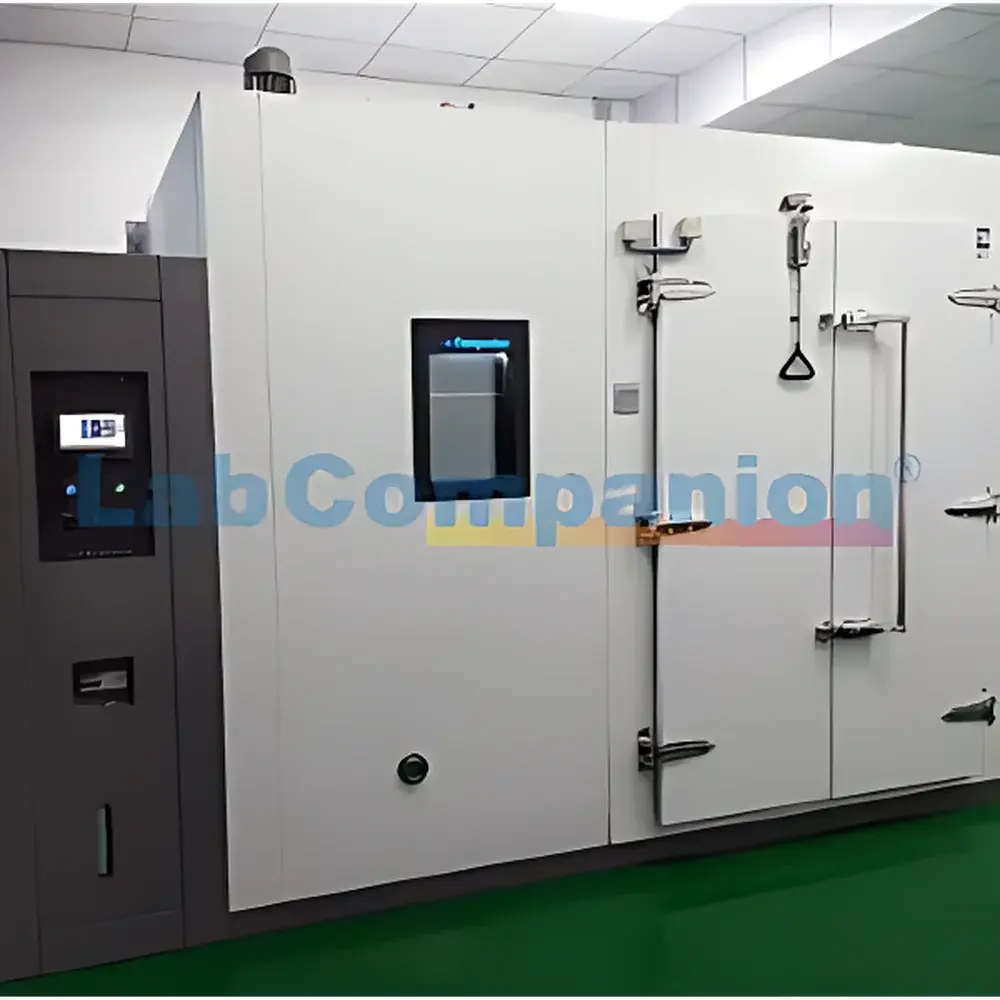
LabCompanion PHP-2467 Walk-in Photovoltaic Module Damp Heat Test Chamber
| Brand | LabCompanion |
|---|---|
| Origin | Guangdong, China |
| Manufacturer Type | Direct Manufacturer |
| Product Origin | Domestic (China) |
| Model | PHP-2467 |
| Internal Dimensions (D×W×H) | 1400 × 750 × 2350 mm |
| Temperature Range | RT + 10 °C to 100 °C |
| Temperature Uniformity | ±2 °C |
| Humidity Range | Ambient RH + 10 % to 98 % RH |
| Humidity Control Accuracy | ±5 % RH (≤75 % RH), ±2–3 % RH (≥75 % RH) |
| Compliance Standards | GB 10586–1989, GB 2423.3–1993, IEC 61215:2005, IEC 61646:2008 |
Overview
The LabCompanion PHP-2467 Walk-in Photovoltaic Module Damp Heat Test Chamber is an engineered environmental simulation system designed specifically for reliability validation of photovoltaic (PV) modules under accelerated aging conditions. It operates on the principle of controlled high-temperature, high-humidity exposure—mimicking long-term field degradation mechanisms such as encapsulant delamination, backsheet hydrolysis, corrosion of metallization, and interfacial moisture ingress. As defined in IEC 61215:2005 and IEC 61646:2008, the damp heat test requires sustained operation at 85 °C ±2 °C and 85 % RH ±5 % RH for up to 1,000 hours. The PHP-2467 meets these stringent requirements through a robust dual-loop climate control architecture, integrating precision PID-controlled heating, steam-based humidification, and refrigerated dehumidification—ensuring stable, reproducible environmental profiles across its full working volume.
Key Features
- Walk-in configuration with internal dimensions of 1400 × 750 × 2350 mm (D×W×H), enabling full-size PV module testing—including 2 m × 1.2 m monocrystalline, bifacial, and thin-film panels—without disassembly or sectioning.
- High-stability temperature control from RT + 10 °C to 100 °C, with uniformity maintained within ±2 °C across the entire chamber volume per GB 10586–1989 verification protocol.
- Humidity range spanning ambient RH + 10 % to 98 % RH, regulated via a calibrated steam generator and chilled-mirror RH sensor; accuracy complies with ±5 % RH (≤75 % RH) and ±2–3 % RH (≥75 % RH) per GB 2423.3–1993.
- 7-inch color touchscreen HMI with embedded programmable logic controller (PLC), supporting multi-step humidity/temperature ramp-soak cycles, data logging at user-defined intervals, and real-time deviation alarms.
- Corrosion-resistant interior constructed from brushed 304 stainless steel; exterior housing fabricated from cold-rolled steel with electrostatic powder coating for durability in industrial laboratory environments.
- Industrial-grade refrigeration system using imported hermetic compressors, coupled with copper-aluminum finned evaporators and condensers for reliable thermal management during extended high-RH operation.
Sample Compatibility & Compliance
The PHP-2467 accommodates standard and oversized PV modules—including crystalline silicon (c-Si), cadmium telluride (CdTe), copper indium gallium selenide (CIGS), and perovskite-based prototypes—as well as raw materials such as EVA encapsulants, POE films, glass substrates, and aluminum frames. Its chamber layout supports both horizontal mounting on adjustable racks and vertical orientation with integrated support fixtures. All operational parameters adhere strictly to internationally recognized PV qualification standards: IEC 61215:2005 (crystalline silicon), IEC 61646:2008 (thin-film), and corresponding national implementations including GB/T 9535–2021 (China). The system design satisfies mechanical and metrological requirements outlined in GB 10592–1989 (temperature chambers) and GB 10586–1989 (damp heat chambers), and is suitable for GLP-compliant test laboratories conducting third-party certification per UL 1703 or TÜV Rheinland PV certification schemes.
Software & Data Management
The integrated control software—supplied with USB dongle license and compatible with Windows 10/11—enables remote monitoring, cycle programming, and traceable data export in CSV and PDF formats. Each test record includes timestamped temperature/humidity profiles, alarm logs, and operator ID metadata. Audit trail functionality meets basic FDA 21 CFR Part 11 expectations for electronic records, including user authentication, action logging, and non-erasable history. Optional Ethernet/IP connectivity allows integration into centralized lab information management systems (LIMS) for automated report generation and cross-chamber comparative analysis.
Applications
- Accelerated damp heat testing per IEC 61215 Clause 10.12 and IEC 61646 Clause 10.11 to evaluate long-term moisture resistance of PV module packaging systems.
- Pre-qualification screening of new encapsulation materials, adhesives, and backsheet polymers under elevated thermal-hygrometric stress.
- Failure mode analysis (FMA) of potential-induced degradation (PID), solder bond fatigue, and junction box seal integrity loss.
- Supporting R&D workflows for tandem cells and building-integrated photovoltaics (BIPV), where non-standard form factors require large-volume environmental exposure.
- Supplemental use in combined stress testing sequences—e.g., thermal cycling → freeze-thaw → damp heat—to replicate real-world climatic duty cycles per IEC 61215 Annex A.
FAQ
What is the maximum allowable load weight inside the chamber?
The standard floor loading capacity is 300 kg/m²; custom reinforcement options are available upon request for heavier module stacks or auxiliary instrumentation.
Does the system include calibration certificates for temperature and humidity sensors?
Yes—NIST-traceable calibration certificates for both PT100 temperature probes and chilled-mirror hygrometers are provided with initial delivery and remain valid for 12 months.
Can the PHP-2467 be configured for combined thermal cycling and damp heat protocols?
While optimized for steady-state damp heat, the controller supports multi-segment programs with alternating temperature/humidity setpoints; however, dedicated thermal cycling chambers (e.g., PHP-TC series) are recommended for IEC 61215 thermal cycling compliance due to faster ramp rates and tighter uniformity specifications.
Is remote diagnostics supported?
Yes—the embedded controller features Modbus TCP and optional 4G LTE telemetry for real-time status monitoring, fault alerts, and firmware updates without on-site technician intervention.
What maintenance intervals are recommended for long-term reliability?
Quarterly inspection of steam generator scale buildup, biannual refrigerant pressure verification, and annual recalibration of RH sensors are advised per the maintenance logbook included with the system.



