
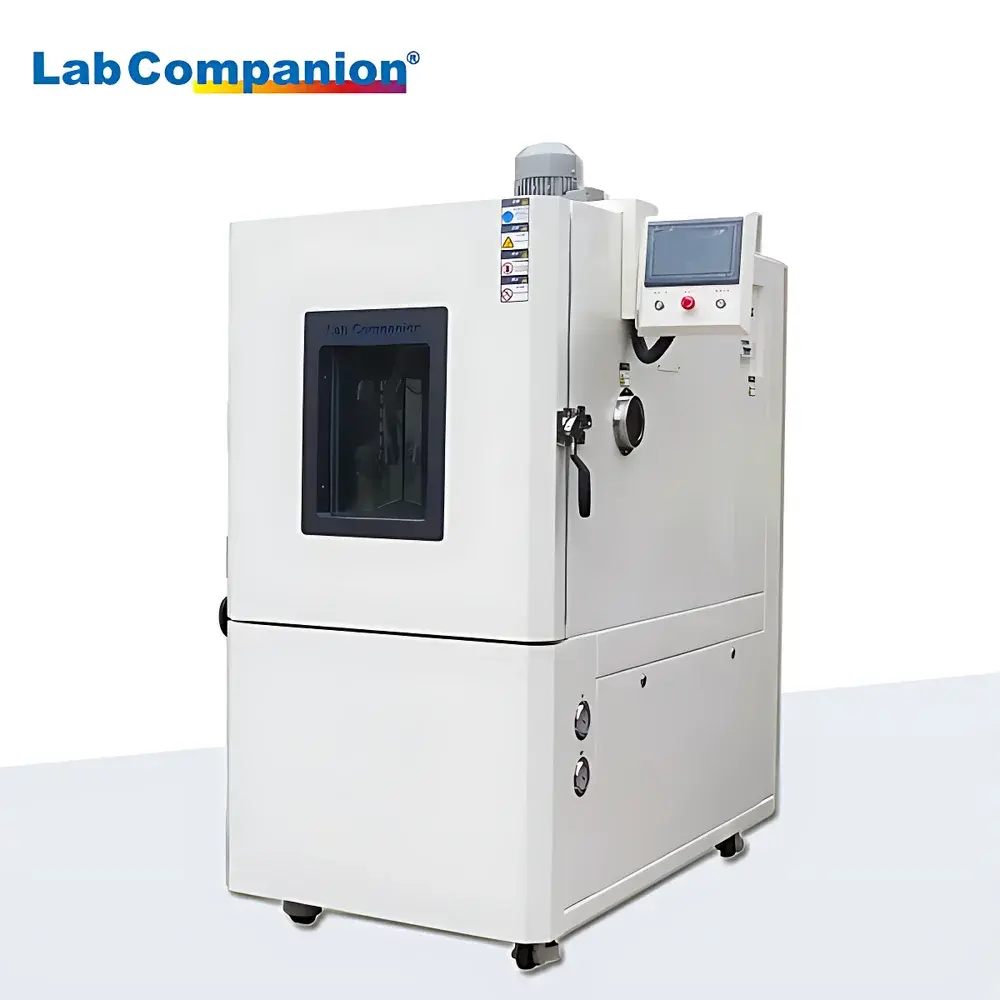
LabCompanion TC-180 High-Low Temperature Cycling Chamber
| Brand | LabCompanion |
|---|---|
| Origin | Guangdong, China |
| Manufacturer Type | Direct Manufacturer |
| Model | TC-180-11 |
| Temperature Range | -70 °C to +150 °C |
| Temperature Uniformity | ±0.5 °C |
| Temperature Deviation | ±2.0 °C |
| Heating Rate Options | 5–25 °C/min (linear or non-linear) |
| Cooling Rate Options | 5–25 °C/min (linear or non-linear) |
| Internal Dimensions (W×H×D) | 600 × 600 × 500 mm |
| Compliance | GB/T 5170.2–2008 (Temperature Testing Methods for Environmental Testing Equipment) |
Overview
The LabCompanion TC-180 High-Low Temperature Cycling Chamber is an engineered environmental test system designed for precise, repeatable thermal stress evaluation of materials, components, and finished products under controlled rapid temperature transitions. Based on dual-refrigeration circuit architecture with independent heating and cooling control loops, the chamber employs PID-driven cascade control logic to maintain high fidelity across dynamic thermal profiles—including linear ramps, step changes, dwell periods, and complex multi-segment cycles. Its core function is to simulate real-world thermal exposure conditions encountered during product transportation, storage, and operational life—enabling accelerated reliability assessment in accordance with IEC 60068-2-14 (Test N: Change of Temperature), MIL-STD-810H Method 503.6, and JESD22-A104D. The TC-180 operates without humidity control (dry-cycle configuration), making it optimized for thermal-only qualification testing where moisture interference must be excluded.
Key Features
- Wide operational temperature range from –70 °C to +150 °C, validated per GB/T 5170.2–2008 using calibrated platinum resistance thermometers (PRTs) at nine standardized sensor locations
- Selectable heating and cooling rates: 5, 10, 15, 20, or 25 °C/min—configurable as either linear or non-linear (e.g., exponential decay) profiles via programmable controller
- Optional liquid nitrogen (LN₂) assisted cooling module available to extend maximum cooling rate to 30 °C/min for ultra-rapid thermal shock simulation
- Stainless steel 304 inner chamber with seamless welded construction, insulated with high-density polyurethane foam (≥120 mm thickness) and vacuum-jacketed door gasketing for minimal thermal leakage
- 7-inch color touchscreen HMI with built-in data logging (10,000-point memory), USB export, and RS485/Modbus RTU interface for SCADA integration
- Independent over-temperature and over-pressure safety cutoffs, plus door interlock and refrigerant leak detection compliant with IEC 61000-6-2/6-4 EMC requirements
Sample Compatibility & Compliance
The TC-180 accommodates test specimens up to 600 mm (W) × 600 mm (H) × 500 mm (D), with a standard payload capacity of ≤20 kg. It supports mounting fixtures, thermocouple feedthroughs (optional), and external sensor interfaces for in-situ monitoring during cycling. The chamber meets national metrological verification standards GB/T 5170.2–2008 and is routinely used in laboratories performing qualification per ISO/IEC 17025-accredited test methods. While not intrinsically rated for hazardous area use, its electrical design conforms to GB 4793.1–2007 (equivalent to IEC 61010-1) for laboratory equipment safety. Traceable calibration certificates (NIST-traceable PRTs) are provided upon request for GLP/GMP-regulated environments.
Software & Data Management
The embedded controller firmware supports up to 100 user-defined test programs, each containing up to 99 segments with individual ramp/dwell settings. Real-time temperature logging occurs at 1-second intervals, with timestamped CSV export capability. Optional PC-based LabCompanion TestSuite™ software (v3.2+) adds remote monitoring, automated report generation (PDF/Excel), audit trail functionality, and 21 CFR Part 11-compliant electronic signatures when deployed with Windows domain authentication and role-based access control. All logged data includes metadata such as operator ID, program version, ambient lab conditions, and calibration status—ensuring full traceability for internal audits or regulatory submissions.
Applications
- Electronics: PCB solder joint fatigue analysis, semiconductor package thermal cycling validation (JEDEC JESD22-A104D)
- Automotive: ECU and sensor thermal endurance testing per ISO 16750-4 and SAE J2380
- Aerospace: Avionics box qualification per RTCA DO-160G Section 4 (Temperature Variation)
- Materials Science: Polymer crystallinity shift analysis, elastomer compression set evaluation under cyclic thermal load
- Quality Assurance: Incoming inspection screening for batch-level thermal robustness prior to final assembly
- Research & Development: Correlation of thermal expansion coefficients (CTE) with mechanical hysteresis in composite laminates
FAQ
What is the standard temperature uniformity specification for the TC-180?
Per GB/T 5170.2–2008, the chamber achieves ±0.5 °C spatial uniformity across the working volume under no-load, steady-state conditions at mid-range setpoints.
Can the TC-180 perform thermal shock testing?
Yes—when equipped with the optional LN₂ assist module, the TC-180 supports two-zone thermal shock protocols via external transfer mechanisms; standalone single-chamber shock profiles are limited to ramp-based transitions per IEC 60068-2-14.
Is third-party calibration documentation available?
Yes. Factory calibration reports with uncertainty budgets (k=2) are included. NIST-traceable field recalibration services can be scheduled through authorized LabCompanion service centers.
Does the controller support custom profile scripting?
The native interface supports segmented ramp/dwell programming. Advanced scripting (e.g., conditional branching, external trigger input logic) requires LabCompanion TestSuite™ with API extension license.
What maintenance intervals are recommended?
Refrigeration oil and filter replacement every 24 months; condenser coil cleaning quarterly; annual verification of safety interlocks and sensor linearity per ISO/IEC 17025 internal procedure ILP-TC-01.



