
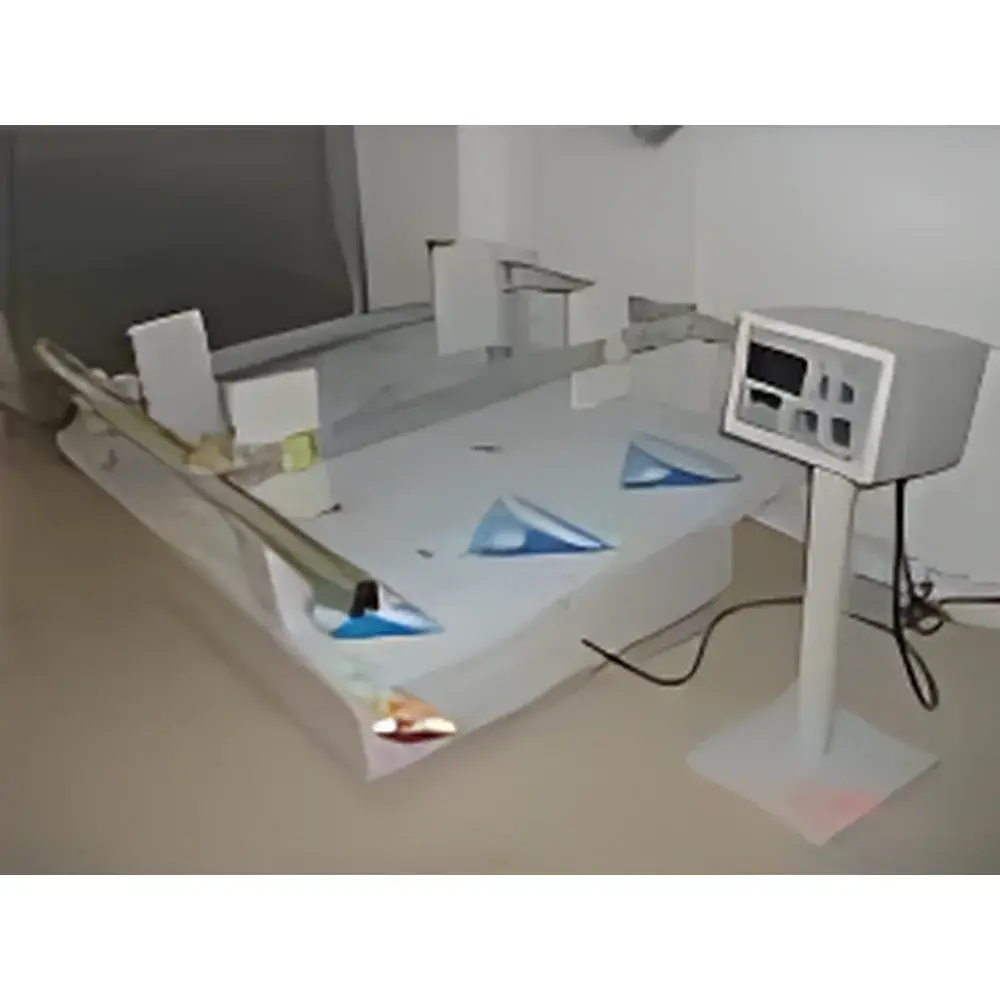
LabCompanion ZD-100 Reciprocating Transportation Simulation Vibration Test System
| Brand | LabCompanion |
|---|---|
| Origin | Guangdong, China |
| Manufacturer Type | Direct Manufacturer |
| Country of Origin | China |
| Model | ZD-100 |
| Frequency Range | 50–300 rpm |
| Amplitude (Peak-to-Peak) | 25.4 mm (1 in ±15%) |
| Load Capacity | 100 lb (45.4 kg) |
| Effective Table Size | 1.2 m × 1.0 m |
| Timing Resolution | 0.1 s |
| Startup Delay | 0.15 s |
| Motor Power | 1 HP DC or AC Variable-Frequency Drive |
| Supply Voltage | 220 V, 50/60 Hz |
| Compliance | ASTM D999, ASTM D3580, ISO 2247, ISTA 1A/2A/3A |
Overview
The LabCompanion ZD-100 Reciprocating Transportation Simulation Vibration Test System is an engineered solution for replicating the dynamic mechanical stresses experienced by packaged goods during over-the-road, rail, and intermodal freight transport. Designed in accordance with ASTM D999 (Standard Test Methods for Vibration Testing of Shipping Containers), ASTM D3580 (Standard Test Method for Vibration (Vertical Linear Motion) Test of Products), ISO 2247 (Packaging — Complete, filled transport packages — Vertical vibration test), and ISTA Series 1–3 protocols, this system subjects packaged units to controlled, repeatable sinusoidal reciprocating motion—mimicking the low-frequency, high-displacement excitation characteristic of truck bed oscillation, trailer sway, and cargo deck resonance. Unlike random or multi-axis shakers, the ZD-100 employs a robust single-degree-of-freedom linear drive mechanism optimized for durability, long-term stability, and waveform fidelity under sustained load. Its fixed 25.4 mm peak-to-peak amplitude and adjustable 50–300 rpm frequency range enable precise correlation to real-world transport profiles—particularly those defined for domestic U.S. Class 8 freight and European CE-marked logistics environments.
Key Features
- Heavy-duty C-channel steel base integrated with high-damping natural rubber isolation mounts—ensuring mechanical stability, minimal floor transmission, and tool-free disassembly for maintenance or relocation.
- Stainless-steel test platform (1.2 m × 1.0 m standard) resistant to corrosion, abrasion, and cleaning agents—compatible with cleanroom-adjacent QC labs and humidity-controlled packaging validation suites.
- Modular aluminum fixture frame with dual-handwheel clamping system—allowing rapid, tool-free positioning and secure immobilization of irregularly shaped samples up to 100 lb (45.4 kg) without slippage or torque-induced deformation.
- Low-noise synchronous timing belt transmission paired with brushless DC motor and soft-start electronic control—reducing operational sound pressure level to ≤62 dB(A) at 1 m distance, meeting ISO 7779 acoustic emission requirements for shared laboratory spaces.
- Dual-mode speed regulation: selectable DC speed control (for fine-grained ramping and dwell stability) or industrial-grade AC variable-frequency drive (for extended runtime reliability and thermal management).
Sample Compatibility & Compliance
The ZD-100 accommodates rigid, semi-rigid, and flexible packaged products—including corrugated shipping containers, molded plastic trays, blister-packed electronics, ceramic giftware, infant toys, and assembled furniture components. Its flat, non-perforated stainless surface supports direct placement of palletized loads (with optional low-profile pallet adapters) and permits integration with environmental chambers for combined temperature–vibration stress testing per ISTA 3E or ASTM D4169. All operational parameters—including frequency, duration, and startup delay (0.15 s)—are traceable and auditable, supporting GLP-compliant documentation workflows. The system meets mechanical safety requirements per IEC 61000-6-2 (immunity) and IEC 61000-6-4 (emissions), and its control logic is compatible with external data loggers for 21 CFR Part 11–compliant electronic records when paired with validated software interfaces.
Software & Data Management
While the ZD-100 operates via intuitive front-panel digital interface (0.1 s timer resolution, LED status indicators, and tactile push-button controls), it supports optional RS-485 or USB-to-serial connectivity for integration into centralized lab management systems. When used with LabCompanion’s optional VibrationLog Pro™ software (sold separately), users can schedule multi-step test sequences, export timestamped RPM/amplitude/duration logs in CSV/Excel format, generate PDF test reports with digital signatures, and maintain full audit trails—including operator ID, calibration date, and firmware version—for FDA, EU MDR, or ISO 9001 internal audits. All firmware updates are digitally signed and verified prior to installation.
Applications
- Validation of primary and tertiary packaging integrity for consumer electronics prior to distribution.
- Design verification of cushioning systems (foam, molded pulp, air pillows) under simulated highway vibration spectra.
- Failure mode analysis of printed circuit board solder joints, display modules, and battery housings subjected to prolonged low-frequency oscillation.
- ISTA-certified test execution for e-commerce fulfillment centers seeking Amazon Frustration-Free Packaging (FFP) or Walmart Sustainable Packaging Seal compliance.
- Academic research on vibration-induced fatigue in polymer-based packaging materials per ASTM D7337 methodology.
FAQ
Does the ZD-100 comply with ISTA certification requirements?
Yes—the ZD-100 meets the mechanical performance criteria for ISTA 1A, 2A, and 3A test protocols when operated within its specified frequency and amplitude envelope. Full ISTA certification requires third-party validation of the complete test procedure, including sample conditioning, instrumentation, and reporting.
Can the system be calibrated in-house?
Yes—routine amplitude verification can be performed using a certified laser displacement sensor (e.g., Keyence LK-G series) and NIST-traceable vibration calibrator. LabCompanion provides a calibration checklist and uncertainty budget template compliant with ISO/IEC 17025 Annex A.3.
Is overload protection included?
Yes—the drive electronics incorporate current-limiting circuitry and thermal cutoffs that automatically halt operation if motor load exceeds rated torque for >3 seconds, preventing mechanical damage and ensuring repeatability across shift changes.
What maintenance intervals are recommended?
Belt tension and rubber isolator compression set should be inspected every 500 operational hours; motor brushes (if applicable) replaced every 2,000 hours; and structural fasteners torque-checked annually per ISO 5344 guidelines.
Can the ZD-100 be integrated into a LIMS environment?
Yes—via Modbus RTU over RS-485, the unit exposes real-time status registers (running state, elapsed time, setpoint RPM) and fault codes, enabling bidirectional communication with major LIMS platforms including LabVantage, Thermo Fisher SampleManager, and Siemens Opcenter Quality.



