
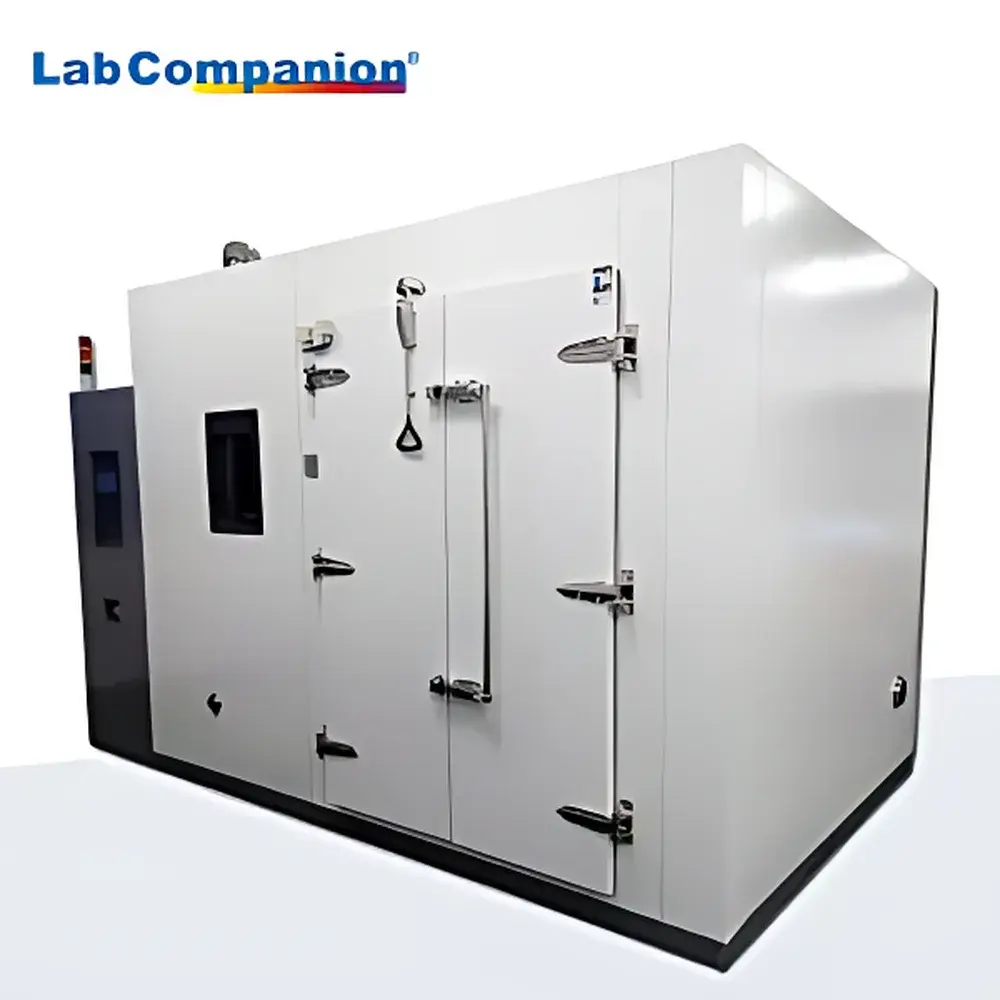
LabCompanion PHP-3619 Walk-in Environmental Test Chamber (Temperature & Humidity Cycling)
| Brand | LabCompanion |
|---|---|
| Origin | Guangdong, China |
| Manufacturer Type | Direct Manufacturer |
| Country of Origin | China |
| Model | PHP-3619 |
| Quotation | Upon Request |
| Internal Dimensions (D×W×H) | 1440 × 1100 × 2350 mm |
| Temperature Range | −73 °C to +177 °C |
| Temperature Uniformity | ±2.0 °C |
| Heating Rate | 4 °C/min |
| Humidity Range | 10–95 % RH (typical configuration) |
| Power Supply | AC 200 V, 3-phase, 3-wire, 50 Hz (optional: AC 380 V, 3-phase, 4-wire, 50 Hz) |
Overview
The LabCompanion PHP-3619 is a fully integrated walk-in environmental test chamber engineered for rigorous temperature and humidity cycling validation across aerospace, automotive, electronics, and defense sectors. It operates on a dual-refrigeration system architecture with independent control loops for thermal and hygrothermal conditioning—enabling precise simulation of real-world environmental stress profiles including rapid thermal transitions, steady-state humidity holds, and complex multi-step climatic sequences per IEC 60068-2, MIL-STD-810H, and ISO 16750-4 protocols. Unlike benchtop chambers, the PHP-3619’s large internal volume (3.7 m³ net usable space) accommodates full-scale assemblies, vehicle ECUs, battery modules, or production-line subassemblies—eliminating scaling artifacts and enabling system-level reliability assessment under controlled, auditable conditions.
Key Features
- Intelligent adaptive control algorithm dynamically modulates refrigerant flow via electronic expansion valves (EEVs), minimizing energy consumption while maintaining setpoint stability within ±2.0 °C uniformity across the entire working volume.
- Robust dual-stage cascade refrigeration system achieves −73 °C minimum operating temperature without liquid nitrogen assist—validated per ASTM E145 Class B specifications for low-temperature performance.
- Steam-based humidification with PID-controlled stainless-steel jacketed boiler ensures repeatable RH generation from 10 % to 95 % RH at temperatures ≥+10 °C; dehumidification accomplished via sub-cooled coil condensation and hot-gas bypass regulation.
- Modular structural design features 150 mm thick polyurethane insulated panels (thermal conductivity ≤0.022 W/m·K), seamless welded interior corners, and double-sealed access doors with magnetic gaskets—reducing thermal leakage and ensuring long-term calibration integrity.
- Self-diagnostic firmware monitors compressor discharge pressure, evaporator superheat, and chamber sensor redundancy; automatic fault recovery reinitiates sequence upon transient power interruption without operator intervention.
Sample Compatibility & Compliance
The PHP-3619 supports static and dynamic testing of non-hazardous solid-state devices, enclosures, PCBAs, and electromechanical assemblies up to 1,200 kg gross load. Internal dimensions (1440 × 1100 × 2350 mm W×D×H) permit vertical orientation of tall equipment racks or horizontal placement of automotive infotainment units. All chamber components—including sensors, wiring conduits, and air distribution baffles—comply with UL 61010-1 and IEC 61000-6-3 EMC immunity standards. The system is preconfigured for optional GLP/GMP audit readiness: data logging timestamps, user-access logs, and parameter change history are stored locally with SHA-256 hash integrity verification—fully compatible with FDA 21 CFR Part 11 electronic record requirements when paired with validated third-party software.
Software & Data Management
Control and monitoring are executed via a 10.1″ capacitive touchscreen HMI running embedded Linux OS with deterministic real-time scheduling. The native LabCompanion Control Suite v4.2 supports up to 99 programmable test profiles, each containing unlimited segments with ramp/soak/humidity coupling logic. Raw sensor data (PT100 RTDs, capacitive RH transducers, pressure transducers) is sampled at 1 Hz and archived in CSV/SQLite formats with configurable retention policies. Optional Ethernet/IP and Modbus TCP interfaces enable integration into factory SCADA systems or centralized test management platforms such as NI TestStand or Keysight PathWave. Calibration certificates traceable to NIM (China National Institute of Metrology) are provided with initial commissioning.
Applications
- Accelerated life testing of lithium-ion battery packs under combined thermal cycling and humidity exposure per UN 38.3 Section 38.3.4.
- Environmental stress screening (ESS) of avionics line-replaceable units (LRUs) per DO-160G Section 4 (temperature) and Section 10 (humidity).
- Validation of IP67-rated automotive connectors subjected to −40 °C → +85 °C thermal shock with 85 % RH dwell cycles.
- Material compatibility testing of conformal coatings and potting compounds under prolonged high-humidity aging at elevated temperatures (e.g., 85 °C / 85 % RH).
- Pre-compliance screening for IEC 60068-2-1 (cold), -2 (dry heat), -14 (change of temperature), and -30 (damp heat, cyclic) test methods.
FAQ
What is the maximum allowable sample mass and thermal load inside the PHP-3619 chamber?
The chamber is rated for continuous operation with up to 1,200 kg of inert mass and a maximum internal heat dissipation of 3.5 kW. Active cooling capacity remains stable under these loads when ambient conditions are maintained at ≤25 °C and 60 % RH.
Does the system support remote monitoring and alarm notification?
Yes—via optional SNMPv3 or MQTT protocol integration, users can configure email/SMS alerts for deviations exceeding user-defined thresholds (e.g., temperature excursion >±3.0 °C for >60 s), door-open events, or compressor fault states.
Is calibration documentation included, and how often is recalibration recommended?
A full NIM-traceable calibration certificate covering temperature and humidity sensors is supplied at shipment. Annual recalibration is recommended per ISO/IEC 17025 guidelines; LabCompanion offers certified field service engineers for on-site verification.
Can the chamber be upgraded to meet MIL-STD-810H Method 502.7 low-temperature storage requirements?
Yes—the standard −73 °C capability satisfies Method 502.7 Table I (Category IV, Storage). Optional enhanced insulation and extended cold-soak stabilization routines are available to support full compliance reporting.
What safety interlocks are implemented to protect personnel and equipment?
Dual-channel door safety switches disable all heating/refrigeration circuits upon opening; over-temperature cutouts (mechanical and electronic) activate independently at +200 °C; humidity over-pressure relief vents prevent condensate accumulation in the steam generator chamber.



