
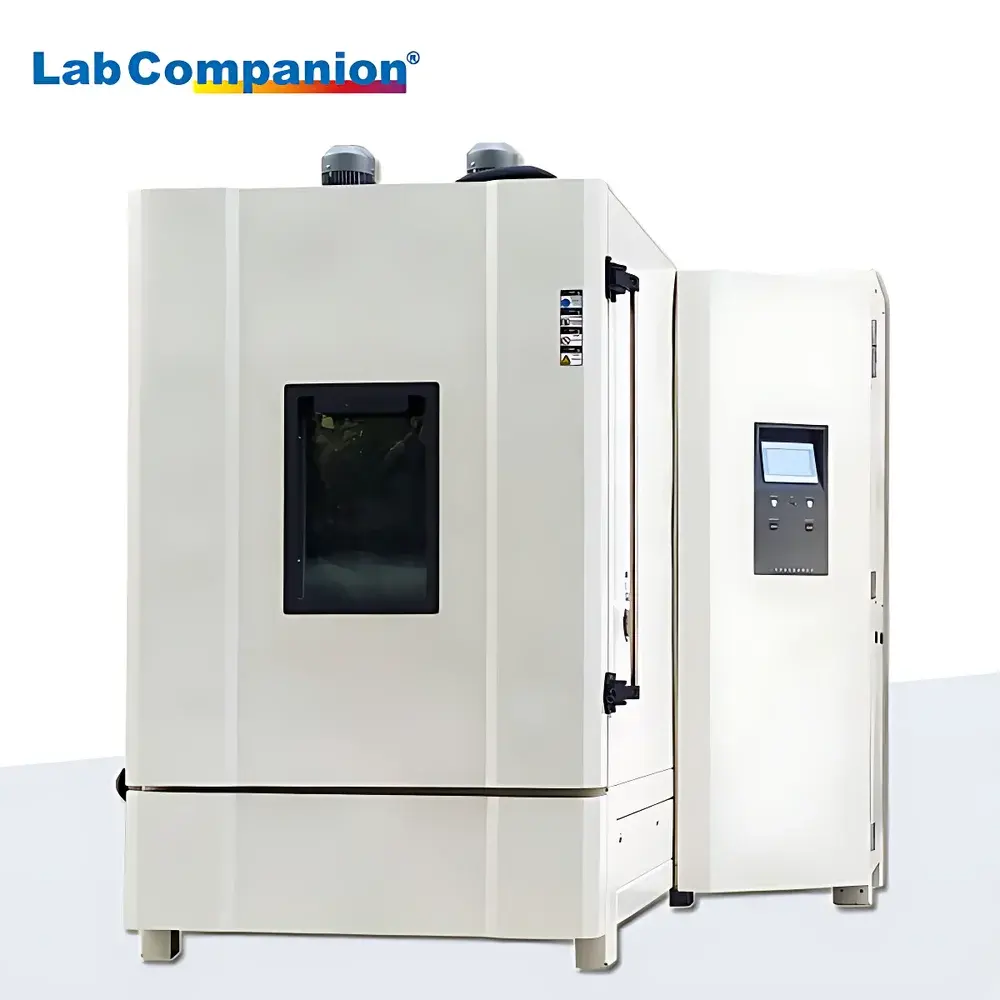
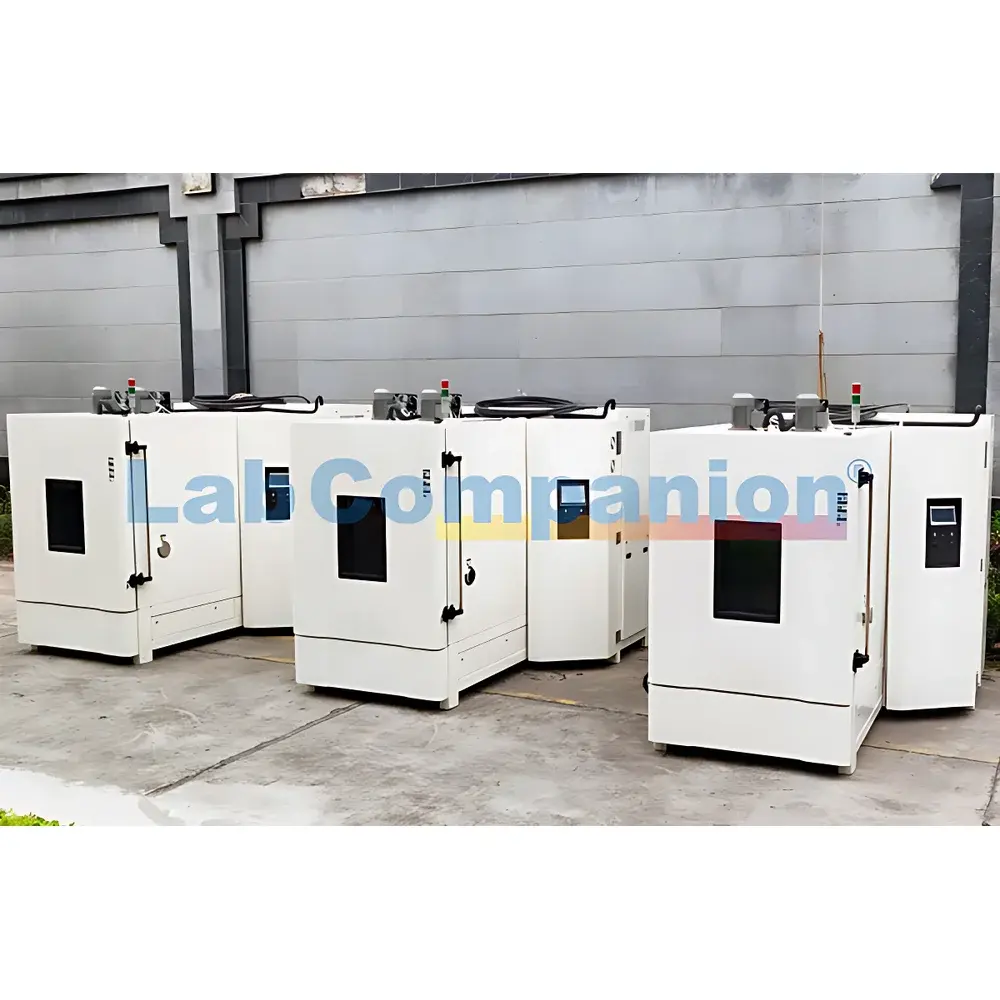
LabCompanion TH-800-12 Rapid Temperature Change Stress Screening Chamber
| Brand | LabCompanion |
|---|---|
| Origin | Guangdong, China |
| Manufacturer | Hongzhan Technology Co., Ltd. |
| Model | TH-800-12 |
| Temperature Range | −70 °C to +150 °C |
| Temperature Fluctuation | ±0.5 °C |
| Temperature Deviation | ±2.0 °C |
| Temperature Uniformity | ≤2.0 °C |
| Heating Rate | 1–25 °C/min (linear or non-linear) |
| Cooling Rate | 1–25 °C/min (linear or non-linear) |
| Internal Chamber Dimensions | 1000 mm × 1000 mm × 800 mm |
Overview
The LabCompanion TH-800-12 Rapid Temperature Change Stress Screening Chamber is an engineered environmental test system designed for accelerated reliability assessment of electronic components, printed circuit assemblies (PCBAs), aerospace avionics, automotive ECUs, and high-reliability semiconductor packages. It operates on the principle of controlled, repeatable thermal cycling—subjecting test specimens to rapid, programmable transitions between extreme low- and high-temperature extremes to induce thermomechanical stress and accelerate latent defects such as intermetallic cracking, solder joint fatigue, wire bond lift-off, and delamination at material interfaces. Unlike standard temperature chambers, the TH-800-12 delivers high-rate thermal transients with precise ramp control, enabling compliance with industry-standard stress screening protocols including MIL-STD-810H Method 503.6 (Temperature Shock), JEDEC JESD22-A104F (Temperature Cycling), and IEC 60068-2-14 (Change of Temperature). Its robust dual-refrigeration architecture and optimized air circulation design ensure stable thermal profiles across the full working volume, supporting both linear and non-linear ramp profiles for application-specific test sequences.
Key Features
- Wide operational temperature range from −70 °C to +150 °C, achieved via cascade refrigeration and high-efficiency electric heating elements
- Thermal performance certified to ±0.5 °C fluctuation and ≤2.0 °C uniformity across the 1 m³ internal workspace (1000 × 1000 × 800 mm)
- Programmable heating and cooling rates from 1 to 25 °C/min, supporting both linear and custom-defined non-linear ramps
- Independent chamber temperature monitoring using calibrated Pt100 sensors with traceable NIST-equivalent calibration paths
- Integrated safety interlocks including over-temperature protection, refrigerant pressure monitoring, and door-open shutdown logic
- Stainless steel interior chamber with reinforced insulation and low-outgassing construction suitable for cleanroom-adjacent operation
- Compliance-ready architecture supporting audit trails, user access levels, and parameter lockout functions per ISO/IEC 17025 and GLP requirements
Sample Compatibility & Compliance
The TH-800-12 accommodates large-format test articles—including full-size automotive control modules, server backplanes, and aerospace subassemblies—without requiring disassembly or fixture modification. Its open-chamber geometry and standardized mounting rails enable compatibility with industry-standard thermal test fixtures and DUT carriers. The system meets structural and operational requirements defined in ASTM E1545 (Standard Test Method for Calibration of Thermocouples), ISO 16750-4 (Road vehicles — Environmental conditions and testing for electrical and electronic equipment — Part 4: Climatic loads), and GB/T 2423.22 (Chinese national standard equivalent to IEC 60068-2-14). All thermal validation reports are generated in accordance with ILAC-P14 and support third-party certification for AEC-Q200 qualification testing workflows.
Software & Data Management
Control and data acquisition are managed via the LabCompanion ESS-Link™ software platform, a Windows-based application compliant with FDA 21 CFR Part 11 for electronic records and signatures. The interface supports multi-step profile programming, real-time graphical overlay of chamber setpoints versus measured temperatures, and automated export of time-stamped CSV and PDF test reports. Audit trail functionality logs all operator actions—including parameter changes, start/stop events, and alarm acknowledgments—with immutable timestamps and user IDs. Data integrity is preserved through local encrypted storage and optional integration with enterprise LIMS or MES systems via OPC UA or Modbus TCP protocols.
Applications
- High-acceleration stress screening (HASS) and highly accelerated life testing (HALT) during new product introduction (NPI)
- Qualification of solder interconnects under JEDEC J-STD-020 and IPC-9701 standards
- Thermal validation of battery management systems (BMS) and power electronics in EV and energy storage applications
- Reliability assessment of optoelectronic modules, RF front-end components, and MEMS devices
- Pre-shipping burn-in and lot acceptance testing for defense-grade microelectronics per MIL-PRF-38534
- Material compatibility studies involving polymer encapsulants, conformal coatings, and underfill materials
FAQ
What is the maximum payload capacity for thermal mass loading without compromising ramp rate performance?
The TH-800-12 maintains specified ramp rates up to 15 kg of typical aluminum-mass load; heavier or high-thermal-mass payloads require derating verification using the built-in thermal inertia compensation tool.
Does the system support nitrogen purging for moisture-sensitive device testing?
Yes—optional inert gas purge ports and flow control valves are available as factory-installed accessories, configurable for continuous or intermittent purge modes.
Can test profiles be imported from external reliability simulation tools?
Profile import is supported via CSV format with time-temperature column mapping; native integration with Weibull++ and ALTA is available through API extension modules.
Is remote monitoring and alarm notification supported?
Standard Ethernet connectivity enables SNMP-based network alerts and web-based status viewing via HTTPS; SMS/email notifications require optional gateway module configuration.
How frequently must the system undergo metrological recalibration?
Annual calibration against accredited reference standards is recommended; internal sensor verification routines can be executed daily or per test cycle using the onboard self-check utility.



