Teleopto LEDA-X Array Illumination System
| Brand | Teleopto |
|---|---|
| Origin | Japan |
| Model | LEDA-X |
| Configuration Options | LEDA4-X (4-zone), LEDA6 (6-zone), Dual-Color Variant |
| Driver Compatibility | LAD-4 (4-channel, BNC-triggered) or LAD-6 (6-channel, USB-controlled) |
| IP Rating | IP67 (fully waterproof) |
| Plate Compatibility | Standard 6-, 12-, 24-, 48-, and 96-well microplates |
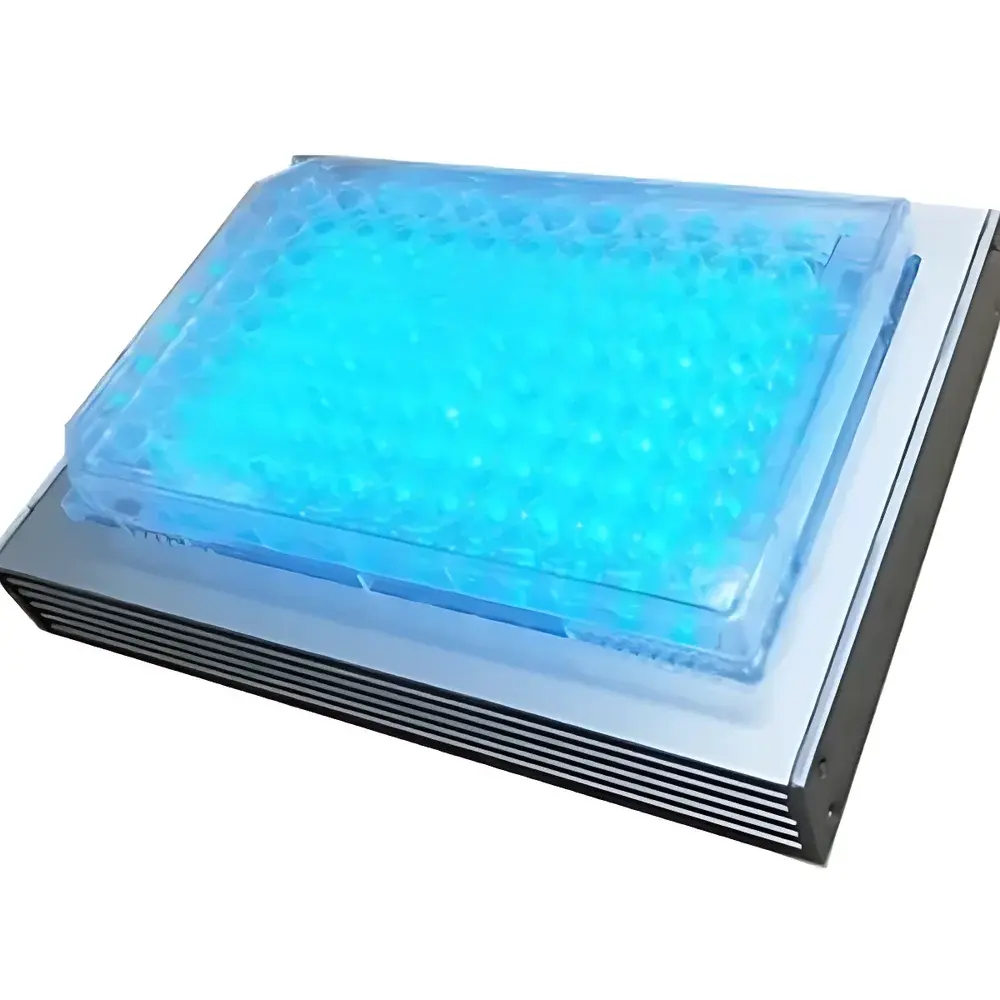
| LED Positioning | Precisely aligned beneath each well center for uniform irradiance |
| Control Modes | Continuous or TTL-triggered pulsed illumination |
| Software Interface | LAD6 GUI (Windows-based, timestamped logging, protocol scheduling) |
Overview
The Teleopto LEDA-X Array Illumination System is an engineered photostimulation platform designed for precise, reproducible, and long-duration optical control in in vitro optogenetics, photopharmacology, and photochemical assays. Built upon a modular architecture of high-stability, narrow-spectrum LEDs, the system delivers spatially resolved, intensity-calibrated light to standard multiwell plates under controlled environmental conditions—including humidified CO2 incubators. Its fully waterproof (IP67-rated) construction ensures uninterrupted operation during extended incubation periods, eliminating condensation-related failure risks common in conventional optical setups. Unlike broad-field lamps or fiber-coupled systems, the LEDA-X employs direct-well illumination geometry: each LED emitter is positioned vertically beneath the center of its corresponding well—enabling consistent photon flux delivery across all wells without cross-talk or edge falloff. This design satisfies the core metrological requirement of optogenetic experiments: temporal fidelity (sub-millisecond TTL synchronization) and spatial uniformity (±5% irradiance variation across a 96-well plate at 10 cm working distance).
Key Features
- IP67-rated sealed enclosure for reliable operation inside humidified cell culture incubators (37 °C, 5% CO2, >95% RH)
- Modular zone architecture: LEDA4-X (4 independently addressable zones, 24 LEDs/zone), LEDA6 (6 zones, 16 LEDs/zone), and dual-wavelength variant with interleaved excitation channels
- Well-centered LED placement ensures per-well irradiance uniformity; optimized for ANSI/SBS-standard 6-, 12-, 24-, 48-, and 96-well plates
- Dual control modes: continuous DC output or externally triggered pulsed illumination via TTL-compatible BNC inputs (LAD-4 driver) or USB-scheduled protocols (LAD-6 driver)
- Driver-level intensity resolution: 12-bit digital control (0–100% full scale) with calibrated radiometric output traceable to NIST-traceable photodiode standards
- No active cooling required; passive thermal management maintains LED junction temperature within ±2 °C over 72-hour continuous operation
Sample Compatibility & Compliance
The LEDA-X system is validated for use with adherent and suspension mammalian cell cultures, primary neurons, organoids, and 3D hydrogel-embedded tissues in standard polystyrene, glass-bottom, or black-walled microplates. Its non-invasive, non-thermal illumination profile avoids phototoxicity artifacts associated with UV or high-intensity broadband sources. All configurations comply with IEC 61000-6-3 (EMC emission limits) and IEC 61000-6-2 (immunity to electrostatic discharge and RF fields), ensuring stable performance in shared laboratory environments with electrophysiology rigs or mass spectrometers. The LAD-6 software supports audit-trail generation and user-access logging in accordance with GLP and FDA 21 CFR Part 11 requirements when deployed in regulated preclinical assay workflows.
Software & Data Management
The LAD6 control software (Windows 10/11, 64-bit) provides deterministic timing control with sub-100 µs jitter on pulse onset. Protocols include ramped intensity profiles, multi-phase wavelength sequencing, and inter-well group activation—all timestamped to system clock with UTC synchronization. Export formats include CSV (irradiance vs. time), JSON (protocol metadata), and HDF5 (high-throughput experiment archives). Raw TTL trigger logs are stored separately for cross-correlation with patch-clamp or calcium imaging data streams. No cloud dependency: all data remains local unless explicitly exported; no telemetry or remote access services are embedded.
Applications
- Optogenetic interrogation of ion channel kinetics in HEK293T or iPSC-derived cardiomyocytes using ChR2/C1V1 co-expression in dual-color mode
- Photoactivatable Cre recombinase (PA-Cre) induction kinetics in 96-well neural differentiation assays
- Spatiotemporal control of photocaged neurotransmitters (e.g., RuBi-Glutamate) in primary cortical slice cultures
- High-throughput screening of photoswitchable drugs under physiological O2/CO2 conditions
- Chronobiological studies requiring circadian-phase-aligned light pulses across 48-well plate arrays
FAQ
Can the LEDA-X be used inside a CO2 incubator without condensation damage?
Yes—the entire array and driver interface are rated IP67 and have been validated for continuous operation at 37 °C and 95% relative humidity.
Is irradiance calibration provided with each unit?
Each LEDA-X system ships with a NIST-traceable spectral irradiance certificate measured at 10 mm working distance, covering 365–740 nm in 5 nm steps.
Does the LAD-6 driver support third-party automation integration?
Yes—LAD6 exposes a documented COM interface and REST-like HTTP API for integration with LabVIEW, Python (PySerial/Requests), or commercial LIMS platforms.
What is the maximum duty cycle for pulsed operation in TTL-triggered mode?
The system supports continuous pulsing up to 10 kHz with 10% duty cycle; sustained 1:1 on/off cycling is limited to 1 kHz to maintain thermal stability.
Are custom wavelengths or irradiance profiles available?
Teleopto offers OEM configuration services including peak wavelength selection (365–850 nm), FWHM optimization (<15 nm), and collimated beam angles (±5° to ±30°) under NRE agreement.