
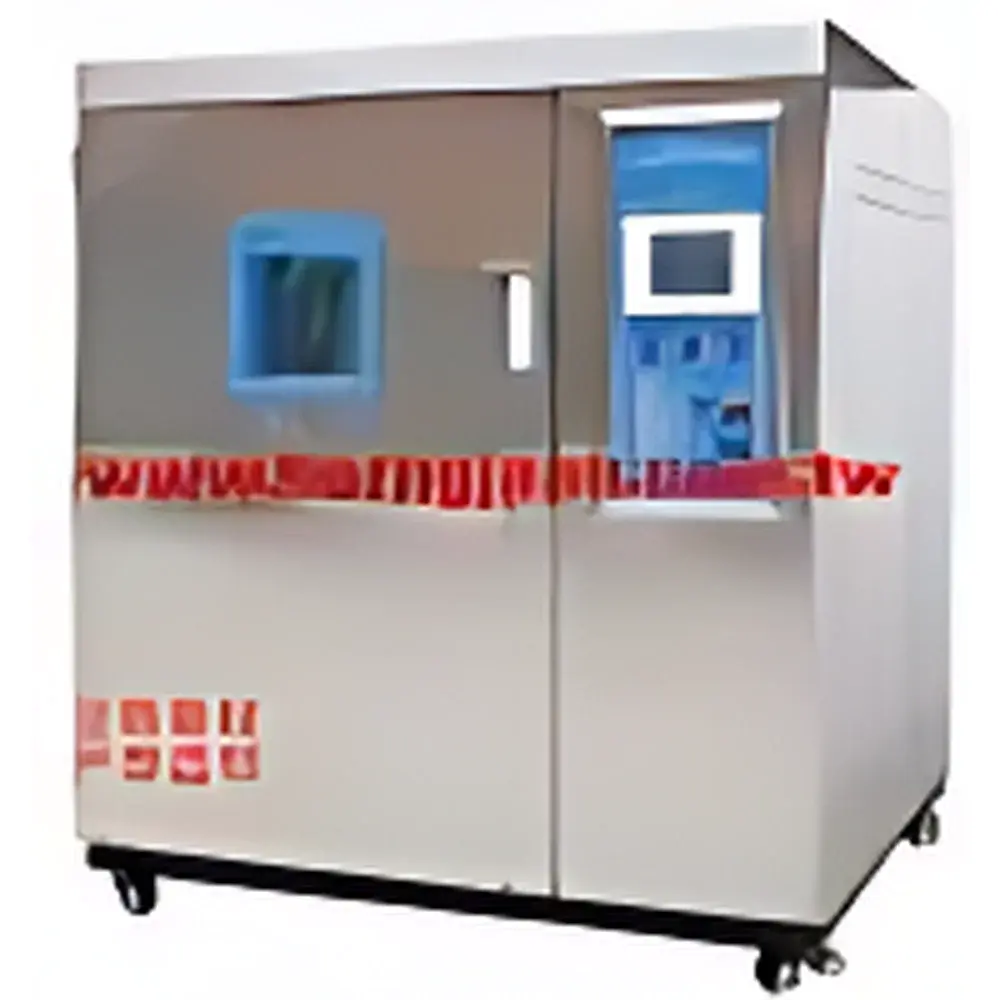
LabCompanion TS Series Thermal Shock Test Chamber
| Brand | LabCompanion |
|---|---|
| Model | TS Series |
| Type | Three-Zone (Hot/Cold/Test) Pneumatically Actuated Thermal Shock Chamber |
| Temperature Range | −65 °C to +200 °C |
| Temperature Transition | RT → −65 °C in ≤70 min |
| Test Zone Temp. Range | −55 °C to +150 °C (TS40/TS55 variants) |
| Temp. Uniformity | ±2 °C |
| Recovery Time | ≤5 min |
| Control System | 7.5″ TFT Color Touchscreen with PID Algorithm, 96 Programmable Profiles |
| Refrigeration | Dual-Stage Mechanical Cascade (R-507/R-23), Air- or Water-Cooled Condenser |
| Construction | SUS304 Interior, Powder-Coated Steel Exterior, Polyurethane + Glass Wool Insulation |
| Compliance | GB/T 2423.1, GB/T 2423.2, GB/T 2423.22, GJB 150.5, GJB 360.7, GJB 367.2-87 Clause 405 |
| Power Supply | AC 380 V ±10%, 50 Hz, 3P+PE |
| Safety | Dual Over-Temp Protection (Chamber & Compressor), Pressure Switches, Leakage Circuit Breaker, Fan Motor Thermal Relay, Emergency Stop |
Overview
The LabCompanion TS Series Thermal Shock Test Chamber is an engineered environmental stress screening (ESS) system designed for rapid, reproducible thermal cycling between extreme high- and low-temperature environments. It operates on the principle of pneumatic air-valve–driven thermal transfer—utilizing physically separated hot and cold reservoirs (and optionally a third ambient test zone) to subject stationary samples to abrupt temperature transitions without mechanical movement. This architecture eliminates thermal inertia associated with single-chamber ramping and ensures precise, repeatable shock profiles required for qualification testing of electronic assemblies, avionics components, military-grade connectors, and hermetically sealed devices. The chamber conforms to internationally recognized thermal shock protocols defined in MIL-STD-810, IEC 60068-2-14, and corresponding Chinese national standards (GB/T and GJB series), making it suitable for GLP-compliant reliability labs, aerospace QA departments, and defense subcontractors performing early-life failure screening (ELF) and HALT precursor validation.
Key Features
- Three-zone configuration (high-temperature reservoir, low-temperature reservoir, and static test chamber) enables true thermal shock without sample relocation.
- Pneumatically actuated damper system ensures rapid, contamination-free air path switching between reservoirs—eliminating cross-contamination and condensation risks inherent in forced-air mixing designs.
- Dual-stage cascade refrigeration using environmentally compliant R-507 (high stage) and R-23 (low stage) achieves stable operation down to −65 °C with minimal maintenance intervals.
- 7.5-inch full-color TFT touchscreen interface supports intuitive programming of multi-segment thermal cycles—including dwell time, transition rate, loop count, auto-defrost scheduling, and pre-conditioning (pre-cool/pre-heat) activation.
- Integrated PT100 Class A platinum resistance sensors with PID-based closed-loop control deliver ±0.1 °C resolution and ±2 °C uniformity across the test volume under load.
- Robust mechanical architecture includes stainless steel (SUS304) interior lining, high-density polyurethane/glass wool composite insulation (>120 mm effective thickness), and reinforced observation window with embedded heating to prevent frosting.
- Standard RS-232/RS-485 serial interface supports integration with LIMS, SCADA, or custom data acquisition systems; optional Ethernet module available for remote monitoring and audit-trail logging per FDA 21 CFR Part 11 requirements.
Sample Compatibility & Compliance
The TS Series accommodates test specimens up to 15 kg and internal volumes ranging from 50 L to 250 L (models TS40 through TS55). Standard cable ports (Φ50 mm), removable stainless steel shelves, and left-side 25 × 100 mm oval feedthroughs allow for powered-in situ evaluation of PCBAs, sensors, and optoelectronic modules. All models are certified to meet GB/T 2423.1 (cold), GB/T 2423.2 (dry heat), GB/T 2423.22 (temperature change), and military specifications GJB 150.5, GJB 360.7, and GJB 367.2-87 Clause 405. Design documentation includes traceable calibration certificates for temperature sensors and verification reports for thermal transition performance—supporting ISO/IEC 17025 accredited laboratory audits.
Software & Data Management
The embedded controller stores up to 96 user-defined test programs, each supporting up to 999 cycles with independent setpoints for high-temperature dwell, low-temperature dwell, transfer time, and recovery interval. Real-time curve recording captures temperature vs. time at up to four discrete sensor locations (standard chamber sensor + three optional probe inputs). Event logs record all alarms—including compressor high-pressure cutout, door interlock breach, and power interruption—with timestamped entries retained for ≥30 days. Optional PC software provides CSV export, statistical process control (SPC) charting, and PDF report generation with digital signature fields compliant with 21 CFR Part 11 Annex 11 expectations for regulated industries.
Applications
- Accelerated life testing (ALT) of solder joints, conformal coatings, and encapsulated IC packages.
- Qualification of automotive ECUs subjected to under-hood thermal cycling per AEC-Q200.
- Validation of MEMS device packaging integrity prior to field deployment in satellite subsystems.
- Screening of ceramic capacitors, tantalum electrolytics, and hybrid power modules for latent delamination defects.
- Supporting JEDEC JESD22-A104 thermal shock qualification for semiconductor packaging.
- Environmental stress screening (ESS) in accordance with IPC-9701 and NASA-HDBK-7107.
FAQ
What distinguishes a three-zone thermal shock chamber from a two-zone design?
A three-zone configuration isolates the test specimen in a thermally neutral chamber while independently maintaining hot and cold reservoirs. This eliminates thermal lag during transitions and prevents residual moisture carryover—critical for testing hygroscopic materials or humidity-sensitive electronics.
Can the TS Series perform standard high-temperature or low-temperature storage tests independently?
Yes. The controller supports standalone constant-temperature operation in either high- or low-reservoir mode, effectively functioning as a dual-purpose environmental chamber compliant with GB/T 2423.1 and GB/T 2423.2.
Is the system compatible with automated test sequencing in production line environments?
Equipped with dry-contact I/O terminals and Modbus RTU protocol support, the TS Series integrates seamlessly into factory automation systems for unattended batch testing with pass/fail gate logic based on real-time thermal deviation thresholds.
How is calibration traceability maintained for regulatory submissions?
Each unit ships with NIST-traceable calibration certificates for primary temperature sensors, and optional annual recalibration services include uncertainty budgets per ISO/IEC 17025 and documented evidence of metrological traceability to national standards.
What safety redundancies are implemented for unattended operation?
Dual independent over-temperature limiters (hardware and firmware), compressor discharge pressure monitoring, loss-of-cooling water detection (for water-cooled variants), and automatic emergency venting ensure fail-safe shutdown under fault conditions—meeting IEC 61000-4-11 and UL 61010-1 requirements.



