
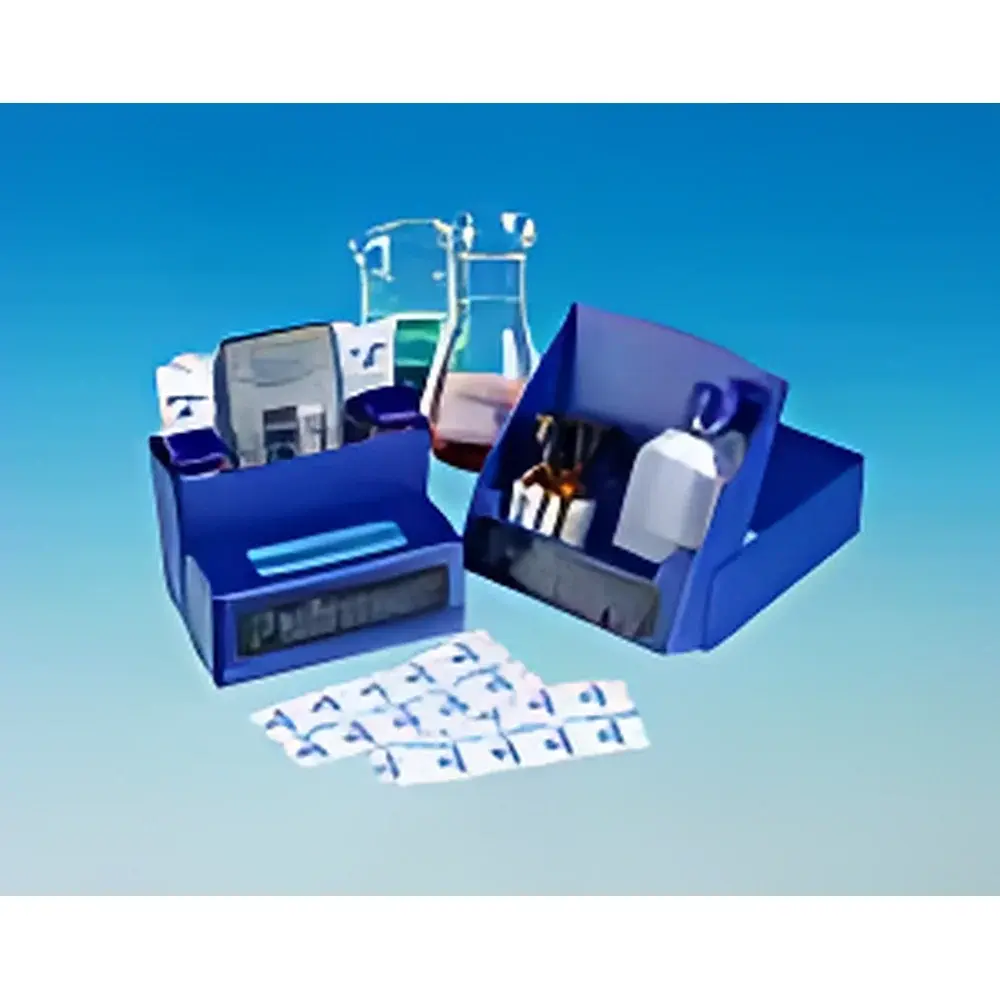
Palintest Pocket Colorimeter Kit
| Brand | Palintest |
|---|---|
| Origin | United Kingdom |
| Model | PK |
| Instrument Type | Portable/Handheld Water Quality Analyzer |
| Detection Parameters | Free Chlorine, Total Chlorine, Total Alkalinity, Calcium Hardness, Acid Demand (Cleaning Acid Strength), Chloride, Total Hardness, Nitrite, Phosphate, pH, Zinc, Ammonia-N, Sulfate, Organic Phosphorus, Quaternary Ammonium Compounds, Aluminum, Nitrate, Copper |
| Accessories Included | PT 210 Kit (1 × 10 mL pipette, 1 × 100 mL sample cup, 1 × grinding rod, rigid portable case |
| Reagents | Not included |
Overview
The Palintest Pocket Colorimeter Kit is a field-deployable, visual colorimetric and turbidimetric water analysis system engineered for rapid, semi-quantitative assessment of critical water quality parameters in non-laboratory environments. Unlike instrumental photometers or electrochemical sensors, this kit operates on standardized visual comparison principles—leveraging calibrated color charts, turbidity standards, and particle-counting reference cards—to deliver consistent, operator-independent results without power, calibration, or software. Its design adheres to fundamental analytical chemistry principles aligned with ISO 8694 (water quality — determination of chlorine compounds), ASTM D1253 (residual chlorine), and EPA Method 330.5 (colorimetric determination of free and total chlorine), ensuring methodological traceability for routine screening applications in drinking water distribution, industrial cooling towers, swimming pool maintenance, and small-scale wastewater pre-checks.
Key Features
- Visual colorimetry and turbidimetry validated against internationally recognized reference standards, eliminating dependence on electronic instrumentation or battery power.
- Modular configuration: PT 210 kit includes a rigid carry case housing up to four distinct reagent sets, plus precision 10 mL pipette, 100 mL graduated sampling cup, and grinding rod for solid-phase reagent dispersion.
- PT 218 variant provides core sampling hardware only—ideal for labs or service teams maintaining multiple reagent portfolios across diverse testing protocols.
- Reagent tablets are manufactured under Palintest’s ISO 9001-certified production process, with lot-specific expiry tracking and stability data compliant with ICH Q5C guidelines for diagnostic reagents.
- Each parameter-specific test follows defined reaction kinetics (e.g., DPD for free chlorine, Nesslerization for ammonia-N, molybdenum blue for phosphate), with documented interference profiles per USP and APHA Standard Methods 2017.
Sample Compatibility & Compliance
The kit supports analysis of potable water, treated effluent, recirculated cooling water, and process rinse solutions within typical turbidity limits (<10 NTU) and temperature ranges (5–35°C). All listed analytes meet detection thresholds appropriate for WHO Guidelines for Drinking-water Quality (4th ed.) screening levels and EU Directive 98/83/EC parametric values. Test procedures comply with GLP documentation requirements when used with Palintest’s optional logbook templates (PN: LOG-PC-01), supporting audit-ready record retention for facility compliance reporting. No CE marking or FDA 510(k) clearance applies, as the system is classified as a general-purpose analytical aid—not an in vitro diagnostic device under IVDR 2017/746.
Software & Data Management
This analog system does not incorporate embedded firmware, wireless connectivity, or digital data output. However, Palintest provides downloadable Excel-based data entry templates (freely accessible via palintest.com/resources) that support structured logging of date, operator ID, sample ID, observed color grade, and pass/fail interpretation against regulatory thresholds. For facilities requiring electronic records, the kit integrates with LIMS platforms via manual CSV import or barcode-scanned reagent lot numbers linked to internal QA databases. Audit trails remain operator-managed per 21 CFR Part 11 Annex A guidance for paper-based systems, with no electronic signature functionality required.
Applications
- On-site verification of disinfectant residuals (free/total chlorine, bromine, ozone) in municipal water mains and hospitality pool systems.
- Routine monitoring of scaling and corrosion indicators—including calcium hardness, total alkalinity, sulfate, and phosphate—in HVAC cooling circuits and boiler feedwater loops.
- Pre-screening of industrial rinse waters for heavy metals (copper, zinc, aluminum, iron) and nutrients (nitrate, nitrite, ammonia-N) prior to discharge permitting.
- Field validation of point-of-use filter performance using pH, chlorine, and turbidity endpoints per NSF/ANSI 42 and 53 protocols.
- Educational use in environmental science curricula for teaching fundamental wet-chemistry principles without instrumentation dependency.
FAQ
Does the Pocket Colorimeter Kit require calibration?
No. It relies on human-perceptible color/turbidity standards traceable to NIST SRM 2806a (liquid color standards) and ISO 7027 turbidity references. Calibration is inherent in the printed chart design and verified during manufacturing.
Are reagents included with the PT 210 or PT 218 kits?
No. Reagents are supplied separately as sealed tablet sets (e.g., CL-FREE for free chlorine, PHOSPHATE-LR for low-range phosphate). Each set carries a unique lot number and expiration date printed on the vial.
Can results be considered legally defensible for regulatory reporting?
Results serve as valid screening data under EPA’s “screening-level assessment” framework and may support Tier 1 compliance decisions. For enforceable reporting, confirmatory analysis by accredited laboratory methods (e.g., SM 4500-Cl G, SM 4500-P E) is required.
What is the shelf life of unopened reagent tablets?
Typically 24 months from manufacture when stored at 2–30°C in original packaging, protected from light and humidity. Stability data is provided in the Certificate of Analysis accompanying each lot.
Is training required to achieve reproducible results?
Yes. Palintest recommends completion of their certified Visual Colorimetry Fundamentals course (online or instructor-led), which covers lighting conditions (D65 daylight simulation), observer color vision screening (Ishihara test), and standardized viewing geometry per ISO 9241-305.
Related Products







