
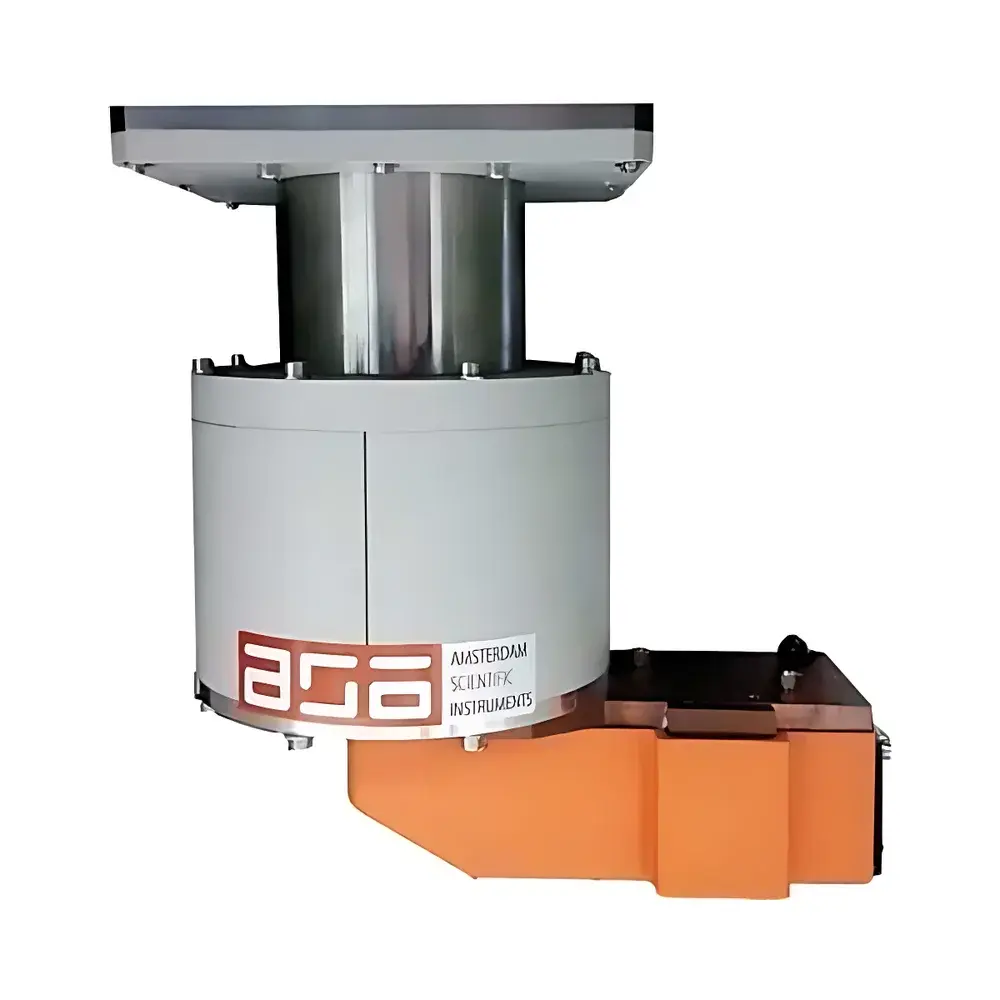
Amsterdam Scientific Instruments Cheetah M3/T3 Ultra Hybrid Pixel TEM Detector
| Brand | Amsterdam Scientific Instruments (ASI) |
|---|---|
| Origin | Netherlands |
| Model | Cheetah M3/T3 Ultra (512 × 1024) |
| Sensor Technology | Medipix3RX / Timepix3 hybrid pixel architecture |
| Pixel Size | 55 µm |
| Radiation Tolerance | >1 GGy (electron beam, Giga-eV equivalent) |
| Readout | SPIDR3 or SPIDR3 Turbo (event-driven or frame-based) |
| Data Interface | Gigabit Ethernet (TCP/UDP) to Linux (Ubuntu) workstation |
| Mounting Options | Bottom-mount static or side-insert retractable |
| Compliance | Designed for GLP/GMP-adjacent TEM environments |
| Software Integration | SerialEM, Instamatic, PantaRhei, LiberTEM via RESTful Serval API |
Overview
The Amsterdam Scientific Instruments Cheetah M3/T3 Ultra is a high-performance hybrid pixel detector engineered specifically for transmission electron microscopy (TEM) platforms requiring gap-free, single-electron-sensitive detection with ultrafast temporal and spectral resolution. Unlike conventional scintillator-coupled CCD or CMOS detectors, the Cheetah M3/T3 Ultra employs direct electron detection using radiation-hardened Medipix3RX and Timepix3 sensor chips—originally developed at CERN and commercially licensed to ASI. Its 512 × 1024 rectangular active area eliminates inter-module gaps, enabling seamless coverage for advanced techniques such as electron energy-loss spectroscopy (EELS), ptychographic imaging, ultrafast electron microscopy (UEM), and photon-induced near-field electron microscopy (PINEM). The detector operates on particle-counting principles: each incident electron generates a charge cloud collected at a 55 µm pixel, converted to a digital event with zero readout noise and programmable energy thresholds. This architecture delivers true quantitative intensity data without integration artifacts, making it suitable for low-dose structural analysis of beam-sensitive materials—including biological macromolecules, MOFs, and soft organic crystals.
Key Features
- Direct electron detection—no scintillator conversion, eliminating light spread, afterglow, and quantum efficiency loss
- Hybrid pixel architecture with 55 µm pitch, fabricated via bump-bonding of Si sensor to Medipix3RX or Timepix3 ASIC
- Giga-eV radiation tolerance: no performance degradation under prolonged high-current electron illumination (e.g., 300 kV STEM mode)
- Zero-noise operation enabled by threshold-based single-electron counting; dynamic range up to 24-bit equivalent via extended exposure accumulation
- Virtual detector synthesis: real-time generation of bright-field (BF), dark-field (DF), annular dark-field (ADF), and high-angle ADF (HAADF) signals from raw event data
- Configurable readout: SPIDR3 module supports frame-based acquisition (up to 2,000 fps at 12-bit); SPIDR3 Turbo increases event throughput by ~3×, critical for time-resolved 4D-STEM
- Timepix3 variant provides per-event timestamping with 1.56 ns time-of-arrival (ToA) resolution and time-over-threshold (ToT)-based energy estimation
- Dual-TDC input for synchronization with external triggers (e.g., laser pulses, beam blankers, scan coils), enabling sub-260 ps timing fidelity
Sample Compatibility & Compliance
The Cheetah M3/T3 Ultra is compatible with all major TEM platforms—including Thermo Fisher Scientific (TFS) Titan, Talos, and Themis systems; JEOL JEM-ARM and GRAND ARM series; and Hitachi HT7800 and HF5000 instruments—via standardized mechanical and electrical interfaces. Its vacuum-compatible design allows installation in both column-mounted and post-column positions. The detector meets operational requirements for GLP- and GMP-aligned laboratories through deterministic data provenance: every acquired frame or event list carries embedded metadata (timestamp, exposure parameters, hardware configuration) traceable via Serval API logging. While not certified to ISO/IEC 17025 per se, its architecture aligns with FDA 21 CFR Part 11 principles for electronic records when deployed with validated acquisition workflows. It is routinely used in academic and industrial labs conducting crystallographic analysis per IUCr guidelines and EELS quantification compliant with ASTM E2917–22.
Software & Data Management
Acquisition and control are managed via ACCOS (Amsterdam Camera Control & Observation Software), a native GUI application supporting real-time preview, histogram analysis, region-of-interest (ROI) masking, and multi-threshold setup. For system-level integration, ASI provides Serval—a production-grade HTTP REST API server running on the acquisition workstation. Serval exposes full detector control (gain, threshold, mode selection), metadata tagging, and asynchronous data streaming endpoints. SDKs include documented Python and C++ client libraries, along with integration modules for SerialEM (cryo-EM automation), Instamatic (TEM data collection scripting), PantaRhei (event-stream processing), and LiberTEM (distributed, GPU-accelerated 4D-STEM reconstruction). All data is stored in HDF5 format with NeXus-compatible attributes, ensuring long-term archival integrity and compatibility with EMDB, PDB, and ICDD databases.
Applications
- 3D Electron Diffraction (3D ED): High-dynamic-range, low-noise diffraction patterns enable robust indexing and structure solution of nanocrystalline and twinned phases where conventional detectors suffer from saturation or readout noise.
- 4D Scanning Transmission Electron Microscopy (4D-STEM): Timepix3-based Cheetah T3 Ultra captures millions of diffraction patterns per second with precise event timing, enabling strain mapping, differential phase contrast (DPC), and virtual detector reconstruction without motion blur.
- Electron Energy-Loss Spectroscopy (EELS): Gap-free geometry ensures full spectral dispersion capture across the zero-loss peak and core-loss edges; Medipix3RX dual-threshold mode allows simultaneous acquisition of multiple energy windows.
- Ptychography: Continuous, high-fidelity diffraction data enables iterative phase retrieval with improved convergence and reduced dose—critical for dose-limited specimens like battery cathode particles or hydrated proteins.
- Ultrafast Electron Microscopy (UEM) & PINEM: Sub-nanosecond ToA resolution permits correlation of electron arrival with optical pump pulses, enabling direct observation of plasmonic decay, phonon dynamics, and non-equilibrium carrier transport.
FAQ
What vacuum conditions are required for installation?
The detector housing is rated for UHV-compatible operation down to 1 × 10⁻⁷ mbar; standard installation requires only a differential pumping stage between the TEM column and detector chamber.
Can the Cheetah M3/T3 Ultra replace my existing CCD or CMOS camera?
Yes—mechanical adapters and signal interface kits are available for Thermo Fisher, JEOL, and Hitachi TEM models; no modification to the microscope column is required.
Is offline calibration supported?
Yes—flat-field, gain, and threshold calibration routines are included in ACCOS; reference datasets can be exported for cross-platform validation.
How is data synchronization handled in pump-probe experiments?
The Timepix3 variant features two independent TDC inputs synchronized to the SPIDR3 Turbo clock; external TTL triggers (e.g., from a femtosecond laser amplifier) are timestamped with ≤260 ps jitter relative to electron events.
Does ASI provide application support for method development?
Yes—ASI offers remote and on-site application engineering support, including workflow optimization for EELS deconvolution, ptychographic reconstruction pipelines, and 4D-STEM data reduction strategies.




