
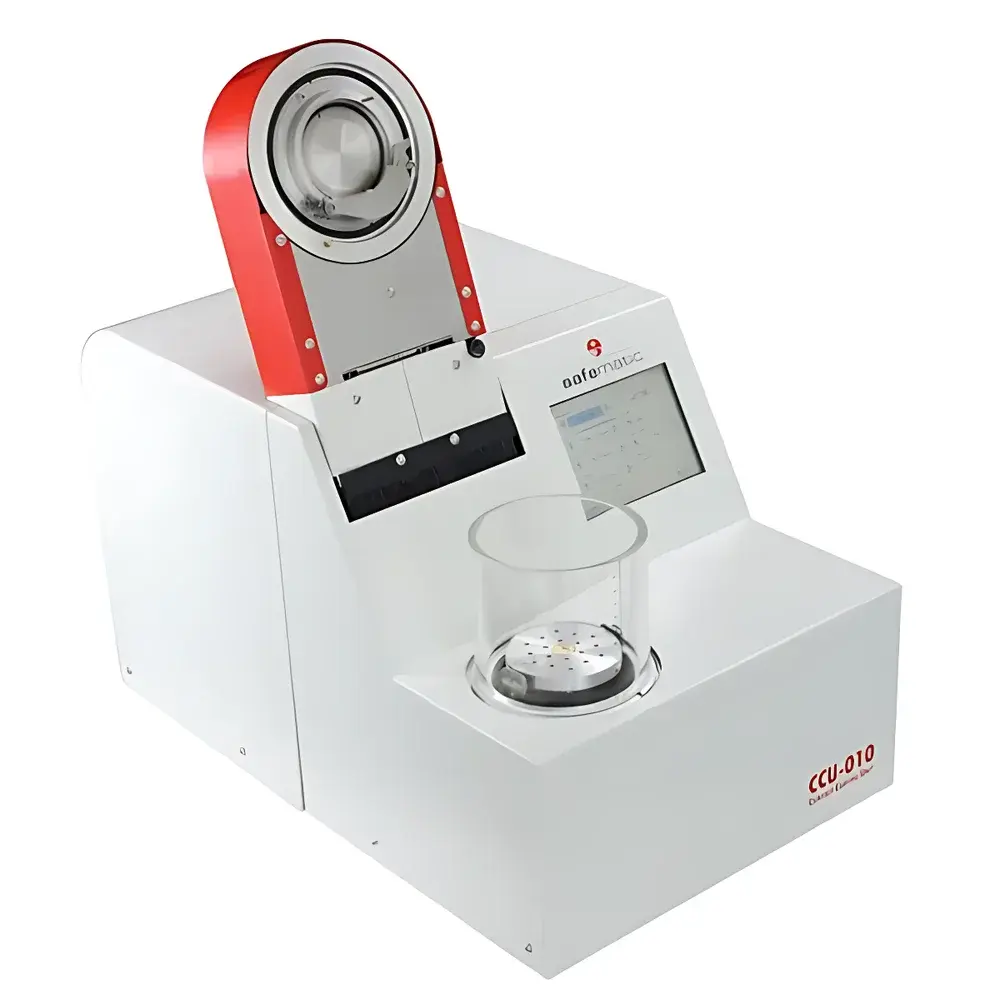
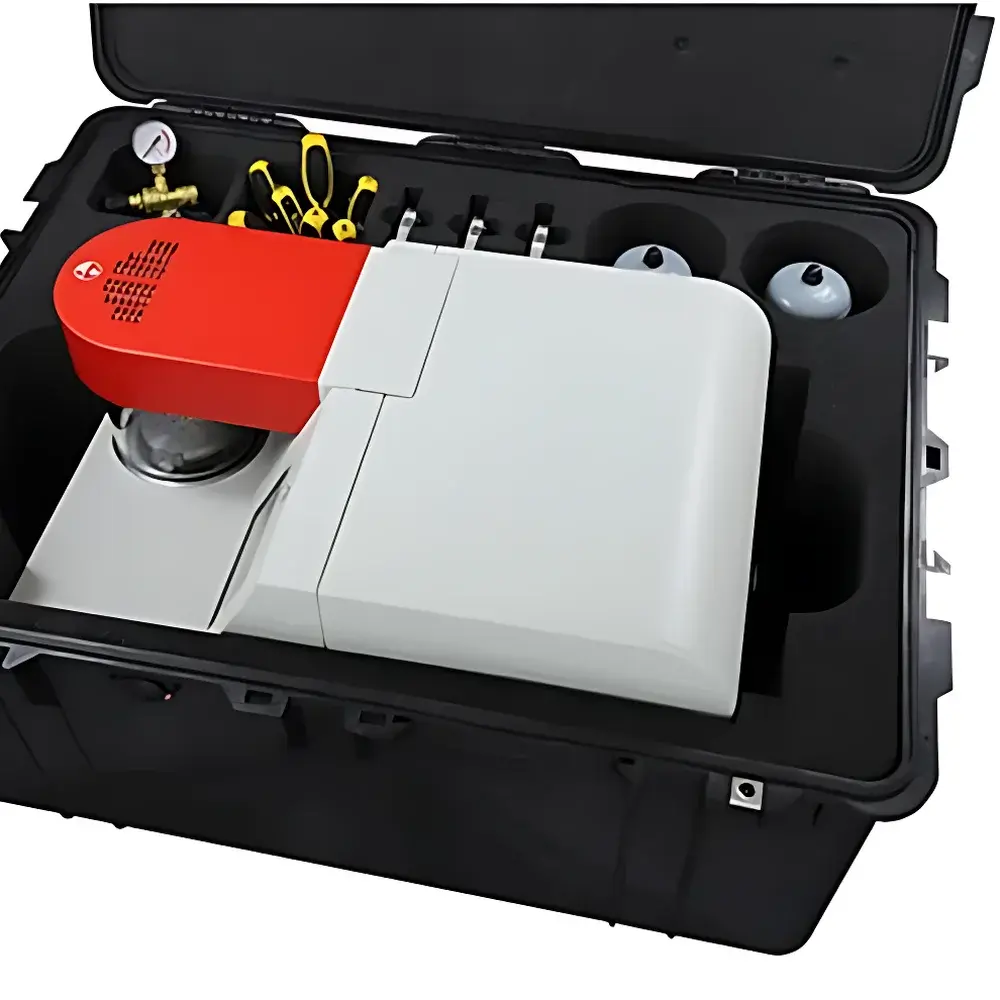
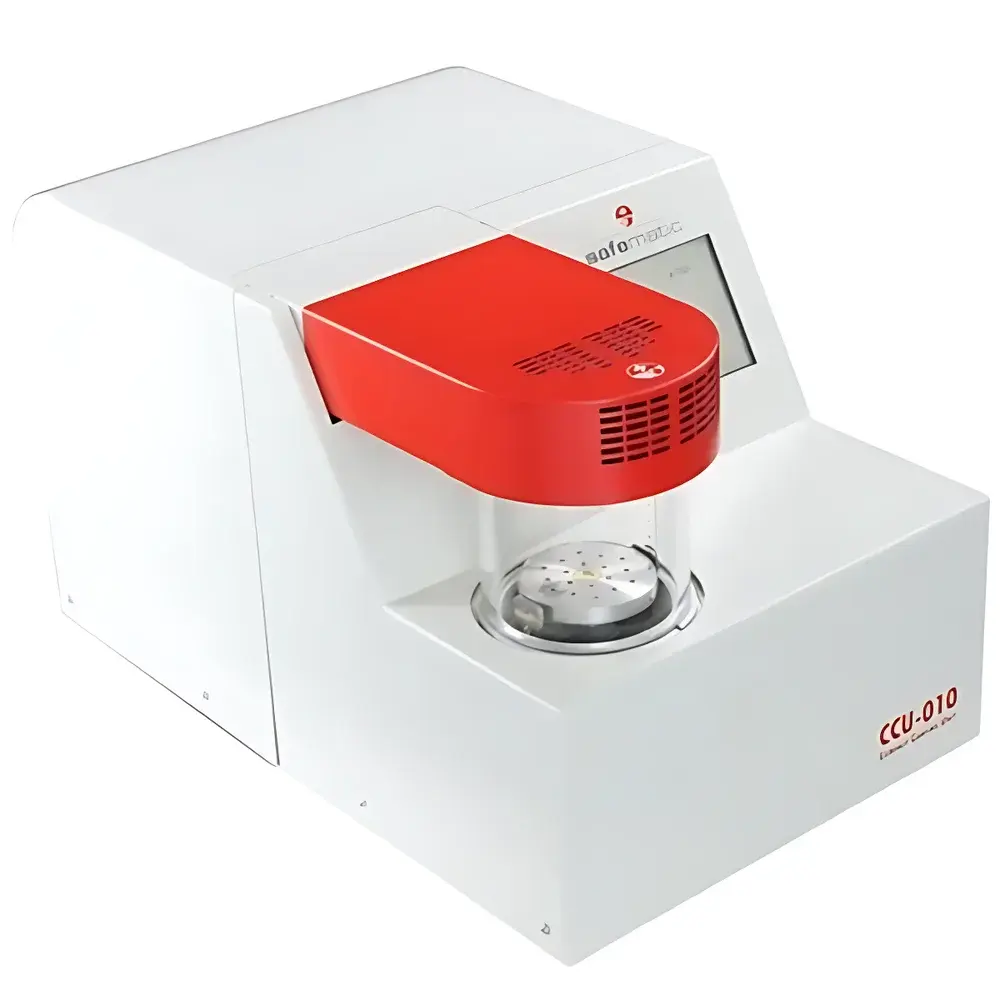
Safematic CCU-010 LV_SP Magnetron Sputter Coater for Electron Microscopy Sample Preparation
| Brand | Safematic |
|---|---|
| Origin | Switzerland |
| Model | CCU-010 LV_SP |
| Vacuum Type | Low-Vacuum Magnetron Sputtering System |
| Coating Modes | Ion Sputtering (Au, Pt, Pd, Cr, Ir, etc.) and Optional Plasma Etching |
| Base Pressure | ≤5 × 10⁻² mbar (with dual-stage rotary vane pump) |
| Pumping Speed | <90 s to operational vacuum (≤1 × 10⁻¹ mbar) |
| Sputtering Target Diameter | 50 mm |
| Film Thickness Monitoring | Dual-position quartz crystal microbalance (QCM) with real-time thickness readout |
| Cooling | Active water-cooled sputter head |
| Plasma Etching Module | ET-010 (Ar, O₂, air configurable) |
| Control Interface | TFT touchscreen + optional RC-010 Windows-based remote software |
| Compliance | CE, RoHS, ISO 9001-manufactured |
| Sample Stage | Ø ≥60 mm, height-adjustable & tilt-capable |
Overview
The Safematic CCU-010 LV_SP is a compact, modular, and fully automated magnetron sputter coater engineered specifically for high-fidelity sample preparation in scanning electron microscopy (SEM), energy-dispersive X-ray spectroscopy (EDS/EDX), and focused ion beam (FIB) workflows. It operates on the principle of direct-current (DC) or radio-frequency (RF) magnetron sputtering—where energetic argon ions bombard a conductive target material (e.g., Au, Pt, Pd, Cr, Ir), ejecting atoms that condense as a uniform, nanoscale conductive film onto non-conductive or beam-sensitive specimens. Unlike thermal evaporation, magnetron sputtering delivers superior grain refinement, enhanced adhesion, and minimal topographical distortion—critical for high-resolution imaging and quantitative elemental analysis. The CCU-010 LV_SP integrates low-vacuum architecture (base pressure ≤5 × 10⁻² mbar) with rapid pump-down kinetics (<90 s to ≤1 × 10⁻¹ mbar), enabling routine lab throughput without requiring turbomolecular pumping—though HV-compatible variants (e.g., CCU-010 HV) are available for ultrafine-grain deposition on nanomaterials or biological ultrastructures.
Key Features
- Modular “plug-and-play” sputter head design: SP-010 (optimized for high-target-utilization noble metal coating) and SP-011 (high-power, broad-material compatibility including refractory metals and oxides) interchange seamlessly within the same CCU-010 LV mainframe.
- Active water-cooled sputter head: Maintains thermal stability during extended runs (>30 min continuous sputtering), ensuring consistent film stoichiometry and preventing target arcing or cracking.
- Dual-position quartz crystal microbalance (QCM): Enables simultaneous thickness monitoring at two independent locations—essential for validating uniformity across irregular or multi-height samples (e.g., fractured cross-sections, porous scaffolds).
- Integrated plasma etching module (ET-010): Supports pre-coating surface cleaning (Ar/O₂ plasma) to remove hydrocarbons and enhance film adhesion, or post-coating surface modification (e.g., controlled oxidation or carbon removal) for analytical optimization.
- TFT touchscreen interface with programmable recipes: All process parameters—including sputter time, current/voltage setpoints, gas flow (optional mass flow controller), stage rotation, and etch duration—are stored, recalled, and audited with timestamped logs.
- Vacuum architecture with two auxiliary CF-35 flanges: Facilitates integration of external instrumentation such as residual gas analyzers (RGA), additional gas inlets, or glovebox transfer interfaces (via RC-010 remote control).
Sample Compatibility & Compliance
The CCU-010 LV_SP accommodates standard SEM stubs (Ø ≤60 mm), TEM grids, silicon wafers, bio-samples on aluminum stubs, and custom substrates mounted on its height-adjustable, ±15° tilt-capable stage. Optional stages include planetary rotation (for isotropic coverage on particulates), motorized rotation (for columnar growth control), and dedicated glass slide holders for histological sections. All wetted materials comply with ISO 10993-5 cytotoxicity standards, and internal chamber surfaces undergo electropolished stainless-steel finishing to minimize outgassing and particle shedding. The system meets CE marking requirements per EU Machinery Directive 2006/42/EC and Electromagnetic Compatibility Directive 2014/30/EU. Firmware supports GLP/GMP-aligned audit trails when used with RC-010 software, including user authentication, electronic signatures, and FDA 21 CFR Part 11–compliant data export (CSV, Excel, PNG).
Software & Data Management
RC-010 is a Windows-based remote control suite that transforms the CCU-010 LV_SP into a networked, protocol-driven instrument. It enables full parameter scripting, real-time QCM thickness plotting with derivative rate analysis, and automated report generation—including metadata (operator ID, date/time, vacuum history, gas composition). Export functions support traceable data archival in .xlsx (with formula-locked cells) and lossless .png plots. Recipes can be version-controlled, shared across multiple instruments, and locked against unauthorized edits. When deployed in regulated environments, RC-010 enforces role-based access control (RBAC), session timeouts, and immutable log files—fully aligned with ISO/IEC 17025 and ASTM E2500-21 documentation expectations for analytical instrument qualification.
Applications
- High-resolution SEM imaging of insulating ceramics, polymers, and geological specimens requiring sub-2 nm Au/Pt coatings with minimal edge buildup.
- EDS quantification workflows where carbon-free sputtered layers (e.g., Cr, Ir) eliminate spectral interference from evaporated carbon films.
- Pre-FIB lamella preparation: Ar plasma etching removes surface contamination prior to Pt deposition, reducing curtaining artifacts during milling.
- Nanoparticle dispersion analysis: Planetary stage + SP-011 enables uniform 3–5 nm Ir coatings on aggregated colloids without agglomeration.
- Correlative light-electron microscopy (CLEM): Plasma-cleaned coverslips retain fluorescent signal integrity while receiving conductive sputter layers for subsequent SEM navigation.
FAQ
What vacuum level is required for optimal sputtering performance on the CCU-010 LV_SP?
The system achieves stable DC sputtering at ≤1 × 10⁻¹ mbar using its integrated dual-stage rotary vane pump. For finer grain structure or reactive sputtering (e.g., TiO₂), optional turbomolecular pumping (CCU-010 HV configuration) extends base vacuum to ≤1 × 10⁻⁵ mbar.
Can the CCU-010 LV_SP deposit non-metallic films such as ITO or SiO₂?
Yes—when equipped with RF power supply (optional upgrade) and appropriate ceramic or oxide targets, the SP-011 sputter head supports reactive sputtering in Ar/O₂ mixtures, enabling transparent conductive oxide or dielectric film deposition.
How does the dual-position QCM prevent measurement drift during long sputtering runs?
Each QCM sensor operates independently with temperature-compensated oscillators; real-time cross-validation between positions detects thermal gradient effects or localized deposition anomalies, triggering automatic recalibration or process halt if deviation exceeds ±2%.
Is glovebox integration supported out-of-the-box?
Yes—the CCU-010 LV_Glovebox variant includes inert-gas purge ports, explosion-proof electronics, and RC-010 remote operation via fiber-optic link, certified for use inside argon- or nitrogen-purged enclosures (ISO 14644 Class 5 compatible).
Does the system support automated calibration of sputter yield across different target materials?
The RC-010 software includes a built-in sputter yield database (NIST-traceable values for 28 target/gas combinations) and allows user-defined yield curves derived from TEM-thickness cross-checks, ensuring accurate thickness prediction across material systems.






