
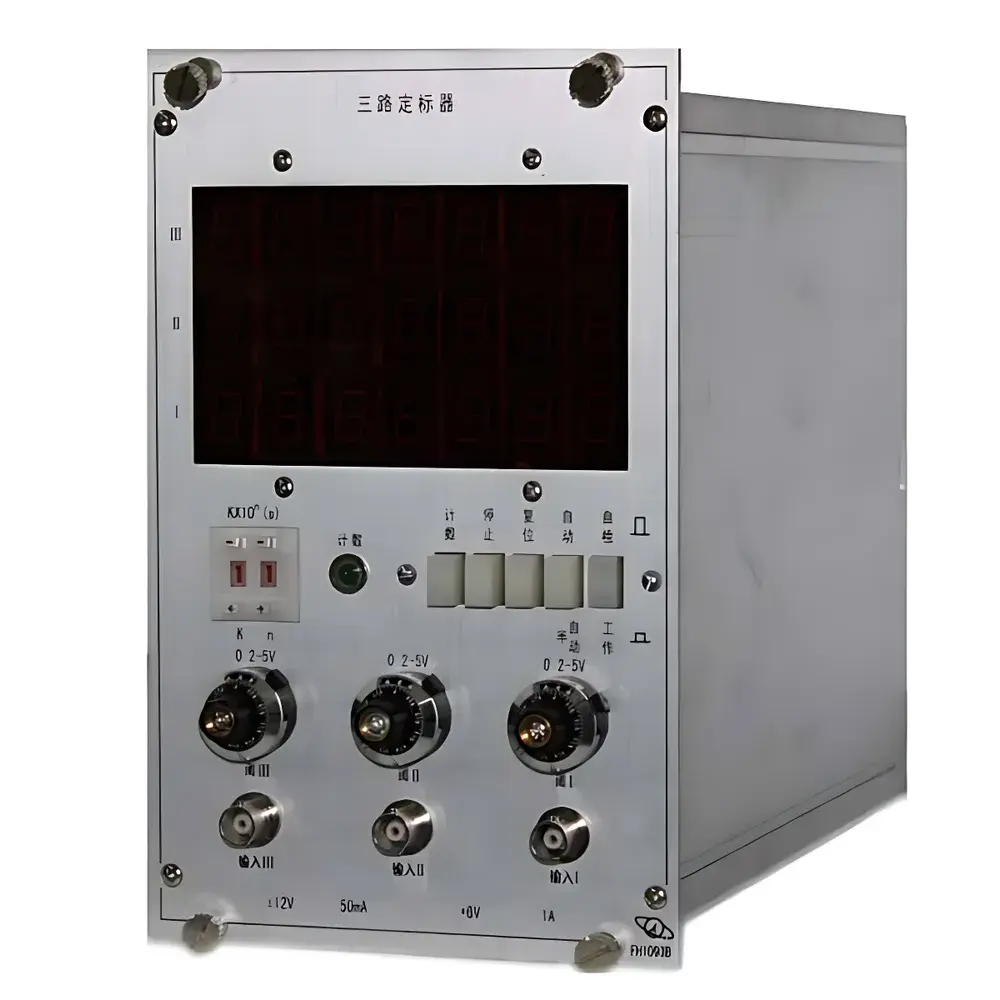
CNCs FH1093B Triple-Channel Automatic Pulse Scalar
| Brand | CNCs (China Nuclear Control Systems) |
|---|---|
| Model | FH1093B |
| Form Factor | 4U NIM Module |
| Input Polarity | Positive |
| Pulse Width Minimum | ≥0.1 µs |
| Dead Time (Dual-Pulse Resolution) | ≤300 ns |
| Discrimination Threshold Range | 0.2–5 V (continuously adjustable, three identical channels) |
| Threshold Temperature Coefficient | 1 mV/°C (0–50 °C) |
| Overload Capacity | 5× nominal threshold |
| Maximum Count Rate | ≥2 × 10⁶ s⁻¹ |
| Count Capacity | 10⁷–1 (seven-digit down-counter) |
| Timing Range | K × 10ⁿ (K = 1–9 |
| Operating Temperature | 0–50 °C |
| Relative Humidity | ≤90% at +40 °C |
| Power Supply | Standard NIM bin (+6 V, −6 V, +12 V, −12 V) |
Overview
The CNCs FH1093B Triple-Channel Automatic Pulse Scalar is a precision nuclear instrumentation module engineered for high-reliability pulse counting and timing applications in radiation detection systems. Designed as a direct upgrade to the FH1093A, this 4-unit-width NIM (Nuclear Instrumentation Module) standard-compliant device implements analog-digital hybrid signal processing to deliver synchronized, independent counting across three identical input channels. Its core measurement principle relies on fast pulse discrimination followed by gated digital accumulation—optimized for alpha, beta, and gamma radiation spectroscopy, activity calibration, and low-background counting protocols. Unlike general-purpose digital counters, the FH1093B integrates channel-matched discrimination circuitry with temperature-stabilized threshold control, enabling reproducible pulse-height selection under variable ambient conditions. It is routinely deployed in national metrology institutes, nuclear research laboratories, environmental monitoring stations, and radioisotope production QA/QC facilities where traceable, multi-channel coincidence or anti-coincidence counting is required.
Key Features
- Three fully independent, electrically isolated input channels with identical performance specifications—ensuring inter-channel consistency for comparative measurements and coincidence logic.
- Continuously adjustable discrimination threshold (0.2–5 V per channel), calibrated and temperature-compensated to ±1 mV/°C over 0–50 °C operating range.
- High-speed pulse processing architecture with ≤300 ns dual-pulse dead time—minimizing count loss in high-flux environments.
- Robust overload tolerance: each channel sustains up to five times its set threshold voltage without damage or baseline shift.
- Flexible timing control via decade-selectable gate intervals (K × 10n, where K = 1–9 and n = 0–4), supporting both short-interval statistics and long-term decay studies.
- Seven-digit down-counter (10⁷–1) with automatic overflow indication and hardware reset capability.
- Standard NIM power interface (+6 V, −6 V, +12 V, −12 V) ensuring seamless integration into existing nuclear instrumentation racks.
Sample Compatibility & Compliance
The FH1093B interfaces directly with standard NIM-compatible radiation detectors—including gas-filled proportional counters, scintillation photomultiplier assemblies (e.g., NaI(Tl), plastic scintillators), and silicon surface-barrier alpha spectrometers. Its positive-polarity input requirement aligns with common preamplifier output conventions in nuclear electronics. The module complies with IEC 60565 (Nuclear instrumentation — Pulse height analyzers and scalers) and supports traceable calibration workflows per ISO/IEC 17025 requirements when used within accredited laboratory environments. While not certified for safety-critical reactor protection systems, it meets electromagnetic compatibility (EMC) expectations outlined in IEC 61000-6-2/6-3 for industrial environments and operates reliably under GLP-aligned QA documentation practices.
Software & Data Management
As a hardware-only NIM scalar, the FH1093B does not include embedded firmware or USB/Ethernet connectivity. Data acquisition is performed externally via TTL-level gate and readout strobe signals, compatible with industry-standard CAMAC, VME, or modern PCIe-based digitizer systems (e.g., CAEN DT57xx series). When integrated into automated test benches, it supports timestamp-synchronized logging via external clock distribution and programmable gate triggers. Audit trails and raw count records are maintained at the host system level, enabling compliance with FDA 21 CFR Part 11 when paired with validated acquisition software (e.g., WinDAQ, ROOT-based frameworks, or LabVIEW VI suites with electronic signature modules). All front-panel displays and controls are manually operated—eliminating firmware-related validation overhead in regulated settings.
Applications
- Radiometric calibration of alpha/beta/gamma sources against national standards (e.g., NIST SRMs) using multi-channel coincidence counting.
- Background subtraction in low-level environmental radioactivity assays (e.g., air particulate filters, water concentrates).
- Half-life determination experiments requiring precise, long-duration gated counting with thermal drift compensation.
- Quality assurance testing of radiation detector linearity, plateau response, and energy resolution stability.
- Education and training platforms for nuclear physics laboratories—demonstrating pulse discrimination, dead-time correction, and statistical uncertainty propagation.
FAQ
Is the FH1093B compatible with modern PC-based data acquisition systems?
Yes—via standard TTL gate/readout strobes and NIM-compatible timing signals; requires external digitizer or CAMAC/VME crate controller.
Does it support remote configuration or Ethernet communication?
No—this is a fixed-function analog-digital hybrid module with no microprocessor, firmware, or network interface.
What is the recommended calibration interval for traceable measurements?
Annual calibration against a reference pulser (e.g., Berkeley Nucleonics Model 577) is advised, with verification before critical experiments per ISO/IEC 17025 Clause 6.6.
Can it be used for neutron detection?
Only indirectly—when paired with appropriate neutron-sensitive converters (e.g., 3He or BF3 proportional tubes) and properly adjusted thresholds; not optimized for fast neutron pulse shape discrimination.
Is there documentation available in English for regulatory submissions?
Technical specifications, NIM mechanical drawings, and electrical interface schematics are provided in English upon request for GMP/GLP audit support.





