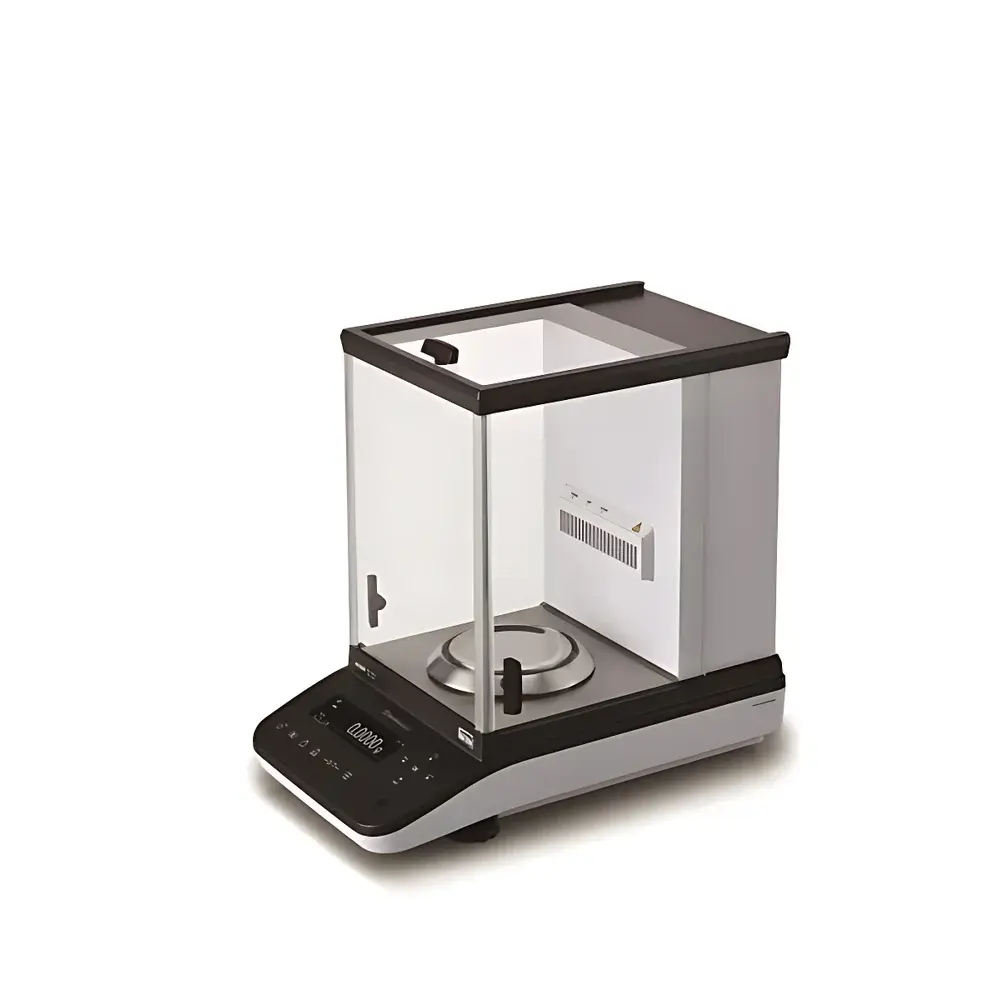
Shimadzu AP225W Ultra-Micro Balance
| Key | Brand: Shimadzu |
|---|---|
| Origin | Japan |
| Model | AP225W |
| Maximum Capacity | 220 g |
| Readability | 0.01 mg |
| Repeatability | ≤0.05 mg |
| Sensor Technology | UniBloc AP |
| Stabilization Time | 1.5 s (for 1 mg load) |
| Interface | USB + RS-232C |
| Compliance | ISO/IEC 17025, USP <41>, FDA 21 CFR Part 11 (with Labsolutions Balance), GLP/GMP-ready printing |
Overview
The Shimadzu AP225W Ultra-Micro Balance is an advanced analytical weighing instrument engineered for laboratories requiring high-resolution mass measurement with exceptional speed, stability, and regulatory traceability. Built upon Shimadzu’s proprietary UniBloc AP monolithic electromagnetic force compensation sensor, the AP225W delivers rapid stabilization—achieving 1.5-second response time for 1 mg loads—while maintaining a readability of 0.01 mg across its full 220 g capacity range. Unlike conventional strain-gauge or hybrid sensor platforms, the UniBloc AP architecture eliminates mechanical hysteresis and thermal drift through integrated thermal compensation and rigid monolithic construction, ensuring long-term repeatability ≤0.05 mg under controlled environmental conditions (20–25 °C, <50% RH, vibration-isolated bench). Designed specifically for regulated environments—including pharmaceutical QC, reference standard preparation, and method validation—the AP225W meets foundational metrological requirements outlined in USP , EP 2.1.6, and ISO 17025:2017 for balance verification and performance testing.
Key Features
- UniBloc AP Sensor Platform: A single-piece, thermally stabilized electromagnetic transducer delivering superior linearity, minimal creep, and immunity to mechanical wear—enabling consistent 0.01 mg resolution without periodic recalibration due to sensor aging.
- Integrated Smart Stand & STABLO AP Electrostatic Control: The factory-installed Smart Stand works synergistically with the optional STABLO AP active ionizer to neutralize electrostatic charge on glassware, plastic vials, and powder surfaces within the draft shield chamber—reducing weighing variability caused by static attraction and improving measurement reliability by up to 40% in low-humidity environments.
- Regulatory-Ready Data Handling: Dual-interface connectivity (USB + RS-232C) supports simultaneous output to printers and PCs. All printouts include timestamp, operator ID, balance ID, calibration status, ambient temperature/humidity (when connected to optional sensors), and audit trail metadata—fully compliant with GLP, GMP, and FDA 21 CFR Part 11 when used with validated Labsolutions Balance software.
- Application-Specific Workflow Modes: Preloaded buffer preparation mode contains 13 standardized pharmaceutical buffer recipes (e.g., phosphate, citrate, acetate); custom buffers can be added and saved with concentration, pH, and component mass calculations performed in real time. Sample Preparation Mode guides users through multi-step gravimetric dilution protocols with stepwise prompts and error-checking logic.
- User-Verifiable Performance Checks: Onboard diagnostic routines enable routine verification of repeatability, eccentricity (four-corner test), linearity, and sensitivity deviation—generating printable reports traceable to internal standards without external weights or service intervention.
Sample Compatibility & Compliance
The AP225W accommodates a broad range of sample forms—including powders, crystals, lyophilized solids, reference standards, and small-volume liquid aliquots—in standard 80 mm diameter weighing pans or optional micro-pans. Its draft shield design minimizes air current interference while allowing unobstructed access for spatula handling and pipette operation. All firmware and embedded functions comply with ISO 9001:2015 quality management system requirements for instrument control. Full documentation packages—including Factory Acceptance Test (FAT) reports, metrological traceability certificates (NMI-Japan accredited), and IQ/OQ templates—are available upon request to support laboratory qualification under GxP frameworks.
Software & Data Management
Labsolutions Balance software (v3.5+) provides centralized, role-based data management for multiple AP-series balances. It enforces electronic signatures, automatic backup to network drives or NAS devices, and configurable audit trails that record every weight event—including manual edits, unit conversions, and report generation—with immutable timestamps and user attribution. Data export conforms to ASTM E1382-22 (Standard Guide for Computerized Systems Used in Analytical Laboratories) and supports CSV, PDF/A-1b, and XML formats for LIMS integration. Optional 21 CFR Part 11 compliance modules provide electronic signature validation, biometric authentication support, and secure password policies aligned with Annex 11 and ICH GCP guidelines.
Applications
- Pharmaceutical assay standard preparation and potency determination per USP
- Gravimetric calibration of volumetric glassware (Class A) and pipettes
- Weighing of high-potency APIs where sub-0.1 mg accuracy is critical
- Stability-indicating method development involving microgram-level impurity spiking
- Reference material certification and inter-laboratory comparison studies
- Environmental analysis of trace metals via gravimetric precipitation techniques
FAQ
What is the recommended environmental class for optimal AP225W performance?
The balance requires Class I (ISO 14644-1) or equivalent vibration-controlled environment with temperature stability ±1 °C and relative humidity 40–60% for full specification compliance.
Does the AP225W support external environmental monitoring inputs?
Yes—optional temperature and humidity probes connect via RS-232C to log ambient conditions alongside each weight record in Labsolutions Balance.
Can the buffer preparation mode be customized for non-pharmaceutical applications?
Yes—users may define new buffer systems with up to five components, specifying molecular weights, purity corrections, and target molarity/pH constraints.
Is internal calibration traceable to national standards?
Internal calibration uses factory-characterized magnetic field references traceable to NMI-Japan; external verification with certified weights (class E2 or better) is required for ISO/IEC 17025 accreditation.
How does the Smart Stand reduce electrostatic interference beyond conventional ionizers?
Unlike passive or pulsed ionizers, the Smart Stand integrates airflow modulation and proximity-sensing electrodes to dynamically adjust ion output intensity based on real-time charge detection inside the draft shield—ensuring uniform neutralization across complex geometries including glass vial walls and powder surfaces.