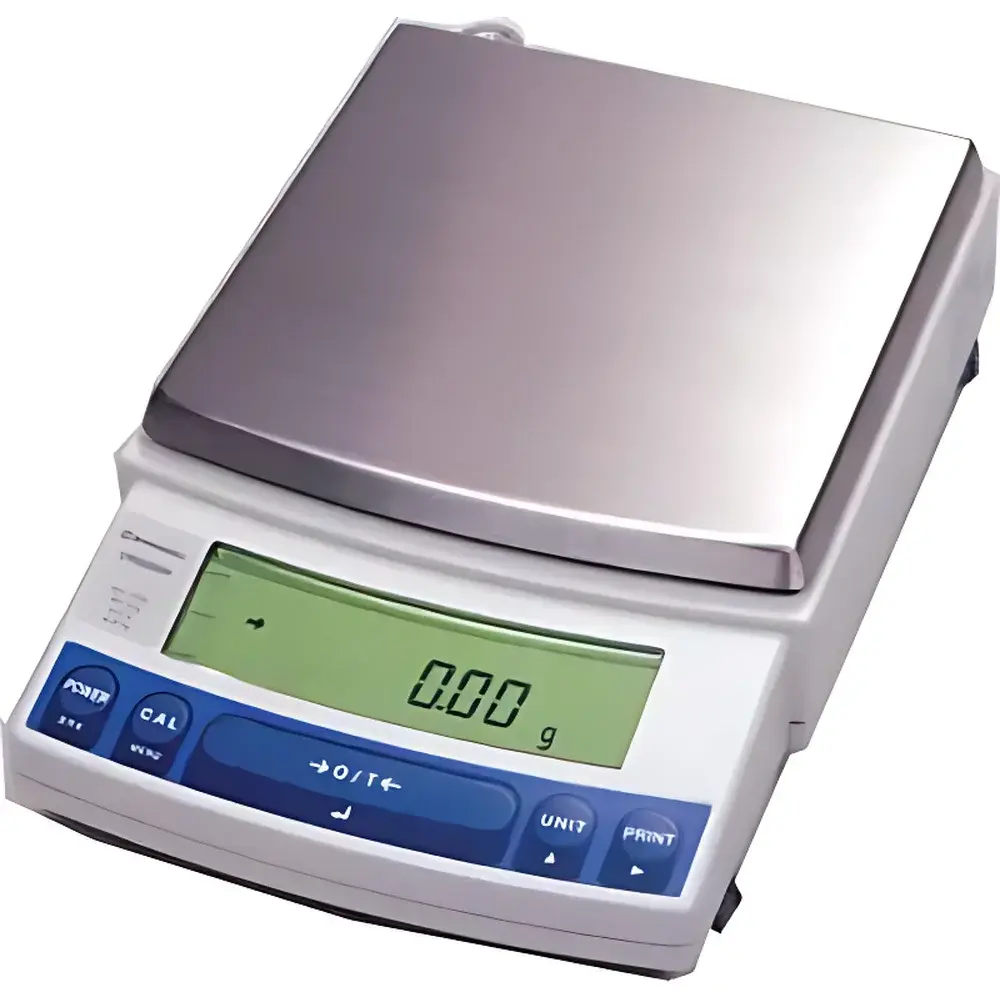
Shimadzu BL-3200S / EL-6000S / ELB-6000S Portable Electronic Balance
| Origin | Japan |
|---|---|
| Manufacturer Type | Authorized Distributor |
| Origin Category | Imported |
| Pricing | Upon Request |
| Capacity | 3200 g |
| Minimum Display | 10 mg |
| Standard Deviation | 0.01 g |
| Linearity Error | ±0.02 g |
| Operating Temperature | 5–40 °C |
| Interface | RS-232C (with IFB-102A interface board), compatible with EP-50/EP-80 printers |
| Sensitivity Drift vs. Temp (10–30 °C) | ±3 ppm/°C (PSC OFF) |
| Units | g, kg, %, pcs, ct, mom, oz, ozt, liang (HK/SG/TW/MY), dwt, gn |
| Pan Dimensions | 160 × 124 mm |
| Device Dimensions | 170 × 240 × 75 mm (W×D×H) |
| Weight | 2.2 kg |
| Power Supply | AC 220 V / DC 12 V, 1 A |
| Standard Accessories | Dust Cover |
Overview
The Shimadzu BL-3200S, EL-6000S, and ELB-6000S portable electronic balances are precision mass measurement instruments engineered for laboratory, quality control, and field applications where portability, repeatability, and regulatory traceability are essential. These models employ electromagnetic force compensation (EMFC) sensor technology—the same principle used in high-end analytical and semi-micro balances—ensuring stable, drift-resistant performance without mechanical levers or load-cell strain gauges. Unlike resistive or capacitive transducers, EMFC sensors generate a restoring current proportional to the applied mass, delivering inherent linearity, high resolution (10 mg at 3200 g capacity), and minimal hysteresis. Designed for ISO/IEC 17025-compliant environments, each unit supports calibration verification via internal or external standards and features built-in diagnostics for sensor stability, temperature compensation, and zero tracking. The compact form factor (170 × 240 × 75 mm) and low mass (2.2 kg) enable deployment in mobile labs, production floors, and remote sampling stations without sacrificing metrological integrity.
Key Features
- Electromagnetic force compensation (EMFC) transduction system—identical architecture to Shimadzu’s benchtop precision balances—ensuring long-term stability and reduced sensitivity to environmental vibration or thermal gradients.
- Fast stabilization time (~1 second for S-type models), optimized for high-throughput workflows including piece-counting and formulation checks.
- Multi-unit display capability: g, kg, %, pcs (piece counting), ct (carat), oz, ozt, dwt (pennyweight), gn (grain), and region-specific units (liang for Hong Kong, Singapore, Taiwan, and Malaysia).
- Dual power operation: AC 220 V mains or DC 12 V input—enabling uninterrupted use during power fluctuations or battery-backed field operations (when paired with compatible external DC supply).
- Visual weight guidance via analog-style bar graph display—providing immediate intuitive feedback on proximity to target mass, especially useful during dynamic weighing or tare adjustments.
- RS-232C serial interface compliant with EIA/TIA-232 standards; supports direct connection to EP-50/EP-80 printers or IFB-102A interface boards for data logging and GLP/GMP audit trail generation.
- Rectangular weighing pan (160 × 124 mm) with raised edges—optimized for containment of powders, granules, and small components while maintaining accessibility for spatula handling.
Sample Compatibility & Compliance
These balances accommodate a broad range of sample types—including solids, powders, pre-weighed vials, and packaged components—without requiring specialized fixtures. The 3200 g capacity and 10 mg readability support applications from raw material receipt inspection (ASTM D6978, ISO 11352) to pharmaceutical intermediate batch release (USP ). All models comply with international metrological requirements per OIML R 76-1 (2021) Class II accuracy class and meet electromagnetic compatibility (EMC) standards IEC 61326-1:2013. Built-in temperature compensation (±3 ppm/°C between 10–30 °C, PSC disabled) ensures consistent performance across typical lab and warehouse ambient conditions (5–40 °C). Optional calibration certificates traceable to NMIJ (National Metrology Institute of Japan) or NIST are available upon request for ISO 17025-accredited laboratories.
Software & Data Management
While the balance operates autonomously via front-panel controls, full integration into digital quality systems is supported through optional data acquisition software (e.g., Shimadzu LabSolutions Balance Edition or third-party platforms compliant with FDA 21 CFR Part 11). When connected via RS-232C and IFB-102A, the device transmits timestamped weight values, unit identifiers, tare status, and error flags—including overload, instability, or calibration alert codes. Audit trail functionality—including operator ID, event timestamp, and parameter change history—is enabled only when used with validated software and appropriate user access controls. Raw ASCII output format ensures compatibility with LIMS, ERP, and MES systems without proprietary drivers.
Applications
- Pharmaceutical QC: Active pharmaceutical ingredient (API) dispensing, tablet weight uniformity testing (USP ), and excipient lot acceptance.
- Chemical manufacturing: Batch formulation verification, catalyst dosing, and reagent reconciliation.
- Food & beverage: Portion control validation, ingredient scaling, and net content compliance (EU Directive 2009/136/EC).
- Academic research: Field-based soil/sediment sampling, botanical specimen mass recording, and educational quantitative analysis labs.
- Electronics assembly: PCB component counting, solder paste mass verification, and ESD-safe packaging audits.
FAQ
Is internal calibration available on these models?
No—these portable balances require external calibration using certified weights. Internal calibration is not implemented to maintain compact design and cost efficiency while preserving EMFC sensor fidelity.
Can the balance be used in environments with air currents or vibration?
Yes, but optimal performance requires placement on a stable, non-resonant surface away from HVAC vents, centrifuges, or foot traffic. The EMFC sensor’s active damping reduces susceptibility compared to strain-gauge platforms.
What is the recommended recalibration frequency?
Per ISO/IEC 17025, recalibration interval must be risk-assessed based on usage intensity, environmental stability, and criticality of measurement. Typical intervals range from daily checks with reference weights to formal recalibration every 3–6 months.
Does the RS-232C interface support bi-directional communication?
The interface is unidirectional (balance-to-host only) for weight data streaming. Command reception (e.g., tare, print trigger) is limited to hardware-level signals via dedicated pins on the IFB-102A board.
Is the dust cover included with all models?
Yes—a rigid polycarbonate dust cover is supplied as standard equipment to protect the weighing pan and sensor mechanism during transport or non-operational periods.