
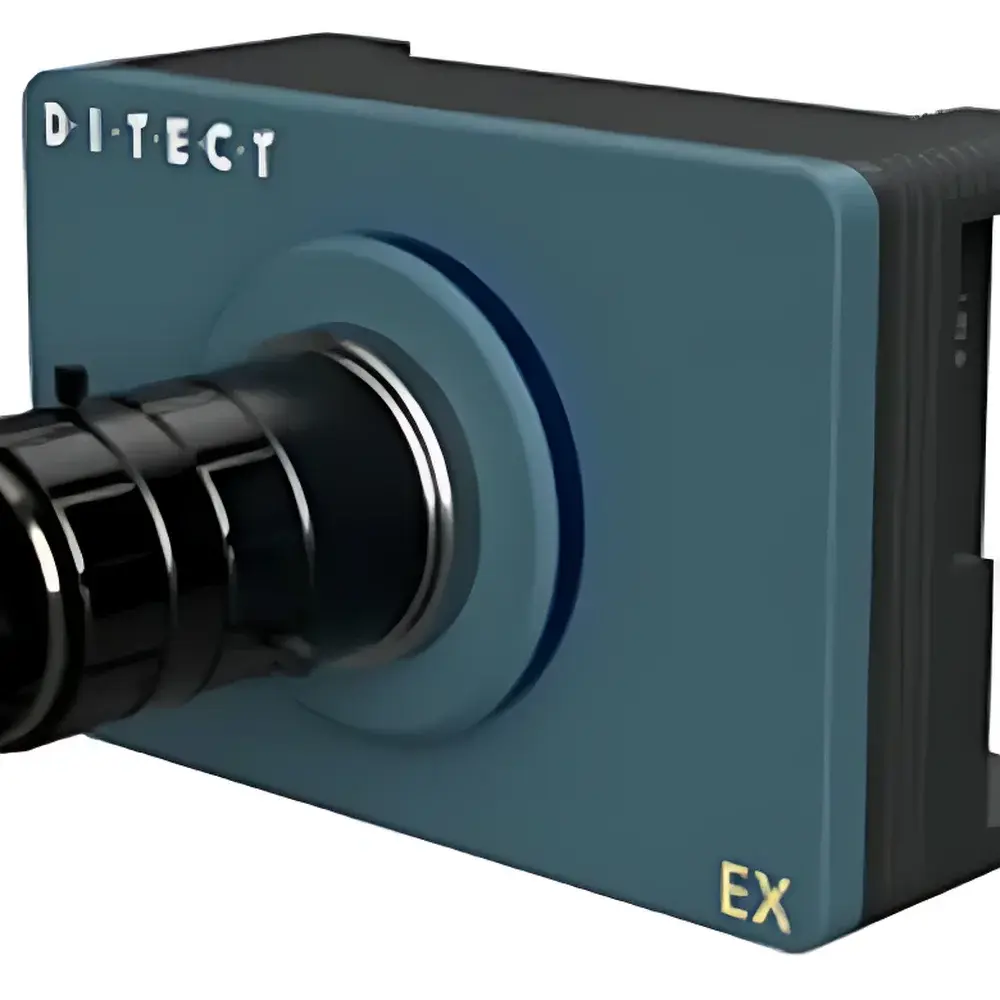
DITECT HAS-EX High-Speed CMOS Camera
| Brand | DITECT |
|---|---|
| Origin | Japan |
| Model | HAS-EX |
| Image Resolution | 1280 × 1024 pixels |
| Frame Rate | 1000 fps (up to 40,000 fps at reduced resolution) |
| Sensor Type | Monochrome (HAS-EXM) / Color (HAS-EXC) |
| A/D Conversion | 12-bit (output: 8-bit) |
| Sensor Size | 2/3" |
| Lens Mount | C-mount |
| Interface | USB 3.0 |
| Sensitivity | 9.6 V/lux·s |
| Onboard Memory | 6 GB (standard), 12 GB (optional) |
| Power Supply | DC 12 V, 1 A |
| Power Consumption | 12 W |
| Weight | 1.2 kg |
| Synchronization | Master/Slave mode |
| Pixel Shift Function | Enabled for enhanced low-light sensitivity |
Overview
The DITECT HAS-EX High-Speed CMOS Camera is an industrial-grade imaging solution engineered for precise temporal capture of rapid transient phenomena in research, quality control, and process monitoring applications. Built upon a global-shutter CMOS sensor architecture, the HAS-EX delivers high-fidelity motion analysis through synchronized exposure control and minimal motion blur—even at extreme frame rates. Its core measurement principle relies on photon integration during precisely timed exposure windows, with pixel-level charge transfer optimized to suppress rolling-shutter artifacts. The integrated pixel shift function enhances effective quantum efficiency by redistributing photogenerated charge across adjacent pixel wells—effectively increasing signal-to-noise ratio under low-illumination conditions without compromising spatial resolution. Designed for integration into automated test benches and inline inspection systems, the HAS-EX supports deterministic triggering, hardware-timed acquisition, and deterministic latency response—critical for time-critical events such as combustion dynamics, microfluidic droplet formation, or mechanical impact analysis.
Key Features
- Real-time 1000 fps capture at full resolution (1280 × 1024 pixels), scalable to 40,000 fps at reduced ROI configurations
- Global shutter CMOS sensor with 12-bit analog-to-digital conversion (8-bit output) ensuring linearity and dynamic range consistency
- Pixel shift technology for improved low-light sensitivity—enabling reliable imaging in ambient-limited environments without external illumination augmentation
- Onboard buffer memory of 6 GB standard (expandable to 12 GB), supporting sustained high-throughput recording without host system bottlenecks
- C-mount lens interface compatible with industry-standard optics; supports telecentric, macro, and UV-enhanced lenses
- USB 3.0 Vision-compliant interface for plug-and-play integration with Windows/Linux hosts; driver support includes GenICam-compliant SDKs
- DC 12 V power input with regulated internal distribution—designed for stable operation in vibration-prone industrial enclosures
- Master/slave synchronization capability via TTL trigger I/O, enabling multi-camera coordination in stereoscopic or multi-angle setups
Sample Compatibility & Compliance
The HAS-EX is compatible with diverse optical path configurations—including transmission, reflection, schlieren, and shadowgraph setups—making it suitable for both transparent and opaque sample analysis. Its 2/3″ sensor format ensures optimal field-of-view scaling when paired with standard microscope objectives or macro lenses. The camera meets CE marking requirements for electromagnetic compatibility (EN 61326-1) and safety (EN 61010-1). Firmware and firmware update procedures comply with IEC 62304 Class B software lifecycle requirements. While not certified for intrinsically safe environments, its sealed aluminum housing and low-power design allow deployment in controlled laboratory and cleanroom settings per ISO 14644-1 Class 5–8 specifications.
Software & Data Management
The HAS-EX is supported by DITECT’s proprietary CaptureStudio software—a lightweight, real-time acquisition and playback application with embedded measurement tools including region-of-interest (ROI) intensity profiling, frame-by-frame contrast analysis, and timestamped metadata logging. All acquired sequences are saved in lossless TIFF or compressed AVI formats with embedded EXIF-compatible headers containing exposure time, gain, trigger status, and sensor temperature. For regulated environments, optional audit-trail-enabled versions support FDA 21 CFR Part 11 compliance through user authentication, electronic signatures, and immutable acquisition logs. Integration with third-party platforms—including MATLAB, LabVIEW, and Python (via OpenCV or Aravis libraries)—is fully documented and validated.
Applications
- Ballistics and impact dynamics: tracking projectile deformation, fragmentation, and material response at sub-millisecond intervals
- Fluid mechanics: visualizing cavitation inception, jet breakup, and turbulent boundary layer transitions
- Electronics reliability testing: capturing solder joint cracking, PCB flexure, and thermal-induced warpage during environmental stress screening
- Biomechanics: analyzing high-speed locomotion, tendon recoil, and vocal fold vibration in animal and human models
- Manufacturing process validation: verifying valve actuation timing, robotic arm repeatability, and adhesive dispensing consistency
- Academic research: supporting fundamental studies in shock physics, granular flow, and laser-induced plasma evolution
FAQ
What is the minimum exposure time achievable at full resolution?
The HAS-EX supports exposure times down to 1 µs at 1280 × 1024 resolution, limited only by the sensor’s electronic shutter performance and system clock stability.
Does the camera support external synchronization with laser pulse sources?
Yes—the TTL-compatible trigger input accepts rising/falling edge signals with configurable delay offsets (±100 ms, 1 µs resolution), enabling precise alignment with Q-switched or ultrafast laser systems.
Is firmware upgradable in the field?
Firmware updates are performed via USB using DITECT-signed binaries and require no hardware modification; version history and rollback capability are maintained in non-volatile memory.
Can the pixel shift function be disabled for quantitative radiometric applications?
Yes—pixel shift is software-controllable and may be deactivated to preserve absolute photon-count linearity for calibrated photometry or radiance mapping tasks.
What operating systems are officially supported?
Windows 10/11 (64-bit), Ubuntu LTS (20.04+), and CentOS 7/8 with kernel 4.18+; ARM64 support is available upon request for edge-computing deployments.






