
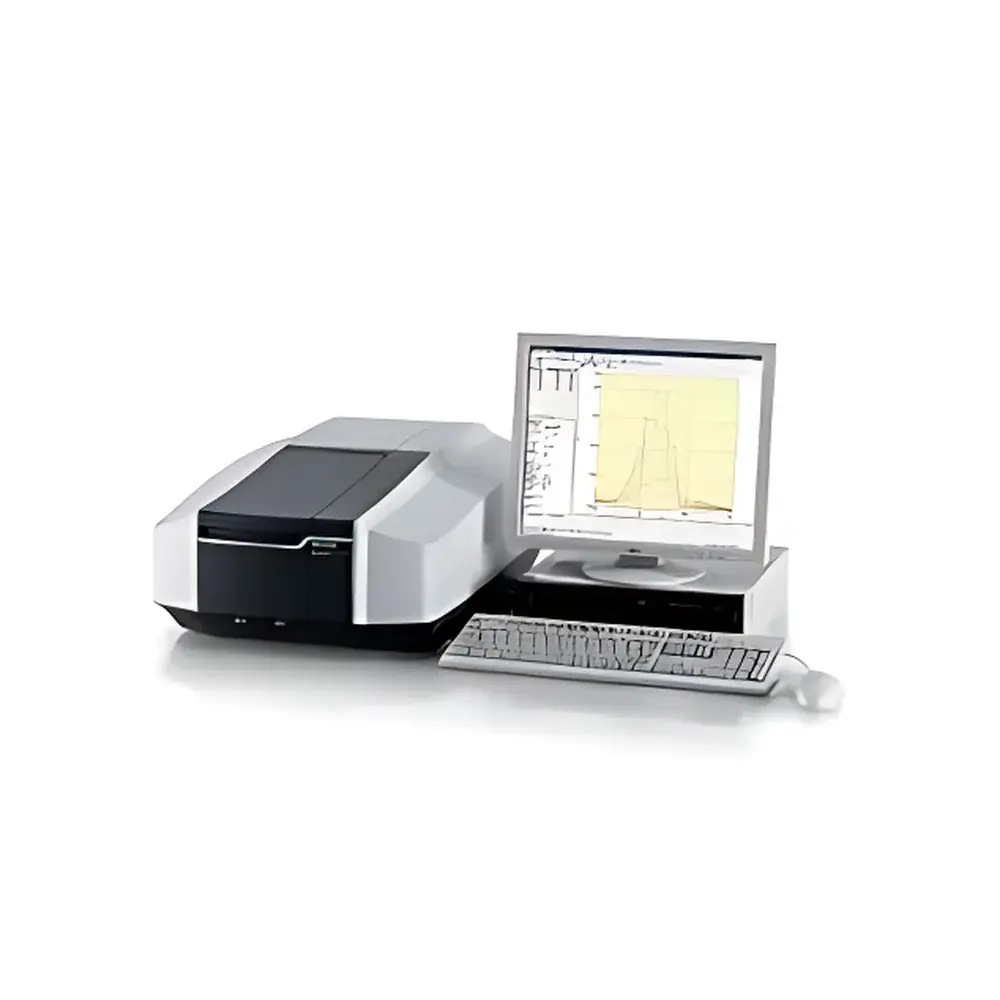
Shimadzu UV-2600i Single-Monochromator Ultraviolet-Visible-Near Infrared Spectrophotometer
| Brand | Shimadzu |
|---|---|
| Origin | Jiangsu, China |
| Manufacturer Type | Authorized Distributor |
| Product Origin | Domestic (PRC) |
| Model | UV-2600i |
| Optical System | Single Monochromator |
| Detector Type | Photodiode Array (PDA) |
| Wavelength Range | 185–1400 nm |
| Wavelength Accuracy | ±0.1 nm |
| Wavelength Repeatability | ±0.1 nm |
| Spectral Bandwidth | 0.1–5.0 nm (variable) |
| Stray Light | < 0.00002% T (at 220 nm and 340 nm) |
| Automation Level | Motorized Wavelength Scanning |
| Standard Software | LabSolutions UV-Vis |
| Hardware Validation Module | Included |
| Dimensions (W × D × H) | 450 × 540 × 260 mm |
| Power Consumption | Reduced by 10% vs. previous Shimadzu UV models |
Overview
The Shimadzu UV-2600i is a high-performance single-monochromator ultraviolet-visible-near infrared (UV-Vis-NIR) spectrophotometer engineered for precision quantitative and qualitative analysis across academic, pharmaceutical, environmental, and industrial laboratories. Operating on the principle of absorbance spectroscopy, the instrument measures sample transmittance and absorbance by dispersing polychromatic light through a high-efficiency Lo-Ray-Light grade holographic diffraction grating and detecting the resulting monochromatic beam with a thermoelectrically cooled photodiode array (PDA) detector. Its extended wavelength coverage—from 185 nm in the deep UV to 1400 nm in the short-wave near-infrared—enables characterization of electronic transitions, charge-transfer complexes, and overtone/combination bands inaccessible to conventional UV-Vis systems limited to 900 nm. The optical architecture employs optimized Czerny-Turner monochromator design with low-stray-light optics and precision stepper-motor-driven grating positioning, ensuring traceable wavelength calibration and long-term photometric stability under routine operation.
Key Features
- Extended spectral range (185–1400 nm) supports NIR-enabled applications including polymer crystallinity assessment, solvent hydration studies, and carbohydrate quantification.
- Ultra-low stray light (< 0.00002% T), achieved via high-fidelity holographic gratings and multi-stage light baffling, ensures accurate measurement of highly absorbing samples up to 6.0 Abs without significant deviation from Beer-Lambert linearity.
- Variable spectral bandwidth (0.1–5.0 nm) allows method optimization for resolution-sensitive analyses (e.g., overlapping peaks in dye mixtures) or signal-to-noise enhancement in low-concentration assays.
- Compact footprint (450 mm width) reduces bench space requirement by 28% compared to prior-generation Shimadzu UV platforms—critical for high-density lab environments and modular analytical workstations.
- Integrated hardware validation module enables automated performance verification per ASTM E275, ISO 6223, and USP <857> guidelines, generating audit-ready reports for GLP/GMP compliance.
- Energy-efficient design consumes 10% less power than predecessor models, aligning with institutional sustainability targets without compromising optical throughput or thermal stability.
Sample Compatibility & Compliance
The UV-2600i accommodates standard 10-mm pathlength quartz, fused silica, and NIR-grade CaF2 cuvettes, as well as microvolume, flow-cell, and solid-sample reflectance accessories—all compatible with legacy Shimadzu UV accessories. It meets key international regulatory requirements: wavelength accuracy and repeatability conform to NIST-traceable standards (±0.1 nm); photometric linearity is verified per ISO 17025-accredited procedures; and software functionality supports 21 CFR Part 11-compliant electronic records when deployed with LabSolutions UV-Vis in validated configurations. Routine operation adheres to ASTM E169 (general practices), E387 (pharmaceutical assay), and EPA Method 415.3 (dissolved organic carbon analysis).
Software & Data Management
LabSolutions UV-Vis provides a unified interface for instrument control, real-time spectral acquisition, kinetic monitoring, and multivariate analysis. Key capabilities include automated spectrum evaluation (peak identification, baseline correction, derivative calculation), batch processing of sample sets with customizable pass/fail criteria, and direct export to LIMS via ASTM E1384-compliant ASCII or XML formats. Audit trail logging, user-level access controls, and electronic signature support are enabled in GxP mode. Raw data files (.spc) retain full metadata—including lamp status, slit width, integration time, and calibration history—for retrospective review and regulatory inspection readiness.
Applications
- Pharmaceutical QC: Assay of active pharmaceutical ingredients (APIs) per USP monographs; excipient compatibility screening; dissolution profile analysis.
- Materials science: Bandgap determination of semiconductors; thin-film thickness estimation via interference fringes; degradation kinetics of photoactive polymers.
- Environmental testing: Nitrate/nitrite quantification in water per EPA methods; humic substance characterization; chlorophyll-a and phycocyanin profiling in algal blooms.
- Food & beverage: Anthocyanin and carotenoid content in fruits; caramel color intensity (E150); ethanol concentration in fortified wines using NIR absorption at 1190 nm.
- Academic research: Ligand-binding stoichiometry via Job’s plot; enzyme kinetics (NADH/NADPH at 340 nm); nanoparticle surface plasmon resonance in visible-NIR region.
FAQ
Does the UV-2600i support dual-beam operation?
No—the UV-2600i is a single-beam spectrophotometer. Reference measurements are performed sequentially using an automated reference holder or software-based background subtraction. For true simultaneous dual-beam capability, consider the Shimadzu UV-2700i.
Is the 1400 nm upper limit achievable with standard quartz cuvettes?
Quartz cuvettes transmit effectively up to ~2500 nm; however, atmospheric water vapor absorption bands above 1300 nm necessitate purging with dry nitrogen or operation in a controlled environment for optimal signal integrity at 1400 nm.
Can LabSolutions UV-Vis generate IQ/OQ/PQ documentation templates?
Yes—the included Hardware Validation module generates preformatted IQ/OQ protocols aligned with ISO/IEC 17025 and ASTM E2500, supporting vendor-qualified installation and operational qualification workflows.
What is the minimum detectable absorbance change (ΔA) at 1.0 Abs?
Based on noise-equivalent absorbance (NEA) specifications and PDA readout stability, the typical ΔA detection limit is ≤0.0002 Abs under standard scanning conditions (1.0 nm SBW, 0.5 s integration).




