
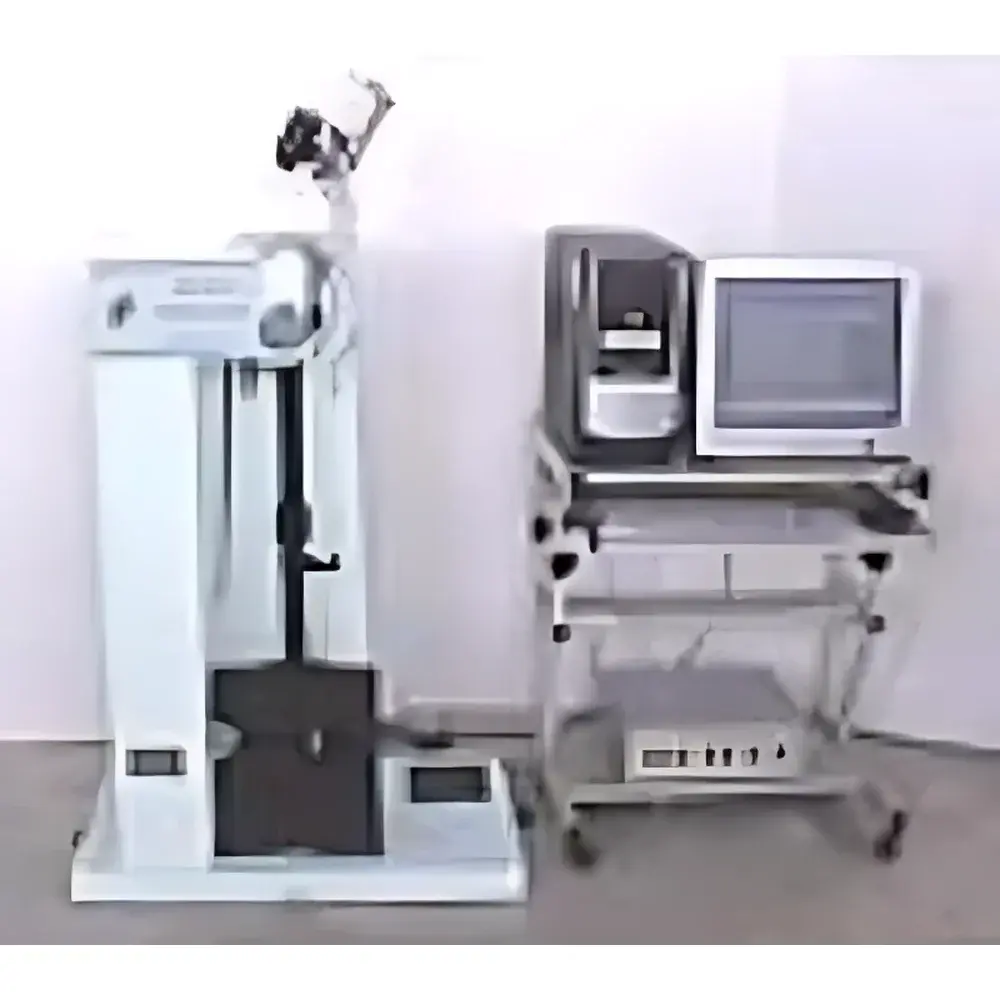
Changchun Intelligent DJF-300 Dynamic Impact Analyzer
| Brand | Changchun Intelligent |
|---|---|
| Origin | Jilin, China |
| Manufacturer Type | Authorized Distributor |
| Country of Origin | China |
| Model | DJF-300 |
| Price | Upon Request |
| Impact Energy | 150 J |
| Impact Velocity | 5.0–5.5 m/s |
| Load Cell Sampling Rate | 1.2 µs |
| Load Resolution | 1/4000 |
| Load Capacity | 20,000 N |
| Load Accuracy | ≤1% |
| Angular Displacement Resolution | 360°/10,000 |
| Notch Geometry Compliance | ISO 148-1:2016 (Charpy V-notch), ISO 83:1976 (Charpy U-notch), GB/T 229–2020 |
| Support Span | 40.0 ± 0.5 mm |
| Hammer Anvil Radius | R2–R2.5 mm, Included Angle: 30° ±1° |
| Support Radius | R1–R1.5 mm |
| Specimen Dimensions | 55.0 ± 0.6 mm (L) × 10.0 ± 0.1 mm (W) × 10.0 ± 0.05 mm (thickness, unnotched) or 8.0 ± 0.05 mm (notched residual thickness) |
Overview
The Changchun Intelligent DJF-300 Dynamic Impact Analyzer is a high-fidelity instrument engineered for the real-time acquisition and quantitative analysis of dynamic mechanical response during Charpy-style impact events. Unlike conventional pendulum impact testers that report only total absorbed energy, the DJF-300 integrates synchronized high-speed load and angular displacement sensing to reconstruct the full force–time and torque–angle histories of the impact event. This capability enables direct derivation of dynamic fracture toughness parameters, strain-rate-dependent yield behavior, and crack initiation/propagation thresholds—critical metrics for materials qualification in aerospace, pressure vessel, nuclear, and rail infrastructure applications. The system operates on the principle of calibrated pendulum impact under standardized simply supported beam geometry, fully compliant with ISO 148-1:2016 (V-notch), ISO 83:1976 (U-notch), and GB/T 229–2020 test protocols. Its core architecture features a rigid cast-iron frame, precision-machined anvil and support assemblies, and a dynamically balanced hammer with traceable energy calibration.
Key Features
- Real-time dual-channel data acquisition: Simultaneous capture of load (via piezoelectric load cell) and angular displacement (via high-resolution optical encoder) at 1.2 µs sampling interval
- High-fidelity signal conditioning: Low-noise, wide-bandwidth amplifiers with anti-aliasing filtering ensure integrity of transient mechanical signals
- Comprehensive energy calibration: Certified 150 J nominal impact energy with traceable verification per ISO 148-2 and GB/T 3808
- Precision mechanical geometry: Hammer knife-edge radius R2–R2.5 mm (±0.1 mm), included angle 30° ±1°; support radius R1–R1.5 mm; span 40.0 ± 0.5 mm—fully aligned with ISO and national standard tolerances
- Remote operation & diagnostics: Ethernet-enabled control interface supports secure remote start/stop, parameter configuration, and firmware updates via TLS-secured web portal
- Integrated safety interlocks: Dual redundant door sensors, emergency stop circuitry, and hammer position verification prior to release meet EN ISO 13857 mechanical safety requirements
Sample Compatibility & Compliance
The DJF-300 accommodates standard Charpy specimens per ISO 148-1 and GB/T 229: rectangular cross-section bars measuring 55.0 ± 0.6 mm in length, 10.0 ± 0.1 mm in width, and either 10.0 ± 0.05 mm (unnotched) or 8.0 ± 0.05 mm (notched residual thickness). Both V-notch (45°, depth 2 mm, root radius 0.25 mm) and U-notch (5 mm depth, root radius 1 mm) configurations are supported. All mechanical components—including hammer, supports, and specimen holders—are manufactured to dimensional tolerances specified in ISO 148-2 and GB 3808. The system’s measurement uncertainty budget has been validated against NIST-traceable reference standards, supporting compliance with ISO/IEC 17025 accredited testing laboratories. Full audit trails—including operator ID, timestamp, environmental conditions (optional sensor input), and raw waveform metadata—are recorded to satisfy GLP and GMP documentation requirements.
Software & Data Management
The proprietary ImpactView™ software suite provides full control, visualization, and post-processing capabilities. It supports synchronized overlay of force–time, torque–angle, and derived energy–displacement curves. Built-in analytical modules compute peak load, time-to-peak, total absorbed energy, ductile-to-brittle transition temperature (DBTT) shift estimation, and normalized energy partitioning (elastic/plastic/fracture components). Data export conforms to ASTM E23-compliant CSV and XML formats, enabling seamless integration into LIMS platforms such as LabWare or Thermo Fisher SampleManager. Software validation documentation (IQ/OQ/PQ protocols) and 21 CFR Part 11-compliant user access controls—including electronic signatures, role-based permissions, and immutable audit logs—are available upon request for regulated environments.
Applications
- Qualification of structural steels for ASME BPVC Section VIII and API RP 2A offshore platforms
- Evaluation of low-temperature toughness in pipeline girth welds per ISO 15614-1 and AWS D1.1
- Material screening for nuclear reactor pressure vessel surveillance programs (ASTM E1820, E23)
- Development and validation of high-strength aluminum and titanium alloys for aerospace airframes
- Research into dynamic fracture mechanics, including rate-dependent J-integral estimation and crack arrest behavior
- Teaching and certification labs requiring full waveform transparency for pedagogical and accreditation purposes
FAQ
Does the DJF-300 comply with current ISO 148-1:2016 requirements for Charpy V-notch testing?
Yes—the mechanical geometry, energy calibration methodology, and data acquisition specifications fully conform to ISO 148-1:2016, including mandatory tolerances for hammer radius, support span, and notch dimensions.
Can the system be integrated into an existing laboratory network with centralized data archiving?
Yes—ImpactView™ supports OPC UA and RESTful API interfaces for bidirectional communication with enterprise LIMS and MES systems. Raw waveform data is stored in HDF5 format for long-term reproducibility.
Is third-party calibration and certification available for regulatory audits?
Yes—factory-certified calibration reports traceable to CNAS-accredited metrology labs are provided. On-site IQ/OQ validation services and 21 CFR Part 11 compliance packages are available as optional add-ons.
What specimen preparation standards does the system assume?
The DJF-300 assumes specimens prepared per ISO 148-3 or GB/T 229–2020, including precise notch machining using certified tooling and surface finish verification per Ra ≤ 1.6 µm.
How is measurement uncertainty quantified for reported absorbed energy values?
Total expanded uncertainty (k=2) is ≤ ±1.8% for 150 J impacts, derived from contributions of load cell linearity, encoder resolution, energy calibration drift, and environmental thermal stability—fully documented in the system’s uncertainty budget report.



