
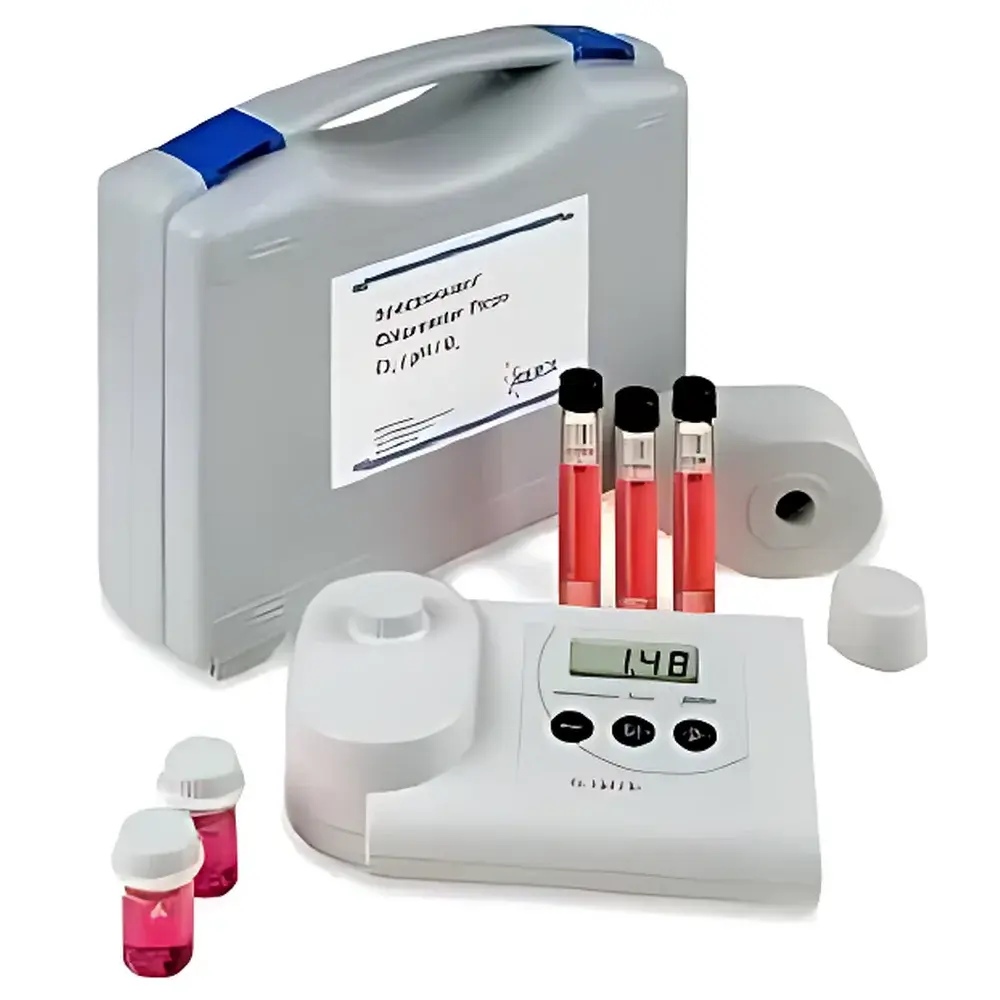
Picco Series Single-Parameter Water Quality Analyzer
| Origin | Germany |
|---|---|
| Manufacturer Type | Authorized Distributor |
| Origin Category | Imported |
| Model | Picco |
| Instrument Type | Portable Colorimetric Water Quality Analyzer |
| Power Supply | 9 V Alkaline Battery (40 h continuous operation) |
| Operating Temperature | 0–40 °C |
| Operating Humidity | 30–90 % RH |
| Dimensions (Instrument) | 190 × 110 × 55 mm |
| Dimensions (Carrying Case) | 270 × 225 × 80 mm |
| Keypad | 3-button polycarbonate membrane, ESD-protected |
| Sample Cell | Waterproof, integrated cuvette chamber |
| Optical System | Temperature-compensated LED light source |
| Auto Power-Off | Yes |
Overview
The Picco Series Single-Parameter Water Quality Analyzer is a field-deployable, battery-powered colorimetric instrument engineered for rapid, on-site quantification of critical water quality parameters in drinking water, wastewater, swimming pools, cooling towers, and environmental surface waters. Based on standardized photometric absorption principles—compliant with ISO 7027 (turbidity), ISO 6223 (free/total chlorine), ISO 15705 (ammonium), and APHA Standard Methods—the Picco employs fixed-wavelength, temperature-compensated LED optics to eliminate thermal drift and ensure measurement stability across variable ambient conditions. Unlike multi-parameter benchtop analyzers, the Picco is purpose-built for single-analyte verification: each model integrates a dedicated optical path, pre-calibrated reagent set compatibility, and wavelength-optimized detection (e.g., 370 nm for nitrate, 605 nm for COD, 660 nm for ammonium), delivering laboratory-grade repeatability (RSD < 2.5 % at mid-range concentrations) without requiring optical alignment or warm-up time.
Key Features
- Compact, rugged design with IP67-rated sample compartment and ESD-protected polycarbonate keypad for reliable operation in humid or dusty field environments
- Integrated temperature compensation algorithm corrects absorbance readings in real time across 0–40 °C, eliminating manual correction factors per ISO 9297 and DIN 38404-4
- Four-decade battery life: 40 hours of continuous use on a single 9 V alkaline cell; auto power-off after 10 minutes of inactivity conserves energy
- Pre-programmed calibration curves aligned with EPA Method 330.5 (chlorine), ISO 11908 (ozone), ISO 11905-1 (ammonium), and ISO 15704 (phosphate)
- No external PC or software required for basic operation—full functionality accessible via intuitive 3-button interface with LCD backlight
- Modular reagent compatibility: Accepts industry-standard powder reagents and liquid test kits (e.g., Hach, Merck, Lovibond) without adapter modification
Sample Compatibility & Compliance
The Picco supports aqueous samples with turbidity ≤ 5 NTU and suspended solids < 50 mg/L. For COD, NH₄-N, NO₃-N, TN, PO₄-P, and TP measurements, digestion-free methods are used where applicable (e.g., ammonium via indophenol blue, phosphate via ascorbic acid/molybdate); for COD, the Picco requires pre-digested samples prepared per ISO 6060 or EPA 410.4 protocols. All models comply with CE marking requirements under Directive 2014/30/EU (EMC) and 2011/65/EU (RoHS). Data integrity meets GLP traceability standards: each measurement stores date/time stamp, operator ID (via optional alphanumeric input), and batch-specific reagent lot number. While not FDA 21 CFR Part 11 certified out-of-the-box, audit trails can be exported in CSV format for inclusion in validated laboratory information management systems (LIMS).
Software & Data Management
The Picco operates autonomously but supports optional infrared (IR) data transfer to Windows-based desktop software (PiccoLink v3.2, included). This application enables export of measurement logs—including raw absorbance values, calibration history, and QC check results—to Excel-compatible CSV or PDF reports. Software features include user-defined report templates, statistical summaries (mean, SD, CV%), and automated flagging of results exceeding user-set action limits. All firmware updates are delivered via USB-to-IR bridge; no internet connection is required on-site. Calibration data is stored in non-volatile memory with write-protection against accidental overwrites.
Applications
- Drinking water distribution: Routine verification of residual free/total chlorine and pH at hydrants, storage tanks, and point-of-use locations
- Wastewater treatment: Monitoring ammonium and nitrate levels in nitrification/denitrification basins prior to discharge compliance reporting
- Swimming pool & spa maintenance: Real-time ozone and combined chlorine assessment per EN 15288-1 and CDC Model Aquatic Health Code
- Environmental monitoring: Field screening of phosphate and total phosphorus in lakes and rivers to support eutrophication risk assessments (OECD 2000)
- Industrial process control: COD tracking in food processing effluents and pharmaceutical rinse waters where rapid turnaround informs dosing decisions
FAQ
Is the Picco suitable for regulatory reporting under EPA or EU directives?
Yes—when used with certified reagents and following prescribed sample preparation protocols (e.g., ISO 6223 for chlorine), Picco measurements meet data quality objectives for Tier 1 field screening and are admissible in pre-compliance verification workflows.
Can multiple parameters be measured with one Picco unit?
No—each Picco model is factory-configured for a single parameter group (e.g., Cl₂/pH/O₃ or NH₄-N). Cross-parameter use is not supported due to optical and calibration architecture constraints.
What is the calibration frequency recommendation?
Factory calibration remains stable for 12 months under normal use; however, daily verification with a primary standard (e.g., potassium hydrogen phthalate for pH, NIST-traceable chlorine standard) is recommended before critical measurements.
Does the instrument require annual recalibration by the manufacturer?
Not mandatory—users may perform full recalibration using NIST-traceable reference standards and the built-in calibration mode; service center recalibration is available upon request for ISO/IEC 17025-accredited validation.
Are replacement cuvettes and batteries commercially available?
Yes—standard 10 mm square glass or disposable plastic cuvettes (UV-transparent grade) and industrial-grade 9 V alkaline batteries are globally sourced; no proprietary consumables are required.







