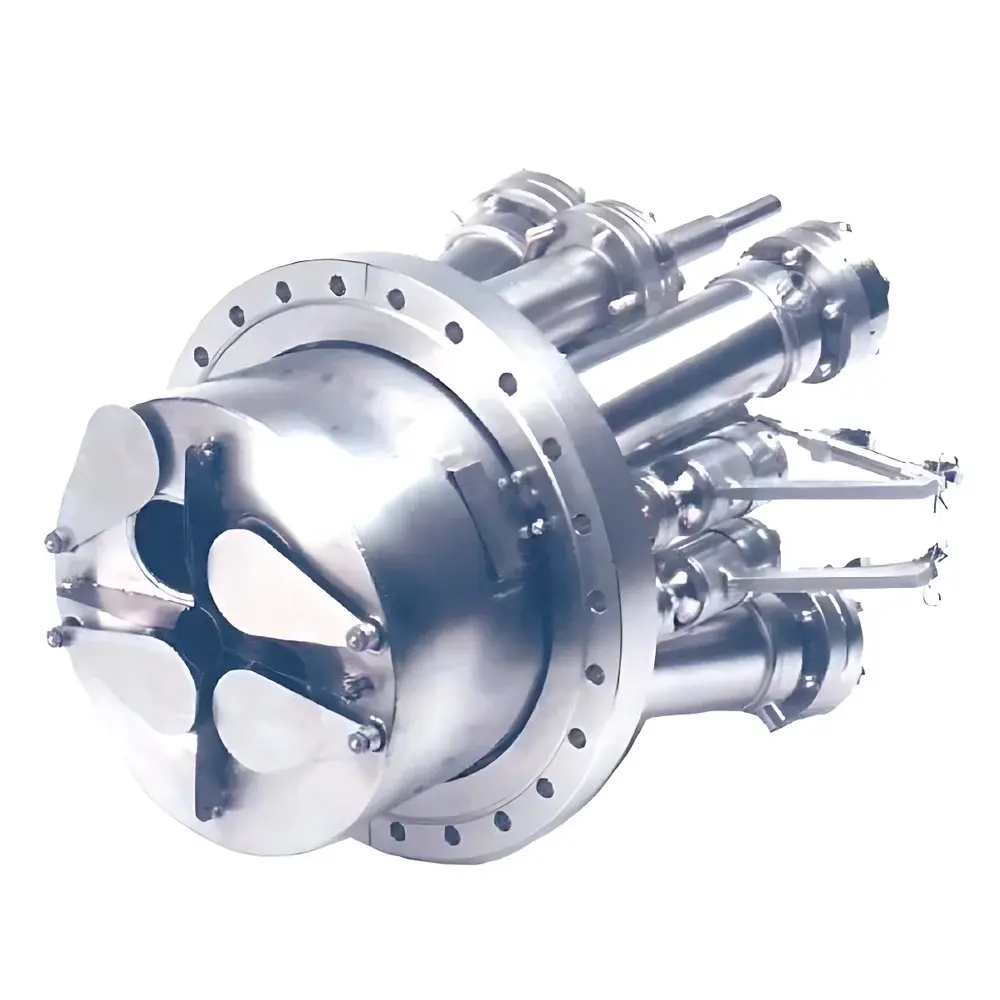
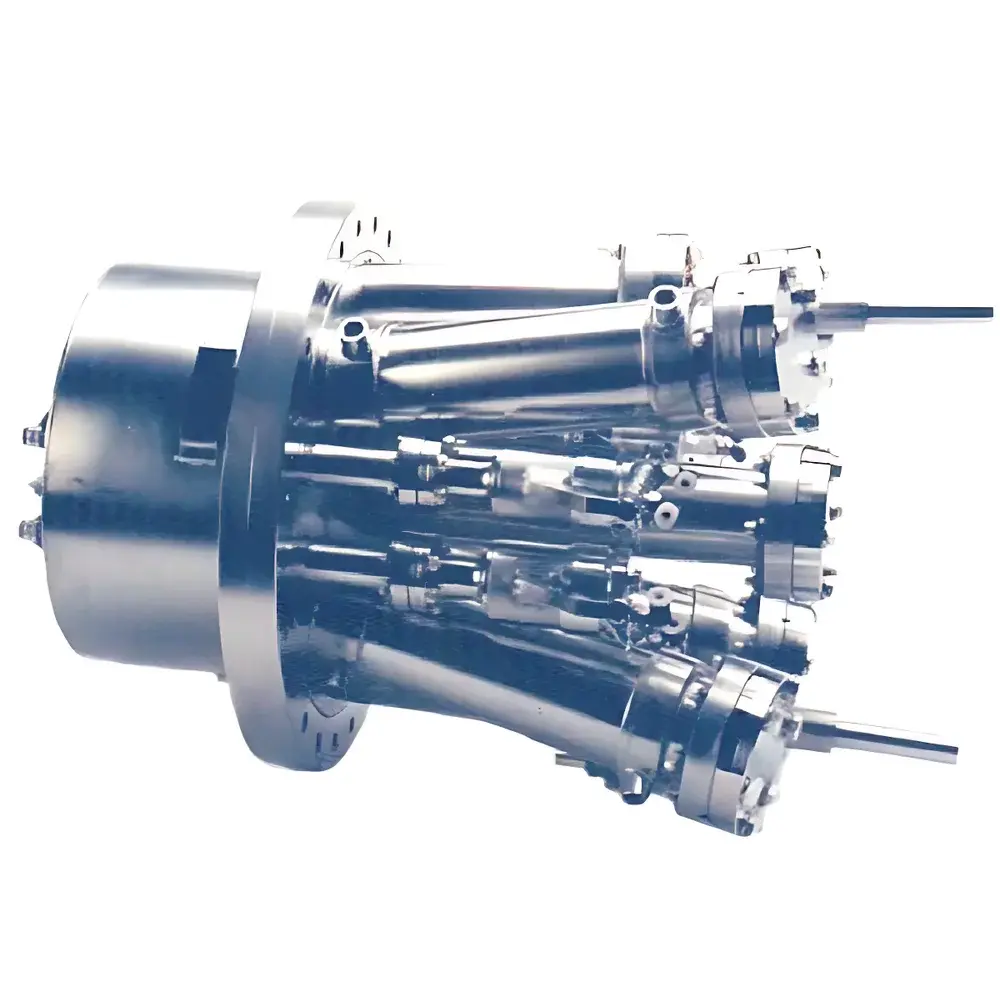
SVT Associates SVTA-SF Molecular Beam Epitaxy Source Flange
| Brand | SVT Associates |
|---|---|
| Origin | USA |
| Model | SVTA-SF |
| Flange Sizes | 10" to 22" |
| Evaporation Port Count | 4 (2.75") to 8 (4.625") |
| Cooling Option | Liquid Nitrogen or Water-Cooled Backplate |
| Integrated Viewport | Center-Mounted |
Overview
The SVT Associates SVTA-SF Molecular Beam Epitaxy (MBE) Source Flange is an engineered vacuum-integrated component designed for high-precision thin-film epitaxial growth systems. Built to meet the stringent mechanical, thermal, and ultra-high-vacuum (UHV) compatibility requirements of modern MBE chambers, the SVTA-SF serves as the primary interface between effusion cells or electron-beam evaporators and the growth chamber. Its design adheres to standard ConFlat (CF) flange geometries and utilizes oxygen-free high-conductivity (OFHC) copper or stainless steel construction—selected per application-specific thermal load and outgassing constraints. The flange operates on fundamental MBE principles: controlled atomic/molecular beam flux generation under UHV conditions (typically ≤1×10⁻¹⁰ Torr), where beam collimation, angular uniformity, and source-to-substrate geometry directly govern film stoichiometry, growth rate stability, and layer abruptness.
Key Features
- Modular flange architecture supporting diameters from 10 inches (254 mm) up to 22 inches (559 mm), enabling scalability across laboratory-scale and production-grade MBE systems.
- Standardized port configurations: 10″ flange integrates four 2.75″ (70 mm) CF ports; 22″ flange accommodates eight 4.625″ (117 mm) CF ports—each rated for UHV service and compatible with industry-standard effusion cell mounts.
- Integrated liquid nitrogen or water-cooled backplate, thermally isolating the flange body from source heating elements and minimizing radiative heat transfer into the main chamber.
- Center-mounted optical viewport (typically KF40 or CF63, fused silica or MgF₂ window) aligned coaxially with the substrate position—enabling in situ pyrometry, reflection high-energy electron diffraction (RHEED), or infrared thermography during growth.
- Optional motorized or pneumatically actuated integrated shutters, fabricated from low-outgassing molybdenum or tantalum, with precise timing control (<10 ms actuation) and bakeable to 250 °C.
- Vacuum feedthroughs routed externally to the chamber wall—reducing internal shadowing, simplifying maintenance, and preserving line-of-sight integrity between multiple sources and substrate.
Sample Compatibility & Compliance
The SVTA-SF flange supports all standard MBE source types, including Knudsen cells, e-beam crucibles, and gas-source injectors, with thermal stability verified from ambient to 1200 °C source operating temperatures. All metallic components comply with ASTM F880-22 (Standard Specification for Vacuum Flanges) and are certified for use in Class 10 cleanroom environments. Surface finishes meet Ra ≤ 0.4 µm per ISO 1302, and helium leak rates are validated to <1×10⁻¹¹ Pa·m³/s per ISO 20484. The design conforms to SEMI E10-0321 (Specification for Semiconductor Manufacturing Equipment Safety) and supports full traceability under ASME BPVC Section VIII Div. 1 for pressure boundary applications.
Software & Data Management
While the SVTA-SF is a passive mechanical component, its integration into automated MBE platforms is facilitated via standardized electrical and pneumatic interfaces. Shutter control signals adhere to TTL/CMOS logic levels (0–5 VDC) and are compatible with common PLC-based sequencing systems (e.g., Beckhoff CX9020, Siemens S7-1500). Optional digital I/O modules provide real-time shutter position feedback and cooling system status (flow rate, temperature differential, coolant pressure) for logging into distributed SCADA architectures. All configuration data—including port layout, cooling type, viewport material, and shutter actuation parameters—is stored in machine-readable XML format compliant with SECS/GEM standards for factory automation interoperability.
Applications
- Growth of III–V compound semiconductors (GaAs, InP, GaN) for high-electron-mobility transistors (HEMTs) and laser diodes.
- Epitaxial deposition of II–VI materials (ZnSe, CdTe) for photovoltaic absorber layers and quantum dot heterostructures.
- Atomic-layer-controlled synthesis of topological insulators (Bi₂Se₃, Sb₂Te₃) and 2D transition metal dichalcogenides (MoS₂, WSe₂).
- In situ calibration of beam flux monitors (quartz crystal microbalances, ion gauges) using geometric source–substrate alignment.
- Multi-source co-evaporation for complex oxide thin films (e.g., La₀.₇Sr₀.₃MnO₃, YBa₂Cu₃O₇₋δ) requiring independent shutter sequencing and thermal management.
FAQ
What vacuum specifications does the SVTA-SF support?
The flange is rated for continuous operation at pressures ≤1×10⁻¹¹ Torr and has been tested to maintain structural integrity under differential pressures up to 1 atm.
Can the flange be customized for non-standard port spacing or non-CF interfaces?
Yes—custom machining for ISO-K, ISO-F, or blind-flanged configurations is available upon submission of mechanical drawings and UHV compatibility documentation.
Is the viewport transmission range specified?
Standard fused silica windows transmit from 190 nm to 2.2 µm; MgF₂ options extend UV response to 115 nm. Custom AR coatings are available per spectral requirement.
How is thermal expansion mismatch managed between the flange and mounted sources?
All mounting interfaces incorporate Inconel 718 flexures and graphite-composite gasketing to accommodate differential thermal contraction between OFHC copper flanges and refractory metal source bodies.
Does SVT Associates provide installation validation reports?
Yes—certified UHV leak test reports, surface cleanliness verification (per ASTM E1253-20), and dimensional inspection certificates are provided with each shipped unit.