
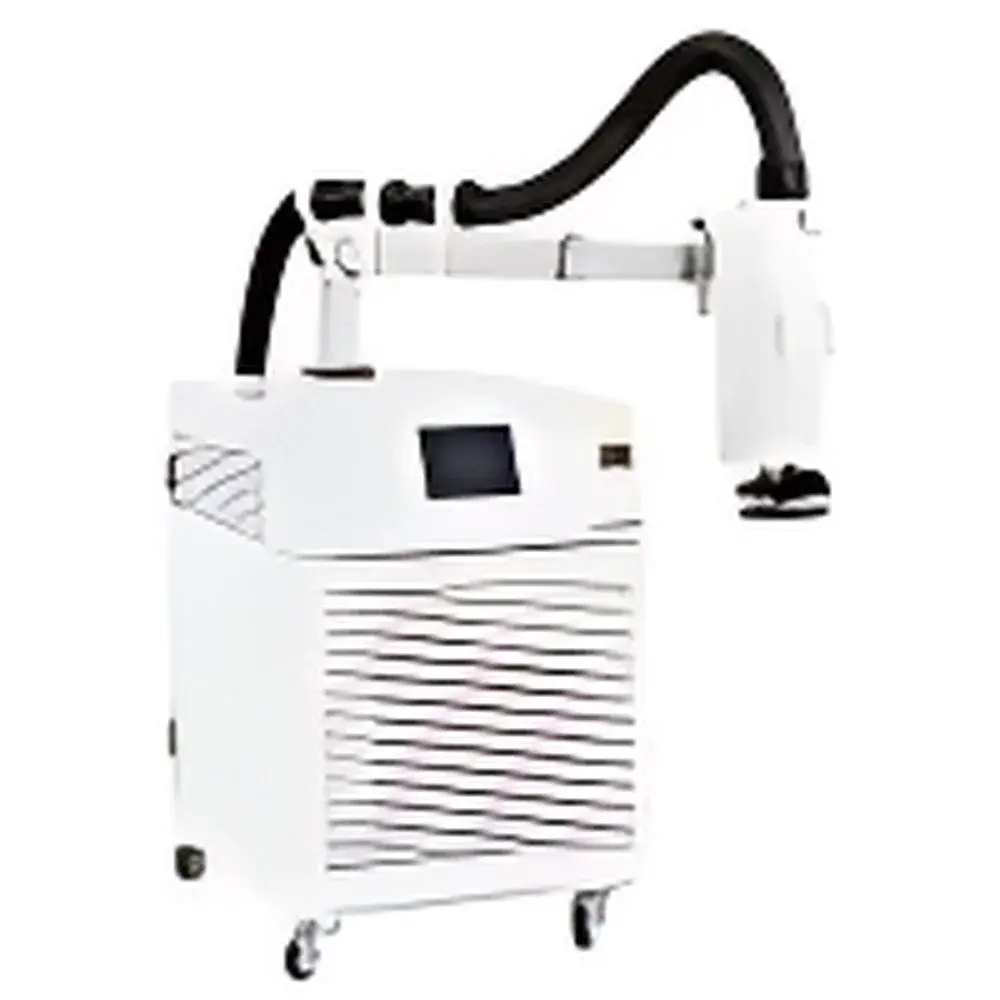
Froilabo LabCompanion Dragon Rapid Thermal Cycling Heat Flux System
| Brand | Froilabo / LabCompanion |
|---|---|
| Origin | Guangdong, China |
| Manufacturer Type | Direct Manufacturer |
| Regional Classification | Domestic (China) |
| Model | Froilabo Dragon Series |
| Pricing | Available Upon Request |
| Temperature Range | −80 °C to +250 °C |
| Ramp Rates | −55 °C → +125 °C in 7 s |
| Temperature Stability | ±0.1 °C |
| Airflow Control | 2.2–8.4 L/s |
| Operating Modes | Manual / Automatic / Programmable |
| User Interface | Touchscreen HMI |
| Program Storage | Up to 45 thermal profiles, each with up to 20 steps |
| Standards Compliance | JEDEC JESD22-A104, MIL-STD-883 Method 1010, MIL-STD-750 Method 1037 |
Overview
The Froilabo LabCompanion Dragon Rapid Thermal Cycling Heat Flux System is an engineered thermal shock and accelerated temperature cycling platform designed for high-fidelity reliability testing of electronic components, advanced packaging, and functional materials. Based on forced-convection air thermodynamics with dual independent refrigeration and heating circuits, the system delivers precise, repeatable thermal transients without mechanical sample movement—enabling true non-contact, high-speed thermal flux application. Its core architecture leverages Froilabo’s century-long heritage in precision temperature control (established 1918, Lyon, France), integrated with LabCompanion’s localized manufacturing and application support infrastructure in Guangdong, China. Unlike conventional chamber-based thermal shock systems, the Dragon platform applies rapid thermal gradients directly to device-under-test (DUT) surfaces via calibrated, laminar airflow—minimizing thermal inertia and enabling sub-10-second transitions across extreme temperature spans.
Key Features
- Wide operational temperature range: −80 °C to +250 °C, maintained with ±0.1 °C stability under dynamic load conditions
- Ultra-fast thermal ramping: −55 °C ↔ +125 °C transitions completed in 7 s (heating) and 14 s (cooling), verified per IEC 60068-2-14 Annex A
- Adjustable volumetric airflow from 2.2 to 8.4 liters per second, digitally regulated to ensure consistent convective heat transfer coefficients across DUT geometries
- Three operational modes: manual real-time adjustment, preloaded automatic sequences, and fully programmable multi-step thermal profiles
- Intuitive 7-inch capacitive touchscreen HMI with contextual navigation, multilingual UI support (English, Chinese, Korean, Japanese), and embedded calibration log access
- Onboard storage for up to 45 independent thermal programs; each program supports up to 20 discrete temperature/time segments with dwell, ramp, and hold logic
- Hardware-level safety interlocks including overtemperature cutoff, airflow failure detection, and refrigerant pressure monitoring aligned with EN 61000-6-2/6-4 EMC requirements
Sample Compatibility & Compliance
The Dragon system accommodates a broad spectrum of test specimens—from bare die and wafer-level packages (e.g., QFN, BGA, WLCSP) to assembled PCBAs, sensors, optoelectronic modules, and polymer-based encapsulants. Its nozzle-based delivery architecture eliminates chamber volume constraints, supporting both single-DUT spot testing and small-batch parallel evaluation using optional multi-nozzle adapters. The platform is validated for compliance with internationally recognized qualification standards including JEDEC JESD22-A104 (Temperature Cycling), MIL-STD-883 Method 1010.12 (Thermal Shock), and MIL-STD-750 Method 1037.1 (Temperature-Humidity-Bias Life Testing). All firmware and control software are architected to support GLP/GMP-aligned audit trails, with timestamped event logging, user authentication, and configuration change tracking compliant with FDA 21 CFR Part 11 principles.
Software & Data Management
Control and data acquisition are managed through Froilabo’s DragonLink™ PC software suite (Windows 10/11 compatible), offering real-time thermal profile visualization, synchronized analog/digital I/O logging (up to 16 channels), and automated report generation in PDF and CSV formats. The software includes built-in statistical process control (SPC) tools for cycle-to-cycle deviation analysis, Cpk calculation, and outlier identification based on user-defined thermal excursion thresholds. Raw sensor data—including PT100 surface probe readings, airflow velocity feedback, and compressor discharge temperature—is recorded at 10 Hz resolution and time-stamped to microsecond precision. Exported datasets conform to ASTM E2917-21 metadata conventions, ensuring interoperability with LIMS platforms and enterprise quality management systems (QMS).
Applications
- Qualification of solder joint integrity and intermetallic growth kinetics in automotive ECUs and ADAS modules
- Accelerated life testing of MEMS devices and piezoelectric actuators under repeated thermal stress
- Evaluation of coefficient-of-thermal-expansion (CTE) mismatch effects in heterogeneous 3D IC stacks
- Process window validation for reflow soldering, underfill cure, and conformal coating thermal cycling
- Reliability screening of power electronics (SiC/GaN modules) prior to burn-in and HAST testing
- Material-level characterization of thermal interface materials (TIMs), adhesives, and encapsulants
- Supporting DOE-driven thermal fatigue studies in accordance with IPC-9701A and IPC-J-STD-020D
FAQ
Does the Dragon system require liquid nitrogen or external chillers?
No. It operates as a self-contained, closed-cycle refrigeration unit using environmentally compliant R-513A/R-1234yf mixed-refrigerant technology—no cryogenics or auxiliary cooling infrastructure required.
Can the system be integrated into an automated test cell?
Yes. Standard Ethernet/IP and Modbus TCP interfaces enable seamless integration with PLC-based handlers, robotic loaders, and ATE platforms. Optional TTL-triggered start/stop and digital status outputs are available.
What is the minimum DUT size supported?
The standard nozzle configuration targets areas ≥3 mm × 3 mm. Custom nozzles down to 1.2 mm diameter are available for die-level thermal mapping applications.
Is ISO/IEC 17025 calibration documentation provided?
Yes. Each unit ships with a factory-issued calibration certificate traceable to NIM (China) and COFRAC (France), covering temperature uniformity, ramp rate accuracy, and airflow linearity across the full operating range.



