
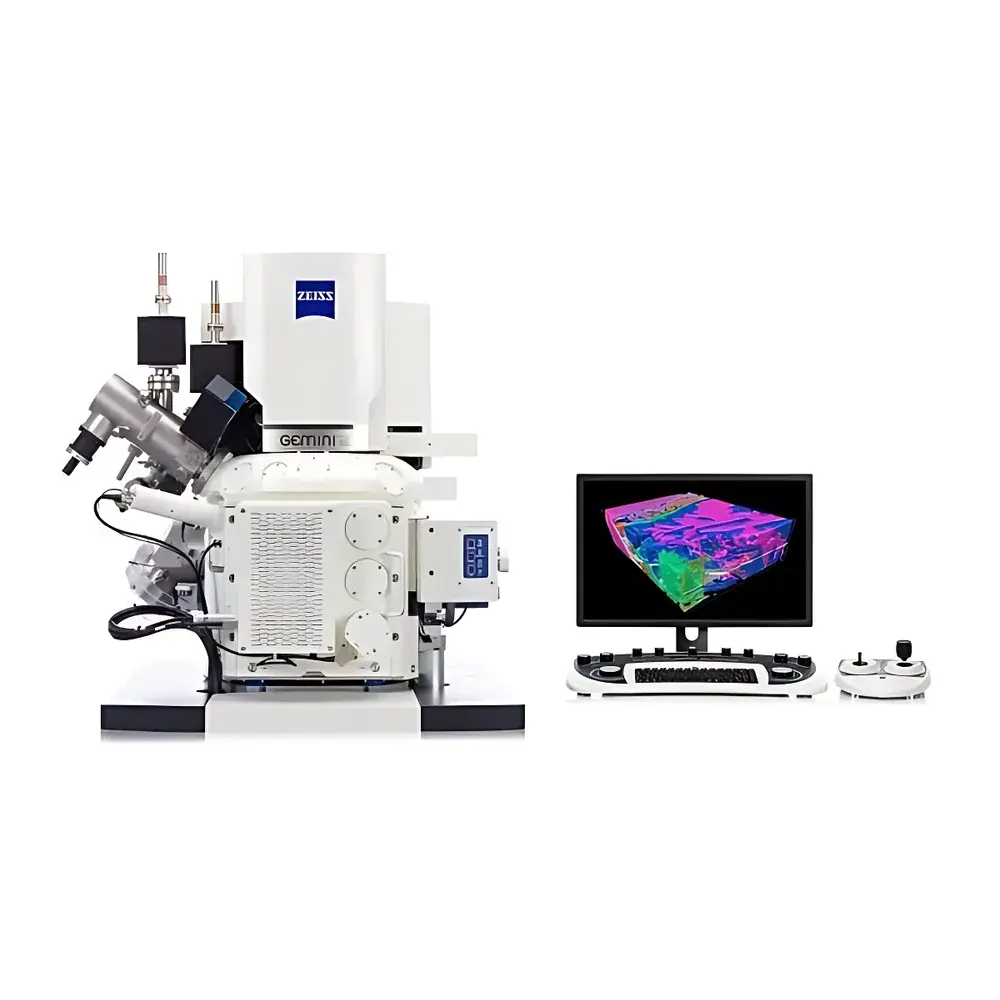
ZEISS EVO10 Tungsten-Filament Scanning Electron Microscope
| Brand | ZEISS |
|---|---|
| Origin | Germany |
| Model | EVO10 |
| Instrument Type | Floor-Standing SEM |
| Electron Source | Tungsten Filament |
| Secondary Electron Resolution | 3 nm at 30 kV |
| Magnification Range | 10× to 1,000,000× |
| Accelerating Voltage | 0.2–30 kV |
| Maximum Sample Dimensions | Ø220 mm × 100 mm (H) |
| Stage Travel | X = 80 mm, Y = 100 mm, Z = 35 mm |
| Standard Detectors | Everhart-Thornley Secondary Electron Detector (SED), Solid-State Backscattered Electron Detector (BSE) |
Overview
The ZEISS EVO10 is a high-performance, floor-standing tungsten-filament scanning electron microscope engineered for robust routine analysis and flexible materials characterization in academic, industrial, and quality control laboratories. Operating on the principle of raster-scanned electron beam interaction with solid specimens, the EVO10 generates high-fidelity topographic and compositional contrast through detection of secondary electrons (SE) and backscattered electrons (BSE). Its design integrates decades of ZEISS expertise in electron optics—rooted in foundational innovations such as the world’s first commercial SEM (1965) and the first fully digital SEM (1985)—with modern engineering rigor. The system supports variable-pressure operation (from high vacuum to low vacuum modes), enabling direct imaging of non-conductive, hydrated, or outgassing samples without metal coating—a critical capability for failure analysis, geoscience, polymer research, and biological specimen screening.
Key Features
- Stable tungsten thermionic electron source delivering consistent beam current and long filament lifetime under routine operating conditions.
- Optimized electromagnetic lens column with minimized aberrations, enabling 3 nm secondary electron resolution at 30 kV and stable imaging across the full magnification range (10×–1,000,000×).
- Large chamber architecture (Ø365 mm × 275 mm internal volume) accommodating specimens up to Ø220 mm × 100 mm height and 5 kg mass, with motorized five-axis stage (X/Y/Z/T/R) for precise positioning and tilt-series acquisition.
- High-efficiency vacuum system featuring turbomolecular pumping for rapid pump-down (<60 s to high vacuum), oil-free operation options, and pressure stability critical for low-vacuum SE imaging.
- Integrated dual-detector configuration: Everhart-Thornley SE detector for high-sensitivity surface topology and solid-state BSE detector for atomic-number contrast and phase discrimination.
- Windows-based SmartSEM™ software with intuitive GUI, keyboard/mouse-driven workflow, automated alignment routines, and real-time image optimization tools including dynamic focus, stigmation, and contrast/brightness mapping.
Sample Compatibility & Compliance
The EVO10 accommodates a broad spectrum of sample types—from conductive metals and semiconductors to insulating ceramics, polymers, geological sections, and partially hydrated biological tissues. Its low-vacuum mode (down to ~100 Pa) enables charge mitigation via gas ionization, eliminating the need for sputter-coating while preserving native surface morphology. Optional environmental ports support integration of energy-dispersive X-ray spectroscopy (EDS), wavelength-dispersive spectrometry (WDS), electron backscatter diffraction (EBSD), and cathodoluminescence (CL) systems. All hardware and software comply with CE marking requirements and support GLP/GMP-aligned documentation workflows, including audit-trail logging, user access controls, and electronic signature readiness per FDA 21 CFR Part 11 when configured with appropriate validation packages.
Software & Data Management
SmartSEM™ provides comprehensive instrument control, image acquisition, measurement, and annotation capabilities. It supports TIFF, BMP, and JPEG export with embedded metadata (kV, WD, mag, detector type, date/time, operator ID). Batch acquisition, time-lapse imaging, and multi-region stitching are natively implemented. Raw image data retains full bit-depth (16-bit) for quantitative post-processing. The software architecture allows seamless integration with third-party analytical platforms—including Thermo Fisher, Oxford Instruments, and EDAX EDS suites—via standard protocols (e.g., TCP/IP, OPC UA). Data integrity is ensured through automatic backup scheduling, checksum verification, and configurable retention policies aligned with ISO/IEC 17025 laboratory management standards.
Applications
The EVO10 serves as a foundational tool in failure analysis labs for fracture surface examination, corrosion assessment, and solder joint inspection in aerospace and automotive components. In materials science, it facilitates grain boundary analysis, inclusion identification, and coating thickness evaluation in metallurgical and ceramic samples. Semiconductor process engineers utilize its high-resolution imaging and low-vacuum compatibility for wafer defect review and package-level inspection. Geoscientists apply BSE imaging for mineral phase mapping and porosity quantification in core samples. Life science researchers employ it for morphological assessment of freeze-dried tissues, pollen grains, and biomaterial scaffolds—without carbon or gold coating. Its reliability, reproducibility, and ease of use make it suitable for both expert microscopists and trained technicians in regulated manufacturing environments.
FAQ
What vacuum modes does the EVO10 support?
The EVO10 operates in high vacuum (≤1 × 10⁻³ Pa), low vacuum (10–100 Pa), and variable-pressure modes, enabling uncoated imaging of insulators and sensitive samples.
Can the EVO10 be upgraded with EDS or EBSD?
Yes—the large chamber and standardized port layout allow straightforward integration of EDS, WDS, EBSD, and CL detectors from major vendors, with full software synchronization via SmartSEM™.
Is the stage fully motorized and programmable?
Yes—the five-axis motorized stage (X/Y/Z/tilt/rotation) supports automated multi-location acquisition, tilt-series reconstruction, and repeatable positioning with sub-micron reproducibility.
Does the system meet regulatory compliance requirements for QC labs?
When deployed with validated software configurations and documented IQ/OQ protocols, the EVO10 supports compliance with ISO/IEC 17025, ASTM E1558, and FDA 21 CFR Part 11 for electronic records and signatures.
What maintenance intervals are recommended for the tungsten filament?
Typical filament lifetime exceeds 100 hours under standard operating conditions; replacement is performed during routine service visits and requires no realignment due to ZEISS’s pre-centered cartridge design.





