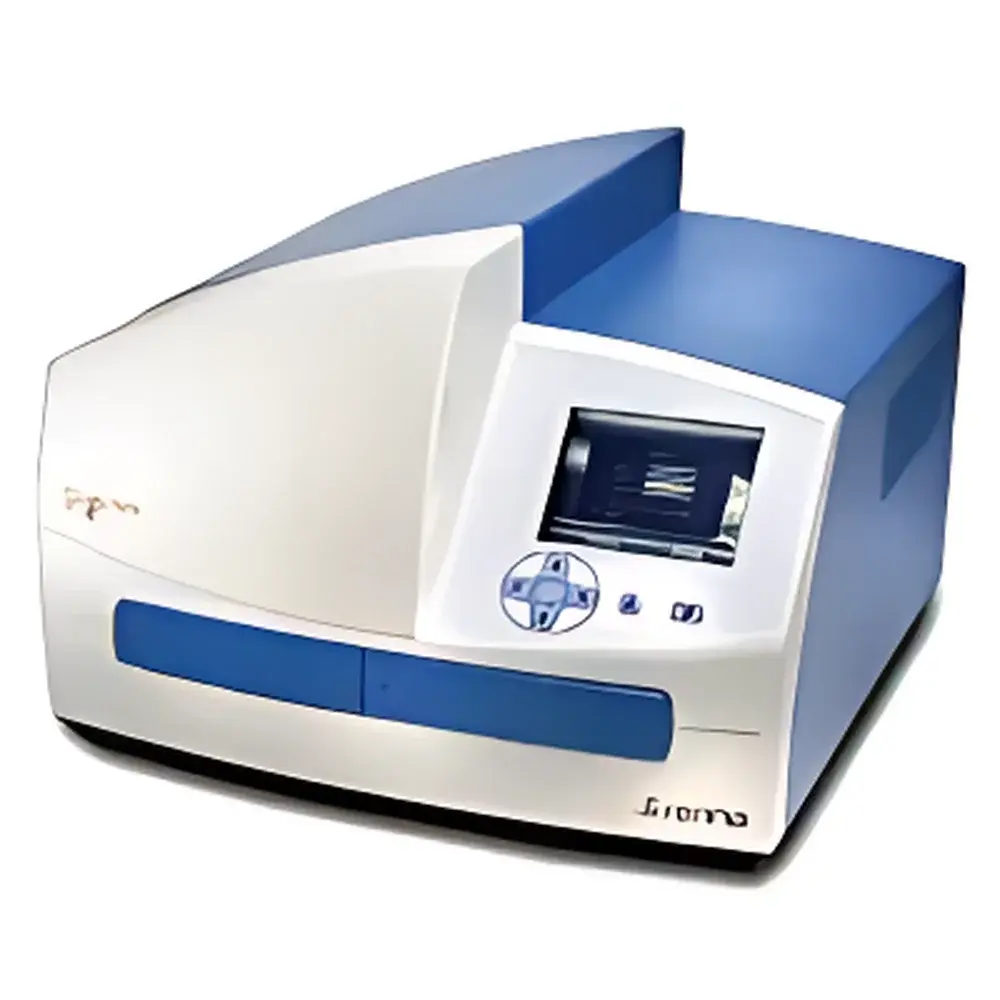
Erenna® Single-Molecule Immunoassay Platform by Merck
| Brand | Merck |
|---|---|
| Origin | USA |
| Manufacturer Type | Original Equipment Manufacturer (OEM) |
| Origin Category | Imported Instrument |
| Model | Erenna® |
| Pricing | Available Upon Request |
Overview
The Erenna® Single-Molecule Immunoassay Platform, developed and manufactured by Merck (USA), is a high-sensitivity digital immunoassay system engineered for quantitative detection of low-abundance protein biomarkers at the single-molecule level. It leverages proprietary Single Molecule Counting™ (SMC™) technology—a laser-based digital detection method grounded in confocal optical principles. A tightly focused laser beam generates an Airy disk—the fundamental diffraction-limited excitation volume—within which ~84% of incident laser energy is concentrated. As fluorescently labeled immunocomplexes flow through this sub-femtoliter detection zone, individual molecules are resolved temporally and spatially. Each fluorescent burst exceeding a defined photon-count threshold is registered as a discrete digital event, enabling true digital quantification rather than analog intensity averaging. This architecture eliminates ensemble averaging artifacts and dramatically extends the lower limit of detection (LLOD) beyond conventional ELISA or electrochemiluminescence platforms—typically achieving sub-attomolar sensitivity (≤0.1 aM) for key cytokines, neurodegenerative markers, and oncology-related analytes.
Key Features
- Digital signal acquisition via time-resolved single-molecule fluorescence burst detection in a confocal Airy disk geometry
- Triple-parameter data output per assay run: Detected Events (DE), Event Photons (EP), and Total Photons (TP)—each serving distinct dynamic range and linearity roles
- Automated, walk-away operation with integrated fluidics, temperature-controlled incubation, and on-board wash stations
- Pre-validated, CE-IVD and RUO-grade assay kits with lot-specific calibration certificates and stability documentation
- Modular incubation flexibility: supports both on-instrument and off-instrument (e.g., plate shaker + centrifuge) sample preparation workflows
- Compliance-ready architecture supporting audit trails, user access control, and electronic signature functionality per 21 CFR Part 11 requirements
Sample Compatibility & Compliance
The Erenna® platform accepts standard 96-well microplates and compatible assay tubes. Sample matrices include human serum, plasma (EDTA, heparin, citrate), cerebrospinal fluid (CSF), cell culture supernatants, and tissue lysates—with demonstrated recovery across diverse viscosity and autofluorescence backgrounds. All commercially available assay kits undergo rigorous analytical validation per ICH Q2(R2) guidelines, including precision (intra- and inter-assay CV ≤15%), accuracy (recovery 85–115%), specificity (cross-reactivity <0.1% against structurally related isoforms), and robustness under variable pipetting volumes and incubation times. The instrument firmware and software comply with ISO 13485:2016 quality management standards for in vitro diagnostic devices and support GLP/GMP-aligned laboratory practices.
Software & Data Management
Instrument control, data acquisition, and analysis are managed through the Erenna® Analysis Software Suite (v5.x), a Windows-based application validated for use in regulated environments. The software provides automated curve fitting using weighted 4- or 5-parameter logistic regression, outlier detection algorithms, and parallel line analysis (PLA) for potency assessment. Raw photon timestamp data are stored in vendor-neutral HDF5 format with embedded metadata (instrument ID, operator, date/time, reagent lot, calibration status). Audit trail functionality logs all user actions—including data modification, report generation, and parameter changes—with immutable timestamps and operator identification. Export options include CSV, PDF, and XML formats compatible with LIMS and electronic lab notebook (ELN) integration.
Applications
The Erenna® platform is deployed in translational research laboratories, biopharmaceutical development groups, and clinical biomarker discovery consortia. Primary use cases include longitudinal monitoring of ultra-low-concentration therapeutic targets (e.g., tau, α-synuclein, IL-17F); pharmacodynamic assessment of biologics in Phase I/II trials; detection of residual host-cell proteins (HCPs) in purified monoclonal antibody batches; and validation of novel exosome-associated cargo proteins. Its ability to resolve concentration-dependent transitions between DE-dominant (low-abundance) and EP-dominant (mid-to-high abundance) quantification regimes enables seamless assay bridging across orders of magnitude—eliminating the need for sample dilution series or method revalidation.
FAQ
What distinguishes SMC™ from other digital immunoassays such as Simoa or Digital ELISA?
SMC™ employs confocal laser excitation within a physically defined Airy disk, enabling deterministic temporal resolution of single-molecule events without reliance on enzymatic amplification or bead-based compartmentalization.
Can Erenna® data be used for regulatory submissions?
Yes—when operated with validated RUO or CE-IVD kits under documented SOPs and 21 CFR Part 11-compliant software settings, datasets meet FDA and EMA expectations for exploratory biomarker qualification.
Is method transfer supported between Erenna® instruments?
Instrument-to-instrument reproducibility is maintained via factory calibration using NIST-traceable fluorescent standards and standardized optical alignment protocols—validated across global installations.
How is carryover controlled during high-concentration sample runs?
The platform integrates pressure-driven fluidic purging, UV-LED surface decontamination between runs, and real-time background photon monitoring to flag and exclude contaminated acquisition windows.
Does Merck provide assay development support?
Merck offers collaborative assay customization services—including conjugate optimization, capture/detection pair screening, and matrix interference profiling—under CDA-governed technical service agreements.
Related Products