
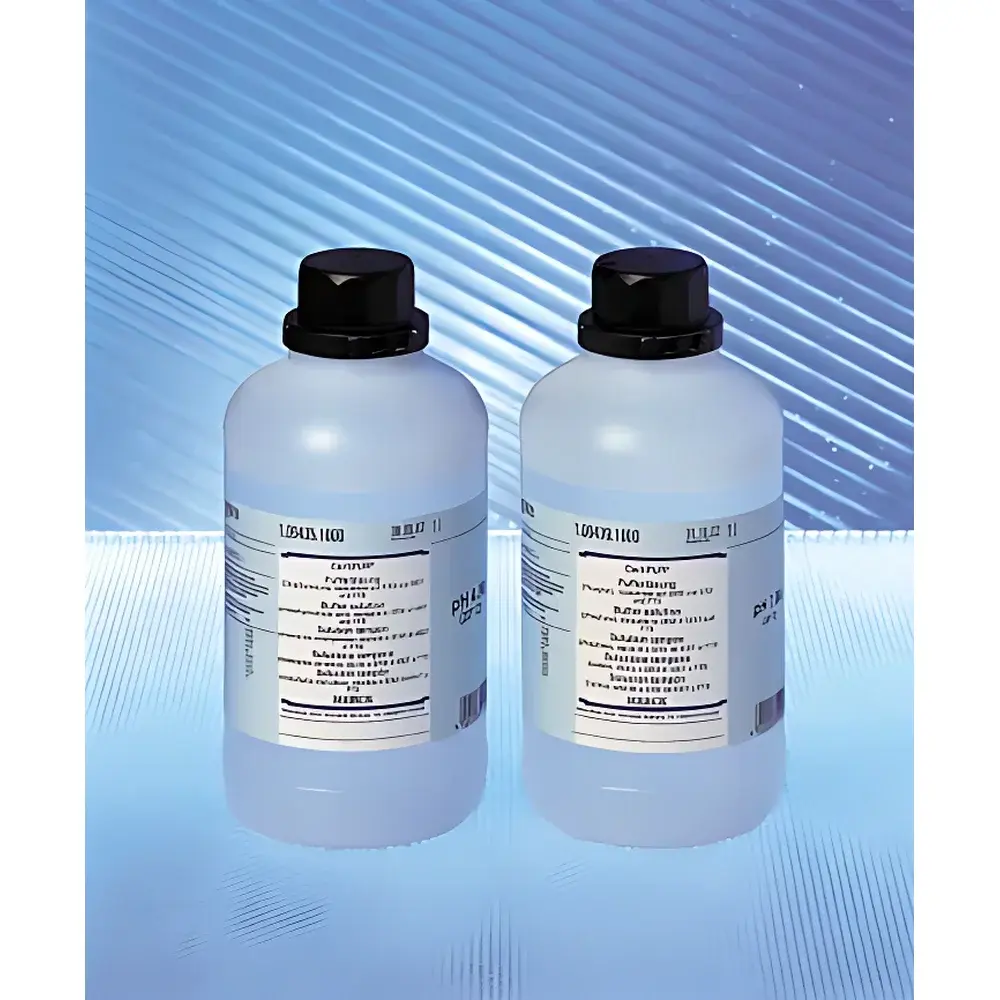
Merck pH Buffer Solutions
| Brand | Merck |
|---|---|
| Origin | Germany |
| Manufacturer Type | Manufacturer |
| Origin Category | Imported |
| Pricing | Upon Request |
Overview
Merck pH Buffer Solutions are high-precision, traceable reference standards engineered for rigorous calibration and verification of pH meters, electrodes, and electrochemical measurement systems in analytical laboratories, quality control environments, and regulated manufacturing facilities. These solutions operate on the fundamental thermodynamic principle of hydrogen ion activity equilibrium in aqueous buffer systems—defined by the Henderson–Hasselbalch equation—and are formulated to deliver stable, reproducible pH values across defined temperature ranges. Each batch is certified against primary reference materials traceable to both the U.S. National Institute of Standards and Technology (NIST) and the German Physikalisch-Technische Bundesanstalt (PTB), ensuring dual metrological traceability required for ISO/IEC 17025-accredited testing laboratories and FDA-regulated operations.
Key Features
- Five-point certified calibration protocol: Each lot undergoes comprehensive pH verification at five discrete temperatures (typically 0 °C, 10 °C, 20 °C, 25 °C, and 30 °C) using high-accuracy glass electrode assemblies calibrated against national primary standards.
- Multiple physical formats: Available as ready-to-use liquid solutions, concentrated stock solutions (for dilution under controlled conditions), lyophilized solid tablets, and single-use sachets—minimizing contamination risk and supporting GLP-compliant documentation workflows.
- Temperature-specific certification: pH values are reported with expanded uncertainty budgets that include temperature-dependent activity coefficients; certificates specify nominal pH at 20 °C and 25 °C, with interpolation tables for intermediate temperatures.
- Extended shelf life and stability: Formulated with high-purity reagents and microbial inhibitors; unopened bottles maintain certified accuracy for ≥24 months when stored at 15–25 °C in opaque containers.
- Compliance-ready documentation: Each package includes a Certificate of Analysis (CoA) listing batch number, expiry date, certified pH value ± expanded uncertainty (k=2), traceability statement, and compliance references to ISO 6779, DIN 19265, and ASTM E70.
Sample Compatibility & Compliance
Merck pH buffers are compatible with all commercially available pH electrodes—including combination glass electrodes, refillable and gel-filled reference systems, and ISFET-based sensors—as well as automated titrators and inline process analyzers requiring NIST-traceable calibration. They meet requirements for routine calibration under USP , EP 2.2.3, and JP 2.05. For regulated pharmaceutical and biotechnology applications, the dual NIST/PTB traceability satisfies audit expectations for data integrity under FDA 21 CFR Part 11 and EU Annex 11, particularly where electronic records and signature validation are mandated. The CoA supports full audit trail reconstruction during GLP or GMP inspections.
Software & Data Management
While Merck pH buffers are consumables rather than instrument-integrated devices, their certification data integrates seamlessly into laboratory information management systems (LIMS) and electronic lab notebooks (ELN). Batch-specific CoA data—including certified pH, uncertainty, and traceability metadata—is provided in PDF and CSV formats for direct import into calibration management modules. When used with Merck-certified pH meters or third-party instruments featuring automated calibration logging (e.g., Metrohm 915 Ti-Touch, Thermo Scientific Orion Star A329), buffer lot numbers and expiration dates can be manually or barcode-scanned into instrument memory to enforce use-by-date controls and prevent out-of-spec calibration events.
Applications
- Primary calibration of benchtop and portable pH meters in environmental monitoring labs (e.g., wastewater effluent testing per EPA Method 150.1).
- Verification of electrode slope and asymmetry potential during daily QC checks in food safety laboratories (ISO 22000, HACCP).
- Calibration of in-line pH probes in bioreactor and fermentation processes governed by ICH Q5D and Q7 guidelines.
- Reference standard selection for method validation studies under ISO/IEC 17025 clause 5.5.2 (reference material selection criteria).
- Training and proficiency testing in academic electrochemistry laboratories requiring demonstrable metrological rigor.
FAQ
Are Merck pH buffers suitable for calibrating ISFET-based pH sensors?
Yes—they are chemically compatible and certified for use with solid-state ion-sensitive field-effect transistor (ISFET) electrodes, provided the sensor’s manufacturer specifies compatibility with standard phosphate- and borate-based buffer systems.
What is the recommended storage condition for opened bottles?
Store at 15–25 °C, protected from light and CO₂ absorption; use within 3 months of opening for optimal accuracy. Avoid refrigeration, which may induce precipitation in some formulations.
Do the certificates include measurement uncertainty at k = 2?
Yes—each CoA reports expanded uncertainty (coverage factor k = 2, ~95% confidence level), calculated per GUM (JCGM 100:2008) and validated through interlaboratory comparison programs coordinated by PTB.
Can these buffers be used for pH meter validation under USP ?
Yes—Merck pH buffers meet the “certified reference materials” definition in USP and are routinely accepted for system suitability testing and performance qualification in compendial methods.
Is there a difference between “ready-to-use” and “concentrated” formulations in terms of traceability?
No—both formats carry identical NIST/PTB traceability; however, concentrated solutions require validated dilution protocols (e.g., volumetric Class A glassware, temperature-controlled water) to preserve uncertainty budgets.





