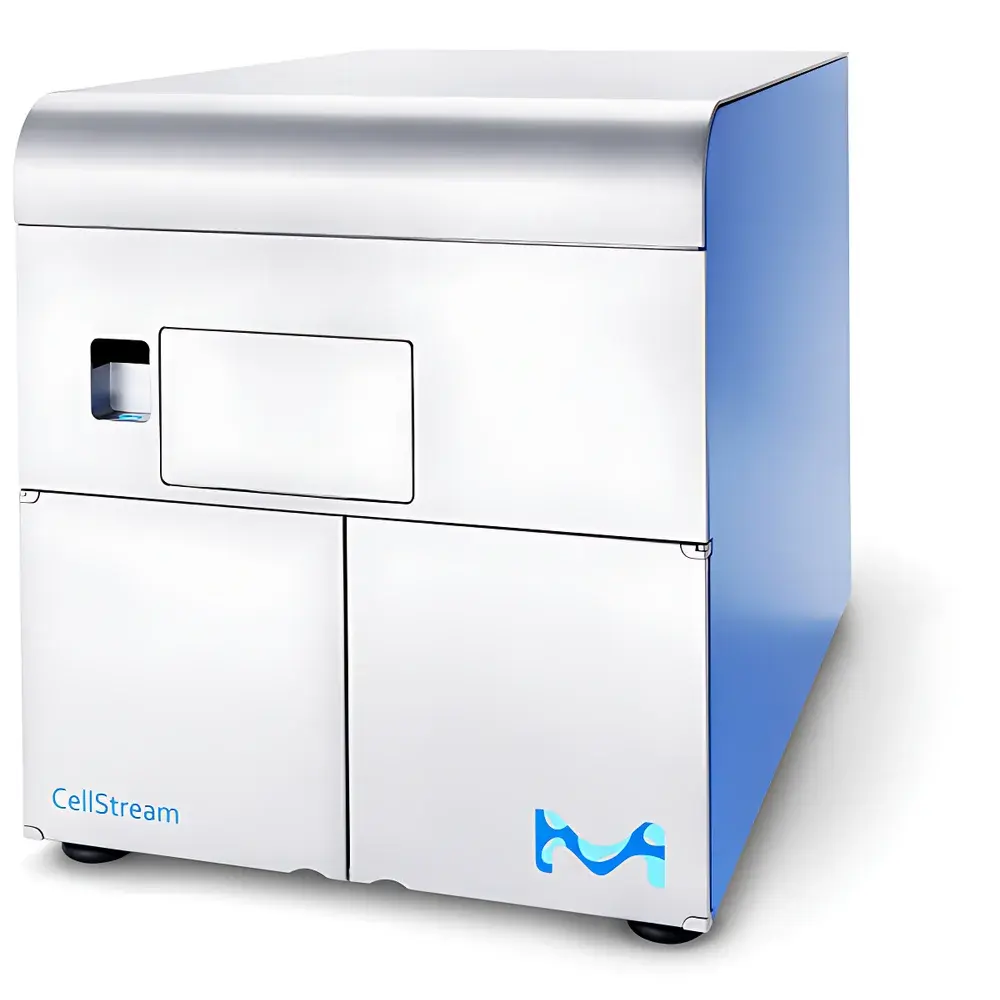

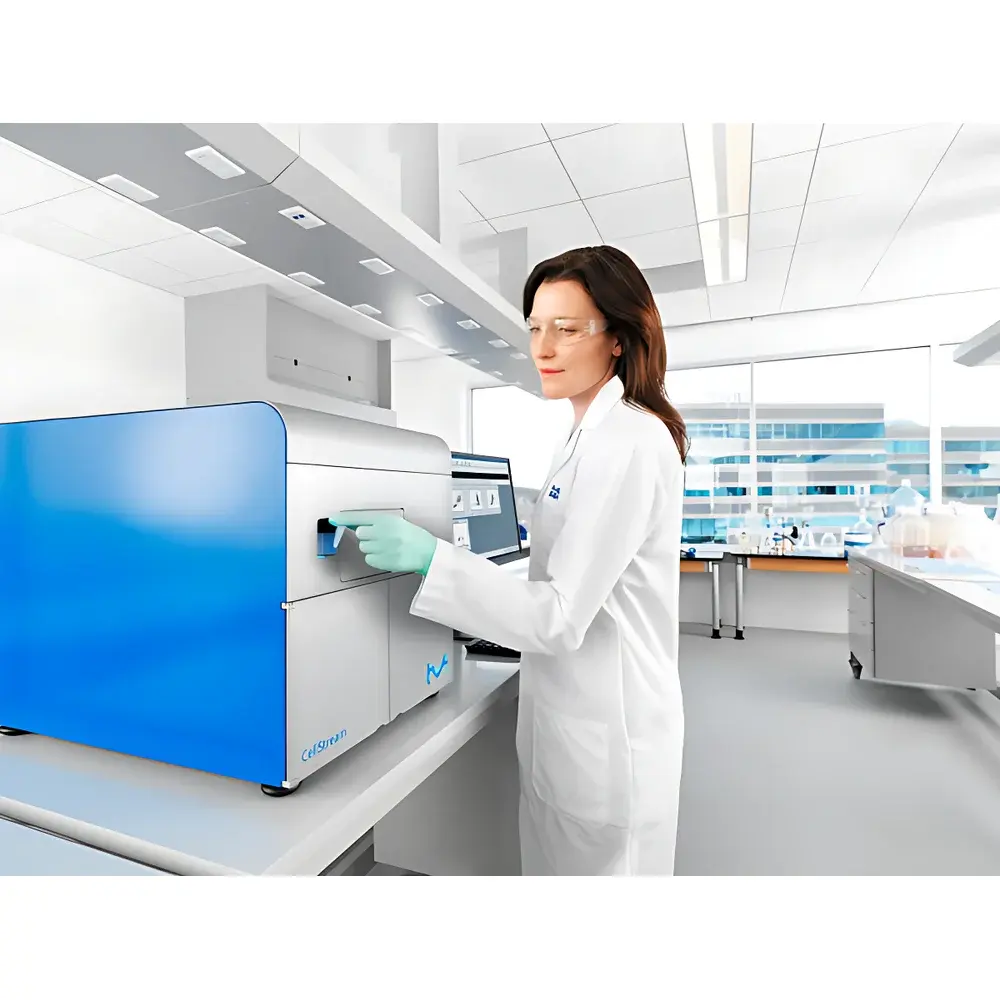
Merck CellStream High-Sensitivity Visual Flow Cytometer
| Brand | Merck |
|---|---|
| Origin | USA |
| Manufacturer Type | Original Equipment Manufacturer (OEM) |
| Product Category | Imported Instrument |
| Model | CellStream |
| Product Type | Flow Cytometry Analyzer |
| Lasers | Up to 7 (configurable) |
| Detection Channels | 22 |
| Fluorescence Sensitivity (MESF) | FITC < 10, PE < 5 |
| Flow Rate | 3.66–14.64 µL/min |
| Fluorescence Detection Limit | 20,000 events/sec |
| Cell Analysis Throughput | FITC MESF < 10, PE MESF < 5 |
| Detector Technology | Time-Delay Integration CCD (TDI-CCD) |
Overview
The Merck CellStream High-Sensitivity Visual Flow Cytometer is an advanced, image-enabled flow cytometry platform engineered for quantitative analysis of rare and submicron biological particles—including extracellular vesicles (EVs), exosomes, apoptotic bodies, and small-diameter immune cell subsets—where conventional flow cytometers reach fundamental detection limits. Unlike traditional photomultiplier tube (PMT)-based systems, the CellStream employs a high-quantum-efficiency Time-Delay Integration CCD (TDI-CCD) detector coupled with a stabilized multi-laser excitation architecture (up to 7 lasers, 22 optical channels). This design enables simultaneous acquisition of spatially resolved fluorescence images and high-fidelity intensity data per event, preserving morphological context while delivering single-event sensitivity at the 100–200 nm particle range. The system operates on hydrodynamically focused laminar flow principles, with precise volumetric sample delivery enabling absolute counting without bead-based calibration—critical for EV quantification, longitudinal clinical monitoring, and regulatory-compliant assay development.
Key Features
- Ultra-high fluorescence sensitivity: <10 MESF for FITC and <5 MESF for PE—validated against NIST-traceable reference standards—enabling reliable detection of low-abundance surface markers on nanoscale vesicles.
- Integrated TDI-CCD imaging detection: Captures >10,000 high-resolution cellular or vesicular images per second with synchronized spectral deconvolution across 22 channels, supporting morphology-informed gating strategies.
- Modular laser architecture: Field-upgradeable from 3 to 7 solid-state lasers (405 nm, 488 nm, 561 nm, 640 nm, etc.), allowing expansion of multiplexing capacity without hardware replacement.
- Volumetric flow control: Precision syringe-pump-driven fluidics deliver stable, pulse-free flow rates between 3.66 and 14.64 µL/min—optimized for low-volume sample conservation and reproducible absolute concentration calculation (objects/µL).
- Single-tube and high-throughput compatibility: Supports both manual single-tube loading and automated 96-well plate integration via optional autosampler—fully programmable for unattended overnight acquisition.
Sample Compatibility & Compliance
The CellStream is validated for direct analysis of minimally processed biological samples including plasma, serum, conditioned cell culture media, cerebrospinal fluid (CSF), and bronchoalveolar lavage (BAL) fluid. Its low-shear fluidics and non-clogging microchannel design minimize shear-induced vesicle disruption and preserve native particle integrity. All optical and fluidic subsystems comply with ISO 13485:2016 for in vitro diagnostic (IVD) device manufacturing. Data acquisition and storage conform to 21 CFR Part 11 requirements when operated with Merck’s validated software suite—including electronic signatures, audit trails, and role-based access control. The platform supports GLP/GMP-aligned workflows through configurable instrument qualification templates (IQ/OQ/PQ) and traceable calibration using Merck-certified reference particles (e.g., Megamix-Plus FSC, ApoCapture™ EV standards).
Software & Data Management
Acquisition and analysis are performed using Merck FlowSight® v6.5 Software—a FDA 21 CFR Part 11-compliant platform featuring real-time image preview, adaptive thresholding, and machine learning-assisted population identification (t-SNE, UMAP, and hierarchical clustering modules). Raw image stacks and parameterized event lists are stored in open-format HDF5 containers, ensuring long-term archival integrity and third-party interoperability (compatible with FlowRepository, Cytobank, and R/Bioconductor packages). Built-in statistical reporting tools generate ISO/IEC 17025-aligned precision profiles (CV%, LOD/LOQ, linearity) for each assay configuration. All software updates undergo rigorous regression testing and are distributed with full version-controlled release notes and cybersecurity vulnerability assessments (CVE-compliant).
Applications
- Extracellular Vesicle Research: Quantification and phenotyping of CD235ab+/CD41+ erythrocyte- and platelet-derived EVs across 5-log dilution series—with demonstrated recovery linearity (R² > 0.998) and inter-instrument CV < 8% (n = 3 instruments, same sample batch).
- Immunophenotyping of Rare Subsets: Identification of CD4−CD8− double-negative T cells, CD38hiHLA-DR+ activated NK subsets, and PD-1+TIM-3+ exhausted T lymphocytes in PBMCs from oncology trials.
- Cell Therapy QC: Release testing of CAR-T products for viability, transduction efficiency, and residual feeder-cell contamination at <0.01% sensitivity.
- Microbiome-Derived Particle Analysis: Discrimination of bacterial membrane vesicles (OMVs) from host-derived debris using forward scatter (FSC) vs. side scatter (SSC) trajectory modeling and lipophilic dye co-staining.
FAQ
What is the minimum detectable particle size under standard operating conditions?
The CellStream achieves consistent detection of spherical polystyrene standards down to 100 nm (as verified by dynamic light scattering correlation) and biological EVs as small as 120–150 nm based on orthogonal cryo-EM validation.
Does the system support spectral unmixing without compensation controls?
Yes—the integrated linear unmixing algorithm uses pre-acquired reference spectra from single-stained controls or database-matched fluorophore signatures, reducing reliance on empirical compensation matrices.
Can I export raw image data for external deep learning model training?
Absolutely. All acquired TIFF sequences and metadata (including laser power, PMT gain, and time stamps) are exported in standardized OME-TIFF format compliant with Bio-Formats and QuPath ingestion pipelines.
Is the instrument compatible with Good Manufacturing Practice (GMP) documentation requirements?
Yes—full GMP documentation support includes configurable electronic batch records (EBRs), instrument logbooks, preventive maintenance scheduling, and deviation tracking aligned with Annex 11 and EU GMP guidelines.
How is calibration maintained across multiple laboratories?
Merck provides annual multi-site calibration verification programs using certified reference materials (CRMs), with remote calibration status monitoring via secure Merck Connect cloud portal and automated alerting for drift thresholds.