
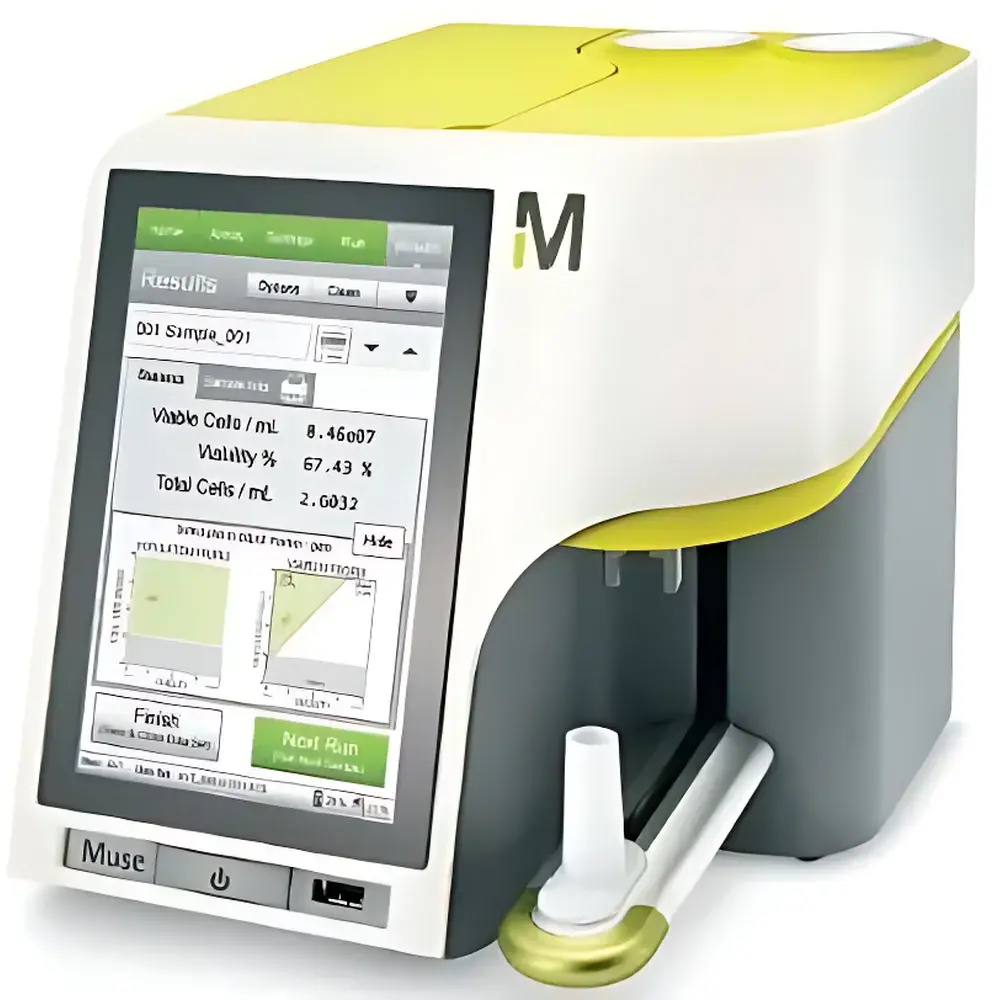
Merck Millipore Muse Smart Touch Cell Analyzer
| Brand | Merck |
|---|---|
| Origin | USA |
| Manufacturer Type | Manufacturer |
| Import Category | Imported |
| Model | Muse |
| Product Type | Flow Cytometry-Based Cell Analyzer |
| Pricing | Available Upon Request |
Overview
The Merck Millipore Muse Smart Touch Cell Analyzer is a compact, benchtop flow cytometry-based cell analysis system engineered for precision, simplicity, and reproducibility in routine and exploratory cell biology workflows. Unlike conventional flow cytometers requiring complex optical alignment, fluidic calibration, and extensive operator training, the Muse platform integrates microfluidic sample handling with dual-laser (488 nm and 635 nm) excitation and two-channel fluorescence detection (FITC/PE and Cy5/PerCP) in a fully self-contained architecture. It employs a proprietary cartridge-based assay format—each single-use cartridge contains pre-optimized reagents, calibrated microchannels, and integrated reference beads—enabling standardized, walk-away operation with minimal user intervention. Designed specifically for labs where throughput, assay consistency, and regulatory traceability are critical—including academic core facilities, bioprocessing QC labs, and early-stage drug discovery units—the Muse analyzer delivers quantitative, publication-ready data for viability, apoptosis, cell cycle, and other phenotypic endpoints without requiring dedicated flow cytometry expertise.
Key Features
- Integrated 7-inch capacitive touch display with embedded Android-based operating system—no external PC required
- Cartridge-driven workflow: pre-aliquoted, lyophilized reagents sealed in sterile, barcode-scannable microfluidic cartridges
- Dual-laser excitation (488 nm blue diode + 635 nm red diode) with simultaneous two-parameter fluorescence detection
- Automated compensation, gating, and analysis via built-in algorithms—no manual thresholding or offline software needed
- On-device data storage with encrypted local database; export options include CSV, PDF, and FCS 3.0-compatible files
- Calibration and performance verification performed automatically at startup using internal reference standards
- CE-IVD marked and compliant with ISO 13485:2016 for in vitro diagnostic use in clinical research environments
Sample Compatibility & Compliance
The Muse platform accepts mammalian suspension cells—including primary isolates, hybridomas, CHO, HEK293, Jurkat, and PBMCs—with input volumes ranging from 50–100 µL per assay. Adherent cells may be analyzed following standard enzymatic or EDTA-based detachment protocols, provided viability remains >70% prior to loading. All assays are validated per ASTM E2877-22 (Standard Guide for Validation of Flow Cytometric Assays) and aligned with ICH S9 and USP guidelines for cell-based assay qualification. The instrument’s firmware and cartridge lot documentation support full audit trail functionality, meeting GLP-compliant record-keeping requirements and enabling retrospective review for FDA 21 CFR Part 11–aligned environments when paired with networked data management systems.
Software & Data Management
The Muse Analyzer runs on a locked-down, real-time Android OS image with application-specific firmware. All analysis modules—including Viability, Apoptosis, Cell Cycle, and Caspase-3/7—are embedded as certified software packages subject to version-controlled release cycles. New assay modules (e.g., Mitochondrial Membrane Potential, DNA Damage Response [γH2AX], T-cell Subsetting, Phospho-Signaling Panels) are distributed via secure over-the-air (OTA) updates—free of charge to all registered users—and undergo internal verification against NIST-traceable reference samples prior to release. Raw event data is stored in FCS 3.0 format with complete metadata (cartridge lot, operator ID, timestamp, instrument serial number), supporting integration into LIMS or ELN platforms via configurable RESTful API endpoints.
Applications
- Routine QC of cell culture harvests and bioreactor runs in upstream bioprocessing
- Apoptosis kinetics profiling during cytotoxicity screening of small-molecule libraries
- Cell cycle arrest validation following CDK inhibitor treatment
- Immunophenotyping of peripheral blood mononuclear cells in translational immunology studies
- Longitudinal monitoring of mitochondrial health in neurodegenerative disease models
- Supporting IND-enabling studies requiring GLP-aligned cell-based assay documentation
FAQ
Is the Muse Analyzer compatible with third-party reagents or custom staining protocols?
No—the system is designed exclusively for use with Merck Millipore–validated, cartridge-integrated assay kits to ensure analytical consistency, regulatory compliance, and instrument longevity.
Can Muse data be exported to FlowJo or other third-party analysis platforms?
Yes—raw FCS 3.0 files contain all detected events with full parameter metadata and are natively importable into FlowJo v10.10+, Cytobank, and FCS Express.
What maintenance is required beyond cartridge replacement?
No routine optical cleaning, fluidic line flushing, or laser recalibration is necessary; the system performs automated diagnostics and self-calibration at each power-on cycle.
Does the Muse platform support multi-user access with role-based permissions?
Yes—on-device user accounts support operator, supervisor, and administrator roles with password protection and activity logging enabled by default.
Are there service contracts or extended warranty options available?
Merck Millipore offers globally supported Platinum Service Plans including next-business-day onsite response, preventive maintenance visits, and priority firmware update deployment.





