
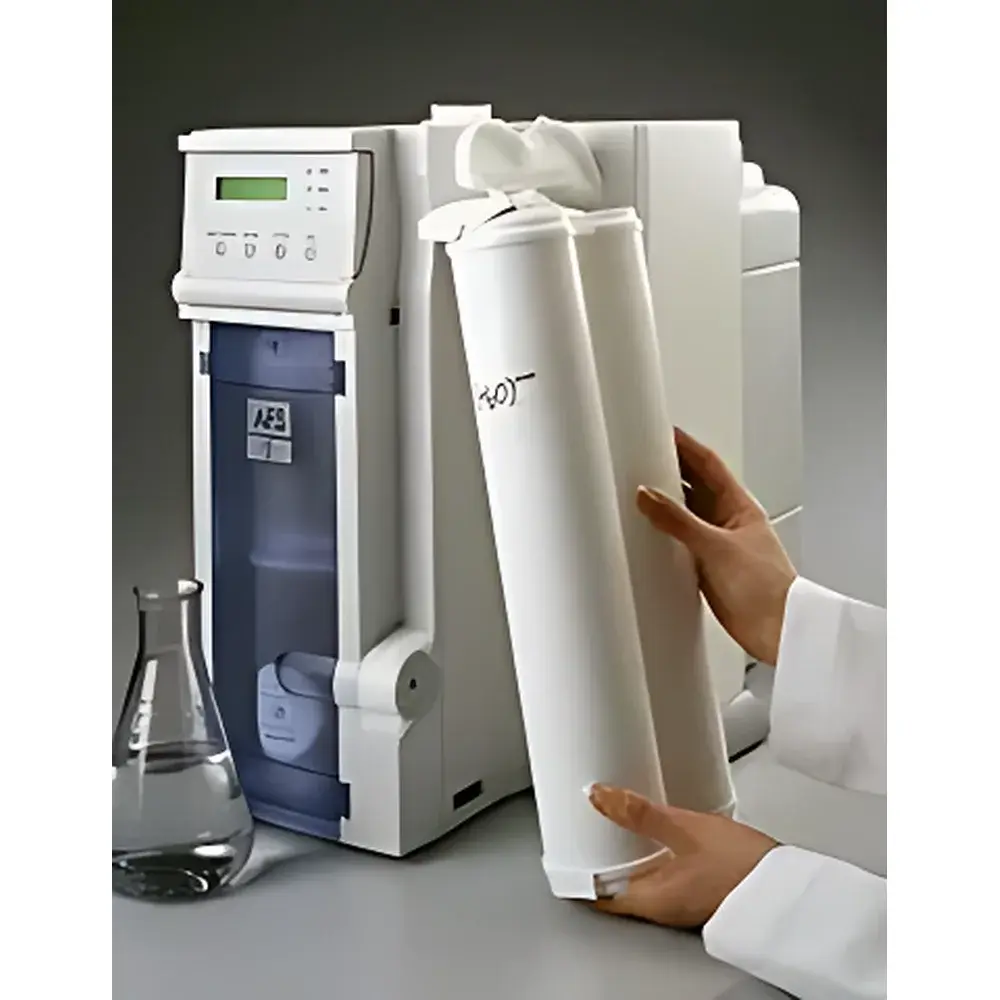
Milli-Q AFS 3/8/16 & Elix Clinical 35/70/100 Automated Feed System for Ultrapure Water Supply
| Brand | Milli-Q |
|---|---|
| Origin | France |
| Manufacturer Type | Original Equipment Manufacturer (OEM) |
| Origin Category | Imported |
| Models | AFS 3/8/16 Elix Clinical 35/70/100 |
| Pricing | Available Upon Request |
| Resistivity | >10 MΩ·cm @ 25 °C |
| Bacterial Count | ≤10 CFU/mL |
| Silica | ≤0.05 mg/L |
| Organic Contaminants | Removed via Activated Carbon & RO Membrane |
| Particulate Filtration | 0.22 µm Final Filter |
| Flow Rates | AFS 3/3D: 3 L/h |
| AFS 8/8D | 8 L/h |
| AFS 16/16D | 16 L/h |
| Elix 35 Clinical | 35 L/h |
| Elix 70 Clinical | 70 L/h |
| Elix 100 | 100 L/h |
| Dimensions | AFS Series: 45.5 × 30 × 35.5 cm |
| Elix Clinical Series | 73.3 × 66.2 × 44.1 cm |
| Recovery Rate | >70% |
| EDI Integration | Integrated Electrodeionization Module |
| Dissolved Oxygen Control | Vacuum Regulator (AFS-D models only) |
Overview
The Milli-Q AFS 3/8/16 and Elix Clinical 35/70/100 Automated Feed Systems are engineered for continuous, on-demand delivery of Type I/II ultrapure water—strictly compliant with NCCLS (now CLSI) and CAP guidelines for clinical laboratory applications. Designed as integrated feed solutions rather than standalone purification units, these systems accept municipal tap water as inlet feed and deliver stabilized, low-particulate, low-bacterial, low-ionic water directly to automated analyzers—including chemistry analyzers, immunoassay platforms, hematology instruments, and molecular diagnostics workstations. The core architecture combines multi-stage pretreatment (sediment filtration, activated carbon adsorption, and reverse osmosis), followed by electrodeionization (EDI) and final polishing via mixed-bed ion exchange and 0.22 µm membrane filtration. Unlike conventional point-of-use purifiers, the AFS/Elix Clinical series operates as a centralized, high-flow distribution node—eliminating intermediate storage tanks and minimizing microbial regrowth risk through continuous circulation and pressure-driven delivery.
Key Features
- Direct analyzer coupling: Seamless integration with major OEM clinical analyzers (e.g., Roche Cobas, Siemens Atellica, Abbott Architect, Beckman Coulter AU/DxH series) via standardized 3/8″ or 1/2″ tubing interfaces and programmable flow-pressure profiles.
- Patented EDI-enhanced deionization: Integrated electrodeionization module continuously regenerates ion-exchange resins electrochemically—extending cartridge service life up to 6× versus conventional DI-only systems and reducing consumable replacement frequency and total cost of ownership.
- Dissolved oxygen management (AFS-D models): Built-in vacuum regulator actively controls inlet dissolved oxygen concentration to <0.5 mg/L, mitigating oxidative degradation of sensitive reagents and calibration standards in hematology and coagulation assays.
- High recovery efficiency: RO stage achieves >70% water recovery—significantly lowering wastewater volume and operational costs in high-throughput laboratories operating 24/7.
- Modular scalability: AFS 3/8/16 units serve low-to-mid throughput labs; Elix Clinical 35/70/100 variants support consolidated core labs, reference laboratories, and hospital central labs requiring uninterrupted 35–100 L/h sustained flow at consistent resistivity (>10 MΩ·cm).
Sample Compatibility & Compliance
The system delivers water meeting CLSI EP28-A3 and CAP Laboratory Accreditation Program requirements for Type I (clinical grade) and Type II (general lab use) purified water. It is validated for compatibility with critical diagnostic workflows including enzymatic colorimetry, turbidimetric immunoassays, electrophoresis buffers, and reagent preparation for PCR and NGS library construction. All wetted components comply with USP Class VI and FDA 21 CFR 177.2490 for food-contact polymers. The design supports GLP/GMP-aligned documentation: full audit trail logging (via optional Ethernet/RS232 interface), electronic signature capability, and configurable alarm thresholds for resistivity, pressure, flow rate, and UV intensity—all traceable per ISO/IEC 17025 and ISO 9001 quality management frameworks.
Software & Data Management
The embedded control system features a 4.3-inch capacitive touchscreen HMI with multilingual UI (English, French, German, Spanish, Chinese). Real-time monitoring includes resistivity (µS/cm and MΩ·cm), TOC (optional add-on), temperature, feed pressure, and cumulative volume dispensed. Data export supports CSV and PDF formats via USB or network transfer. For regulated environments, optional software modules provide 21 CFR Part 11-compliant user access control, electronic records retention (≥12 months), and change history tracking for all parameter modifications. Calibration logs, maintenance alerts, and consumable lifetime counters are automatically timestamped and exportable for internal QA review or external auditor requests.
Applications
- Clinical chemistry and immunochemistry analyzers requiring stable, low-conductivity rinse and diluent water.
- Hematology and coagulation instruments where dissolved oxygen and silica content impact platelet function and fibrinogen assay precision.
- Automated sample preparation workstations (e.g., for DNA extraction or protein precipitation) demanding particle-free water to prevent clogging of microfluidic channels.
- Centralized lab water hubs serving multiple floors or departments via pressurized loop distribution.
- Research labs validating diagnostic assays under CLIA, CAP, or ISO 15189 accreditation scopes.
FAQ
Does the AFS/Elix Clinical system require pre-treatment of municipal feed water?
Yes—feed water must meet local drinking water standards (e.g., EPA 600/R-98/011 or WHO Guidelines) and be free of excessive chlorine, iron, or hardness (>100 ppm CaCO₃ requires optional softener integration).
Can the system be validated for ISO 15189 compliance?
Yes—full IQ/OQ/PQ documentation packages, including protocol templates, test records, and calibration certificates, are available upon request and align with ISO/IEC 17025 Annex A.2.
What is the expected service life of the EDI module?
Under typical clinical lab usage (8–12 h/day, 5 days/week), the EDI stack maintains nominal performance for ≥36 months before scheduled refurbishment.
Is remote monitoring supported?
Standard Ethernet port enables SNMP-based network monitoring; optional cloud connectivity (Milli-Q Connect) provides real-time dashboards and predictive maintenance alerts via secure TLS 1.2 encrypted transmission.
How does the system handle power interruptions?
Integrated UPS-ready circuitry retains configuration memory and resumes operation at pre-interruption setpoints; no recalibration required after brief outages (<30 min).



