
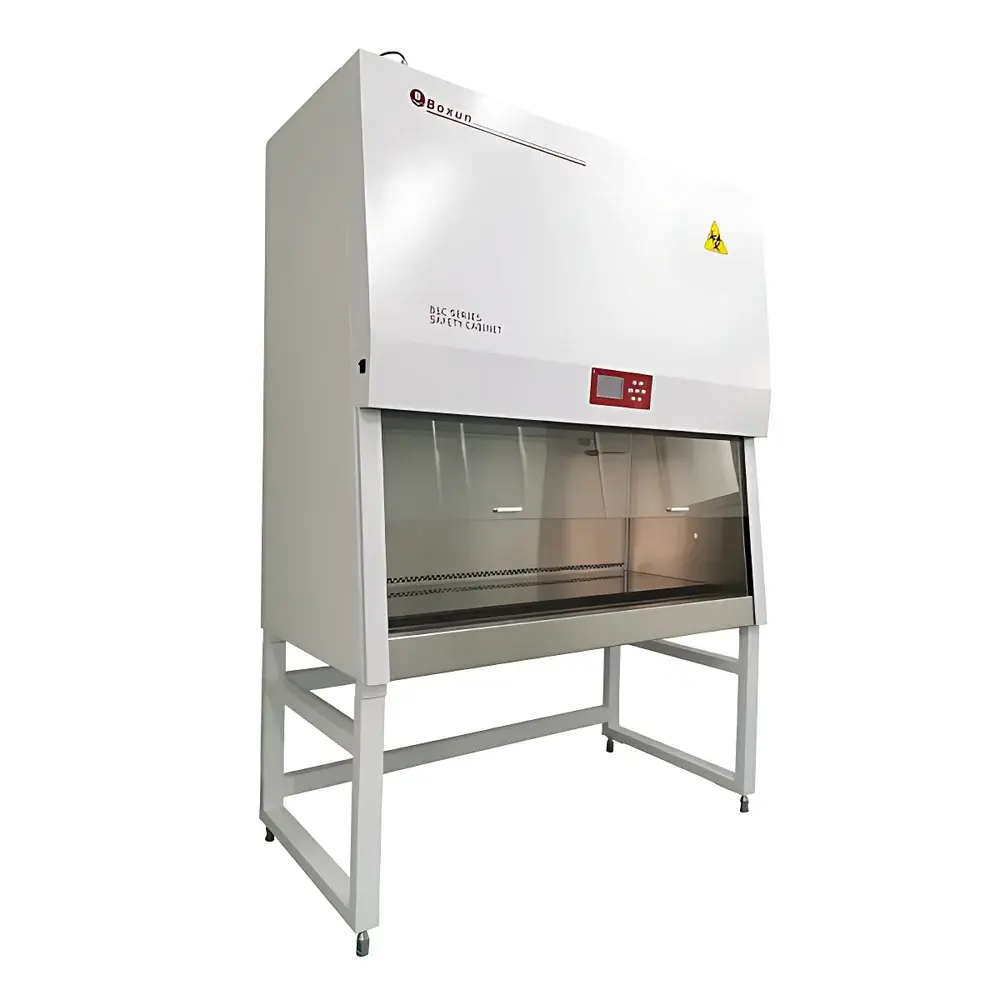
Brookfield BSC-1360A2 Class II Type A2 Biological Safety Cabinet
| Brand | Brookfield |
|---|---|
| Origin | Shanghai, China |
| Model | BSC-1360A2 |
| Cabinet Class | Class II, Type A2 |
| External Dimensions (L×W×H) | 1500 × 770 × 2135 mm |
| Internal Work Area (L×W×H) | 1360 × 580 × 595 mm |
| Airflow Mode | 70% recirculated, 30% exhausted |
| Inflow Velocity | 0.55 m/s ± 0.02 m/s |
| Downflow Velocity | 0.35 m/s ± 0.02 m/s |
| HEPA Filter Efficiency | ≥99.998% @ 0.3 µm |
| Noise Level | ≤67 dB(A) |
| Illumination | ≥650 lux |
| Power Supply | AC 220 V ±10%, 50/60 Hz |
| Total Power Consumption | 1.4 kW |
| Personnel Protection Factor (KI test) | ≥1 × 10⁵ |
| Product Protection (CFU/test) | ≤5 CFU |
| Cross-Contamination Protection (impactor sampling) | ≤2 CFU |
| Operating Temperature | 10–30 °C |
| Relative Humidity | ≤70% @ 25 °C |
| Ambient Pressure Range | 80–105 kPa |
Overview
The Brookfield BSC-1360A2 is a certified Class II, Type A2 Biological Safety Cabinet engineered for reliable personnel, product, and environmental protection in biosafety level 1–2 (BSL-1/BSL-2) laboratories. It operates on the principle of laminar airflow combined with dual-stage filtration—using a pre-filter and a certified HEPA filter (ISO 5, equivalent to NSF/ANSI 49 Class II standards)—to maintain a sterile work environment. Air is drawn inward through the front opening at a controlled inflow velocity (0.55 m/s), passes across the work surface, and undergoes partial recirculation (70%) after filtration, while 30% is exhausted via a dedicated ducted or thimble-connected system. This configuration ensures containment of aerosols generated during microbiological manipulations, including those involving recombinant DNA, clinical specimens, and low-to-moderate risk biological agents. The cabinet meets international design and performance criteria aligned with ISO 14644-1 (cleanroom classification), EN 12469:2000, and NSF/ANSI 49–2022 for Class II cabinets.
Key Features
- Advanced AirClean intelligent control system with full-color LCD interface displaying real-time inflow/downflow velocity, HEPA filter lifetime estimation, and operational status of UV lamp, lighting, blower, and power outlets.
- Auto-compensating constant-airflow technology: high-precision anemometric feedback enables dynamic motor speed adjustment; airflow stability maintained within ±0.02 m/s even when filter resistance increases by up to 50%, with exhaust volume reduction <10%.
- Dual interlock safety: UV irradiation automatically deactivates upon illumination activation; mechanical and optical sensors enforce front sash height limits (±5 mm tolerance), triggering audible/visual alarms if deviation compromises negative pressure integrity.
- ISO 5–compliant workspace: constructed from seamless, welded SUS304 stainless steel with radius-rounded corners and sloped 10° tempered glass sash—optimized for ergonomics, glare reduction, and UV/impact resistance.
- Integrated utility management: recessed, splash-proof AC sockets with programmable timer function; provisioned water/gas quick-connect ports; removable stainless steel work surface with integrated liquid collection trough and drain valve.
- HEPA filter system: uses imported filter media meeting IEST-RP-CC001.3 specifications; standard configuration achieves ≥99.998% efficiency at 0.3 µm; optional ULPA (ISO 4) upgrade available for enhanced particulate retention (≥99.9995%).
Sample Compatibility & Compliance
The BSC-1360A2 supports routine handling of cell cultures, bacterial/viral suspensions, primary tissues, and genetically modified organisms under BSL-2 conditions. Its airflow dynamics and containment validation—performed using potassium iodide (KI) tracer gas challenge and microbial impactor assays—demonstrate compliance with personnel protection factor (PPF) ≥1 × 10⁵, product protection (≤5 CFU per test), and cross-contamination control (≤2 CFU per impactor test). All structural and functional verifications are traceable to ISO 14644-1 cleanroom certification protocols and align with GLP-compliant laboratory infrastructure requirements. The unit is suitable for use in academic research labs, clinical diagnostics centers, biopharmaceutical QC facilities, and vaccine manufacturing environments governed by WHO TRS 961 Annex 2 and EU GMP Annex 1 guidelines.
Software & Data Management
While the BSC-1360A2 does not incorporate cloud-based or networked software, its embedded firmware supports audit-ready event logging—including sash position history, UV exposure duration, filter usage hours, alarm triggers, and operational mode transitions. Logs are stored locally in non-volatile memory and exportable via USB interface for integration into institutional electronic lab notebooks (ELN) or LIMS platforms. The control system supports time-stamped calibration verification records and retains data for ≥12 months. All user-accessible settings—including UV scheduling, lighting intensity presets, and outlet timers—are password-protected to ensure procedural consistency and regulatory traceability under FDA 21 CFR Part 11 (when deployed with supplementary electronic signature controls).
Applications
- Molecular biology workflows: plasmid transfection, CRISPR-Cas9 editing, and lentiviral vector preparation requiring sterility and aerosol containment.
- Clinical microbiology: isolation and subculture of pathogenic bacteria (e.g., Mycobacterium tuberculosis, Staphylococcus aureus) and fungal species from patient samples.
- Cell therapy QA/QC: aseptic manipulation of human mesenchymal stem cells (hMSCs) and induced pluripotent stem cells (iPSCs) prior to cryopreservation or formulation.
- Vaccine development: handling of attenuated viral strains during seed stock expansion and adjuvant mixing under validated ISO 5 conditions.
- Regulatory testing: USP sterility testing, EP 2.6.1 microbial enumeration, and ISO 11737-1 bioburden assessment where operator protection and sample integrity are co-dependent.
FAQ
What biosafety level is the BSC-1360A2 rated for?
It is certified for BSL-2 applications and may be used for certain BSL-1 procedures requiring enhanced containment.
Is ducting required for safe operation?
Yes—Type A2 cabinets require either hard-ducted exhaust to the exterior or connection to a thimble system with dedicated makeup air supply to maintain stable inflow velocity and prevent room air imbalance.
Can the HEPA filter be replaced in-house?
Filter replacement must be performed by authorized service personnel following ISO 14644-3 leak-testing protocols; post-replacement certification is mandatory before revalidation.
Does the cabinet support integration with building management systems (BMS)?
No native BACnet or Modbus interface is provided; however, dry-contact alarm outputs are available for external monitoring relay integration.
What maintenance intervals are recommended?
Pre-filters should be inspected weekly and replaced every 3–6 months depending on ambient particulate load; HEPA filters typically last 5–7 years under normal use but require annual integrity testing per EN 1822.



