
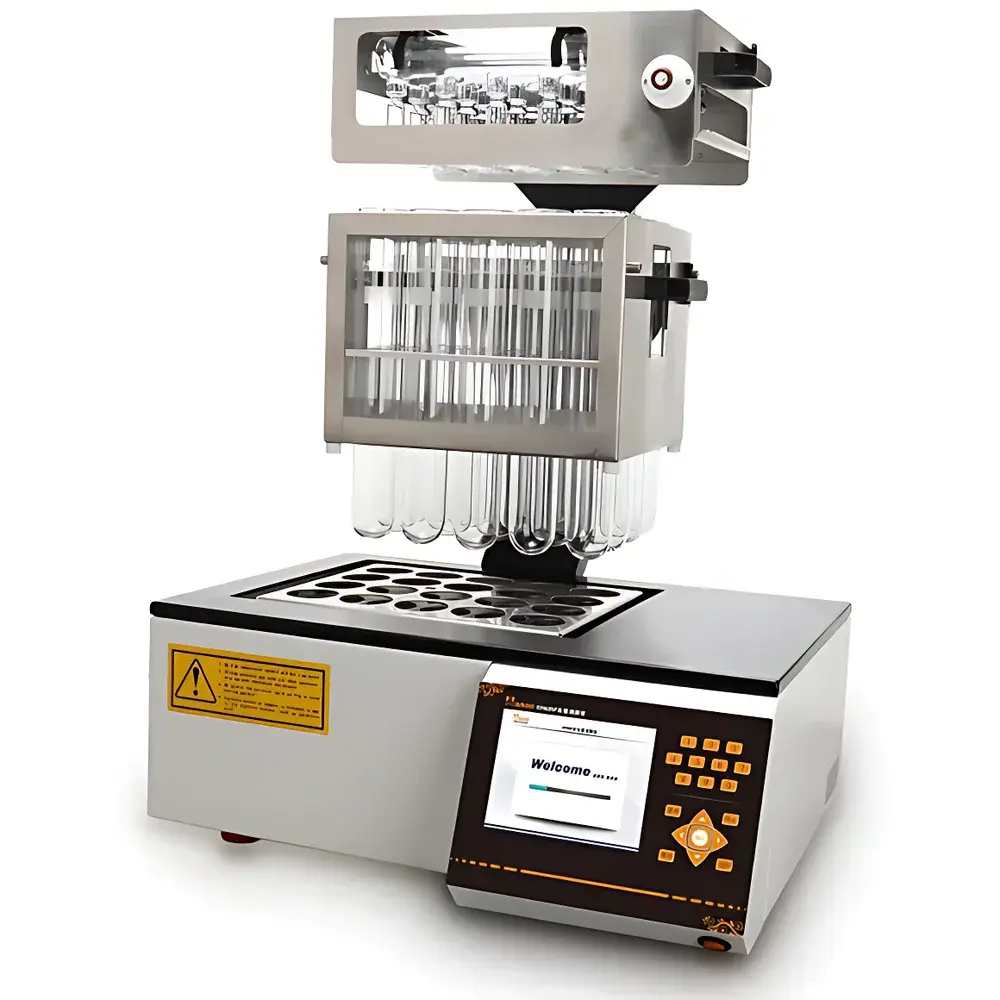
Hanon SH420F Graphite Block Digestion System
| Brand | Hanon |
|---|---|
| Origin | Shandong, China |
| Model | SH420F |
| Instrument Type | Graphite Block Digestion System |
| Automation Level | Fully Automatic |
| Sample Capacity | 20 positions |
| Temperature Range | Ambient +5°C to 450°C |
| Temperature Accuracy | ±1°C |
| Heating Principle | Infrared Radiation + High-Purity Graphite Thermal Conduction |
| Reagent Handling | Simultaneous digestion of 20 samples |
| Display | 5.6-inch full-color LCD touchscreen |
| Safety Features | Over-temperature, over-current, over-voltage protection with audible/visual alarm |
| Insulation | Ceramic barrier + optimized air-channel thermal isolation |
| Surface Finish | PTFE-coated corrosion-resistant housing |
| Cooling | Standard quick-cooling rack (manual post-digestion cooling) |
| Compliance | Designed for ISO/IEC 17025-compliant labs |
Overview
The Hanon SH420F Graphite Block Digestion System is a fully automated, high-precision sample preparation instrument engineered for reproducible, trace-metal-grade acid digestion in environmental, food, agricultural, pharmaceutical, and clinical laboratories. It employs a dual-mode heating architecture—combining focused infrared radiation with uniform thermal conduction through high-purity graphite blocks—to deliver rapid, spatially homogeneous heating across all 20 digestion positions. Unlike conventional ceramic or metal-block heaters, the graphite matrix ensures minimal inter-well temperature deviation (<±1.5°C at 400°C), critical for achieving consistent decomposition of organic matrices and quantitative recovery of analytes such as heavy metals (Pb, Cd, As, Hg), nutrients (K, Ca, Mg), and halogens. The system operates under microprocessor-controlled PID algorithms, enabling precise ramp-and-hold thermal programming essential for method compliance with EPA Method 3050B, ISO 11466, ASTM D5191, and USP . Its modular design supports seamless integration into regulated workflows where documentation integrity, operator safety, and environmental stewardship are non-negotiable.
Key Features
- Fully automatic 20-position digestion platform with programmable thermal profiles up to 500 user-defined methods, each supporting up to 25 independent temperature–time segments
- Infrared-assisted graphite block heating: achieves ambient-to-400°C ramp in ≤25 minutes with <±1°C setpoint accuracy and <±1.5°C well-to-well uniformity
- 5.6-inch full-color TFT LCD interface with intuitive icon-based navigation, real-time temperature graphing, and on-screen method editing
- PTFE-coated stainless steel chassis and graphite block housing resistant to concentrated HNO₃, HCl, HF, H₂SO₄, and aqua regia exposure
- Dual-layer thermal isolation: ceramic thermal barrier + engineered air-channel convection suppression minimizes external surface temperature rise (<50°C at 450°C operation)
- Integrated hardware-level safety: triple-redundant thermal cutoff (primary PID control, secondary thermistor monitoring, tertiary mechanical fuse), over-current/voltage detection, and audible/visual fault alerts
- Standard quick-cooling rack enables manual post-digestion sample quenching—reducing cycle time without compromising digest stability
Sample Compatibility & Compliance
The SH420F accommodates standard 300 mL borosilicate or quartz digestion tubes (e.g., SCP Science, Milestone, or Anton Paar formats) and is validated for use with open-vessel digestion protocols per AOAC 999.10, EPA 3050B, and ISO 11466. Its corrosion-resistant construction meets IEC 61010-1 safety requirements for laboratory electrical equipment. When paired with the optional WD03 exhaust management system and S402 neutralization module, the platform satisfies local occupational health regulations (OSHA 29 CFR 1910.1200, EU Directive 2004/37/EC) by reducing operator exposure to acidic vapors (HNO₃, HCl, SO₂). The system’s firmware architecture supports electronic record retention for GLP/GMP environments; when connected to a networked LIMS, it enables timestamped method execution logs and parameter change history—aligning with FDA 21 CFR Part 11 data integrity expectations for audit-ready operations.
Software & Data Management
The embedded control firmware provides deterministic real-time scheduling with millisecond-level timer resolution. Users may select between linear and multi-segment curve-based heating profiles, with automatic dwell stabilization confirmation before advancing to the next step. All methods—including temperature ramps, hold durations, power modulation, and cooling delay—are stored in non-volatile memory with checksum validation. The interface supports USB export of CSV-formatted run logs (start time, target temp, actual temp per minute, error flags, completion status). No proprietary software installation is required: method files are human-readable plain-text configurations editable via standard text editors. For enterprise deployment, the system accepts Modbus RTU commands over RS-485, enabling centralized orchestration within automated sample prep lines.
Applications
- Environmental analysis: soil, sediment, sludge, and wastewater digests for ICP-MS/OES quantification of regulated metals (Cd, Cr, Ni, Pb, As)
- Food safety testing: total arsenic speciation support, pesticide residue matrix cleanup prior to GC-MS/MS
- Clinical toxicology: biological tissue (liver, kidney, hair) digestion for elemental profiling
- Geochemical research: rock and mineral dissolution using HF-HNO₃-HClO₄ mixtures
- Pharmaceutical QC: excipient and active ingredient screening for catalyst residues (Pd, Pt, Rh)
- Academic teaching labs: standardized digestion training with visual feedback and fail-safe thermal limits
FAQ
What digestion tube sizes are supported?
The SH420F is configured for 300 mL tall-form digestion vessels (standard outer diameter: 50 mm); custom adapters are available for 50–100 mL tubes.
Is remote monitoring or control possible?
Yes—via RS-485 Modbus RTU interface; Ethernet or Wi-Fi connectivity requires external protocol gateway (not included).
Does the system comply with ISO/IEC 17025 documentation requirements?
It generates timestamped, immutable run logs; full compliance requires integration with a validated LIMS or ELN for electronic signature and audit trail management.
Can the SH420F be used for closed-vessel microwave digestion support?
No—it is designed exclusively for open-vessel, atmospheric-pressure digestion; however, it serves as an ideal pre-concentration or post-digestion evaporation station.
What maintenance is required for long-term reliability?
Annual verification of thermocouple calibration and inspection of PTFE coating integrity; graphite block replacement recommended after 5,000 cycles or visible pitting.
Related Products



