
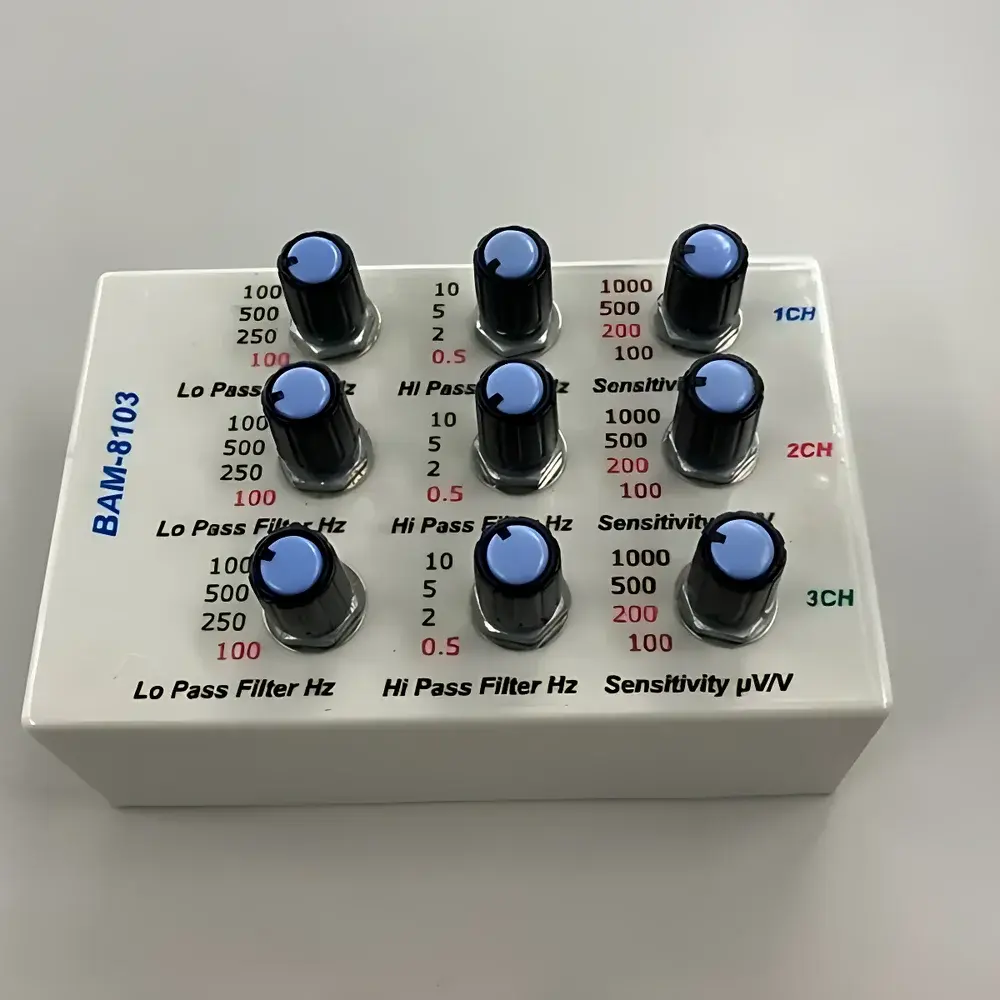
FM Headstage Amplifier BAS-8103 by KISSEI
| Brand | KISSEI |
|---|---|
| Origin | Japan |
| Model | BAS-8103 |
| Power Supply | +5 V ±5% (from PC AD card) |
| Current Consumption | < ±2.8 mA |
| Input Connector | 2-pin socket |
| Number of Channels | 3 |
| Gain Settings | 100, 200, 500, 1000 µV/V |
| Low-Pass Filter Cutoff Frequencies | 100, 250, 500, 1000 Hz |
| High-Pass Filter Cutoff Frequencies | 0.5, 2, 5, 10 Hz |
| Input Impedance | > 10 MΩ |
| Input-Referred Noise | < 5 µVp-p |
| Weight | < 40 g |
| Dimensions | 65 × 35 × 100 mm |
Overview
The FM Headstage Amplifier BAS-8103 is a compact, low-noise, three-channel headstage amplifier engineered for high-fidelity acquisition of weak bioelectrical signals in awake, freely moving, or restrained rodent and small-mammal preparations. Designed specifically for integration with standard PC-based data acquisition systems—particularly those utilizing analog-to-digital (AD) cards operating at +5 V logic levels—the BAS-8103 functions as an impedance-matching preamplifier placed directly at the electrode interface. Its core architecture employs active filtering and precision gain staging to minimize signal degradation from cable capacitance, electromagnetic interference (EMI), and thermal noise—critical constraints in chronic electrophysiology experiments involving EEG, EMG, EOG, or single-unit extracellular recordings. Unlike conventional benchtop amplifiers, the BAS-8103’s headstage configuration ensures optimal common-mode rejection ratio (CMRR) and preserves signal integrity over extended cable runs, making it suitable for behavioral paradigms requiring simultaneous locomotion tracking and neural monitoring.
Key Features
- Three independent, fully isolated input channels with selectable voltage gain (100 / 200 / 500 / 1000 µV/V), enabling flexible scaling across signal amplitudes—from microvolt-level EEG oscillations to millivolt-range EMG bursts.
- Dual-stage analog filtering: programmable high-pass (0.5 / 2 / 5 / 10 Hz) and low-pass (100 / 250 / 500 / 1000 Hz) cutoffs implemented via precision passive RC networks and active op-amp topologies, supporting compliance with ISO 14155 and ICH E6(R3) signal conditioning requirements for preclinical neurophysiology studies.
- Input impedance exceeding 10 MΩ at 1 kHz ensures minimal loading of high-impedance microelectrodes (e.g., tungsten, glass micropipettes, or chronically implanted microwire arrays), preserving signal fidelity and reducing baseline drift.
- Ultra-low input-referred noise (< 5 µVp-p, measured over 0.1–100 Hz bandwidth) enables reliable detection of subthreshold neuronal activity and fine-grained muscle fiber recruitment patterns without digital post-processing artifacts.
- Lightweight (≤40 g) and compact form factor (65 × 35 × 100 mm) allows secure mounting on animal headcaps or lightweight tethering systems, minimizing mechanical perturbation during operant conditioning, fear conditioning, or open-field assays.
- Powered exclusively from the host PC’s AD card (+5 V ±5%), eliminating external power supplies and associated ground-loop risks—a design aligned with GLP-compliant electrophysiology workflows where electrical safety and traceability are mandated.
Sample Compatibility & Compliance
The BAS-8103 is validated for use with stainless steel, platinum-iridium, and tungsten microelectrodes; dry-contact surface EMG electrodes; and chronically implanted screw or pedestal-based EEG anchors in mice, rats, and gerbils. It complies with IEC 61000-4-3 (radiated immunity) and IEC 61000-4-6 (conducted immunity) standards for laboratory-grade biomedical instrumentation. While not FDA-cleared for human use, its signal chain design adheres to principles outlined in ASTM F2503 (Standard Practice for Labeling Medical Devices) and supports audit-ready documentation per 21 CFR Part 11 when paired with compliant DAQ software featuring electronic signatures and change logs.
Software & Data Management
The amplifier interfaces transparently with widely adopted acquisition platforms including National Instruments DAQmx, Spike2 (CED), and MATLAB-based custom acquisition toolboxes. No proprietary drivers are required; raw analog outputs are routed directly to the AD card’s differential inputs. Filter settings and gain configurations are manually selected via DIP switches—ensuring deterministic, real-time signal conditioning without firmware dependencies or latency-inducing USB handshaking. This architecture facilitates full traceability of hardware-level parameters in experimental metadata, satisfying GLP/GMP documentation requirements for longitudinal neurobehavioral studies.
Applications
- Chronic EEG/EMG telemetry-free monitoring in sleep-wake cycle analysis and seizure onset detection.
- Real-time feedback-triggered stimulation protocols in optogenetic or chemogenetic closed-loop experiments.
- High-temporal-resolution correlation of motor output (hindlimb EMG) with cortical LFP during skilled reaching or rotarod performance.
- Multi-site field potential recording across hippocampal–prefrontal–amygdala circuits during associative learning tasks.
- Validation of novel electrode materials and geometries under physiologically relevant signal-to-noise conditions.
FAQ
Is the BAS-8103 compatible with USB-based data acquisition systems?
No—it requires a +5 V-powered analog input card with sufficient current sourcing capability (≥±3 mA per channel). USB DAQ devices lacking regulated +5 V auxiliary rails are not supported.
Can gain and filter settings be changed dynamically during recording?
No—DIP-switch configuration is fixed per session. Dynamic adjustment would require hardware redesign to incorporate digitally controlled analog switches, which is outside the scope of this analog headstage architecture.
What is the recommended electrode-to-amplifier cable length?
For optimal noise performance, keep coaxial leads ≤15 cm between electrode connector and BAS-8103 input. Longer cables increase capacitive loading and degrade high-frequency response above 500 Hz.
Does the unit include built-in A/D conversion?
No—BAS-8103 is an analog-only headstage. Digitization must occur externally via the host PC’s AD card or a dedicated digitizer.
Is calibration documentation provided with shipment?
Yes—each unit ships with a factory verification report listing measured gain error (±1.2% typical), CMRR (>90 dB at 60 Hz), and noise spectral density at all filter/gain combinations.
Related Products




