
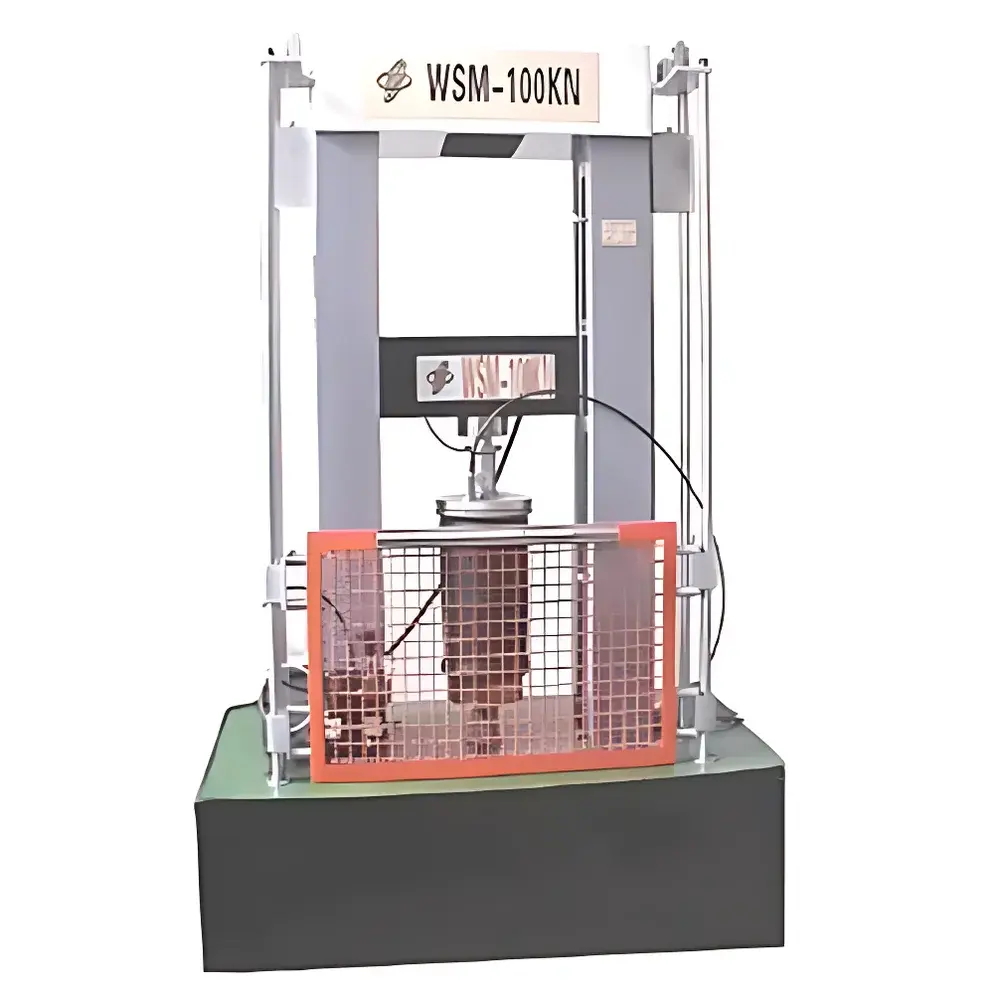
Air Spring Characterization Test System PQH-80 by Changchun Intelligent
| Brand | Changchun Intelligent |
|---|---|
| Origin | Jilin, China |
| Model | PQH-80 |
| Maximum Load Capacity | 100 kN |
| Crosshead Speed Range | 0.2–200 mm/min (±0.5% accuracy) |
| Pressure Source | Integrated Air Compressor (up to 1.0 MPa) + Separate Hydrostatic Burst Test Unit (up to 2.5 MPa, ramp rate 100 kPa/min) |
| Displacement Sensors | Dual-axis high-precision extensometers — axial range 200–600 mm (±1.0 mm), radial diameter change range 0–200 mm (±0.05 mm) |
| Force Transducer | Sartorius (USA) load cell |
| Drive System | Precision ground ball screw (Germany) |
| Control & Data Acquisition | Full-digital PC-based control system running Windows OS with native Chinese GUI |
| Compliance | Designed for ASTM D395, ISO 7627, and GB/T 13347 test protocols |
| Safety | Integrated protective cage and emergency stop circuitry |
Overview
The PQH-80 Air Spring Characterization Test System is an electromechanical testing platform engineered specifically for the static and quasi-static mechanical evaluation of pneumatic suspension components used in automotive, rail, and industrial applications. It operates on the principle of controlled uniaxial compression under simultaneous pneumatic pressure regulation and multi-parameter dimensional monitoring. Unlike generic universal testing machines, the PQH-80 integrates synchronized force, displacement, internal pressure, axial deformation, and radial diameter change measurement channels—enabling concurrent acquisition of four fundamental performance curves: (1) compressive load vs. axial deflection, (2) internal air pressure vs. axial deflection, (3) compressive load vs. lateral diameter expansion, and (4) compressive load vs. effective volume change. This capability supports full characterization of nonlinear viscoelastic behavior, hysteresis, pressure-dependent stiffness, and geometric compliance—critical parameters for vehicle dynamics modeling, durability validation, and OEM specification compliance.
Key Features
- 100 kN rated load capacity with high-resolution Sartorius force transducer (traceable calibration certificate available upon request)
- Precision-ground German ball screw drive system ensures smooth, backlash-free motion across the full speed range of 0.2–200 mm/min, with closed-loop positional accuracy better than ±0.5% of reading
- Dual-channel extensometry: axial extensometer (200–600 mm range, ±1.0 mm resolution) and radial diameter sensor (0–200 mm range, ±0.05 mm resolution) mounted orthogonally to capture coupled deformation modes
- Integrated pneumatic subsystem including oil-free air compressor, pressure regulator, digital manometer (0–1.0 MPa, ±0.5% FS), solenoid valves, and leak-tight quick-connect fittings compatible with standard air spring inlet ports
- Independent hydrostatic burst test module capable of controlled pressure ramping up to 2.5 MPa at 100 kPa/min, with real-time pressure logging and automatic hold/abort logic per ISO 1402 and GB/T 7939
- Full-enclosure safety cage with interlocked access doors and emergency stop circuit compliant with EN ISO 13857 and GB 5226.1
Sample Compatibility & Compliance
The PQH-80 accommodates air springs with nominal diameters from 120 mm to 500 mm and heights between 100 mm and 400 mm using interchangeable upper and lower support platens with concentric alignment guides. Fixture sets include conical adapters, flat-faced plates, and adjustable clamping rings to secure bellows-type, rolling lobe, and sleeve-style air springs without slippage or edge loading. The system is configured to execute standardized test sequences defined in ASTM D395 Method B (compression set), ISO 7627 (pneumatic spring stiffness), and China’s GB/T 13347 (automotive air spring performance requirements). All hardware and software components meet electromagnetic compatibility (EMC) Class B requirements per EN 61326-1 and are suitable for GLP-compliant laboratories conducting type approval testing for Tier 1 suppliers.
Software & Data Management
The native Windows-based control software provides real-time dual-axis plotting (e.g., force vs. displacement + pressure vs. diameter), programmable test profiles (ramp-hold-ramp, cyclic loading, step-pressure sweeps), and automated report generation in PDF or Excel formats. Raw data files (.csv) include timestamps, analog channel readings (load, position, pressure, diameter), and system status flags. Audit trail functionality records user login, method edits, calibration events, and test execution logs—supporting 21 CFR Part 11 readiness when paired with network authentication and electronic signature modules. Data export conforms to ASTM E1447 and ISO/IEC 17025 traceability frameworks.
Applications
- OEM and Tier-1 validation of air spring static stiffness, dynamic hysteresis, and pressure-volume relationships across temperature-controlled environments
- Development of nonlinear finite element models requiring experimentally derived constitutive data for rubber-cord composite membranes
- Comparative analysis of aging effects (ozone exposure, thermal cycling) on load-deflection hysteresis loops
- Quality assurance testing per incoming inspection plans, including batch sampling for compressive yield and burst resistance
- Support for regulatory submissions to CNAS-accredited bodies and international homologation authorities (e.g., ECE R24, FMVSS No. 121)
FAQ
What standards does the PQH-80 support for air spring testing?
ASTM D395 (Method B), ISO 7627, GB/T 13347, and EN 15085-2 for railway applications.
Can the system perform cyclic fatigue testing?
No—the PQH-80 is optimized for static and quasi-static characterization; it does not include servo-hydraulic actuation or high-frequency cycling capability.
Is third-party calibration documentation provided?
Yes—factory calibration certificates for load cell, pressure transducer, and displacement sensors are included; ISO/IEC 17025 accredited recalibration services are available.
Does the software support English-language interface?
The base version ships with Chinese GUI; English-language firmware and UI localization can be enabled via optional license key.
What is the typical lead time for installation and commissioning?
Standard delivery includes factory acceptance testing (FAT); on-site installation, mechanical alignment, and software validation require 2–3 working days post-delivery.
Related Products



