
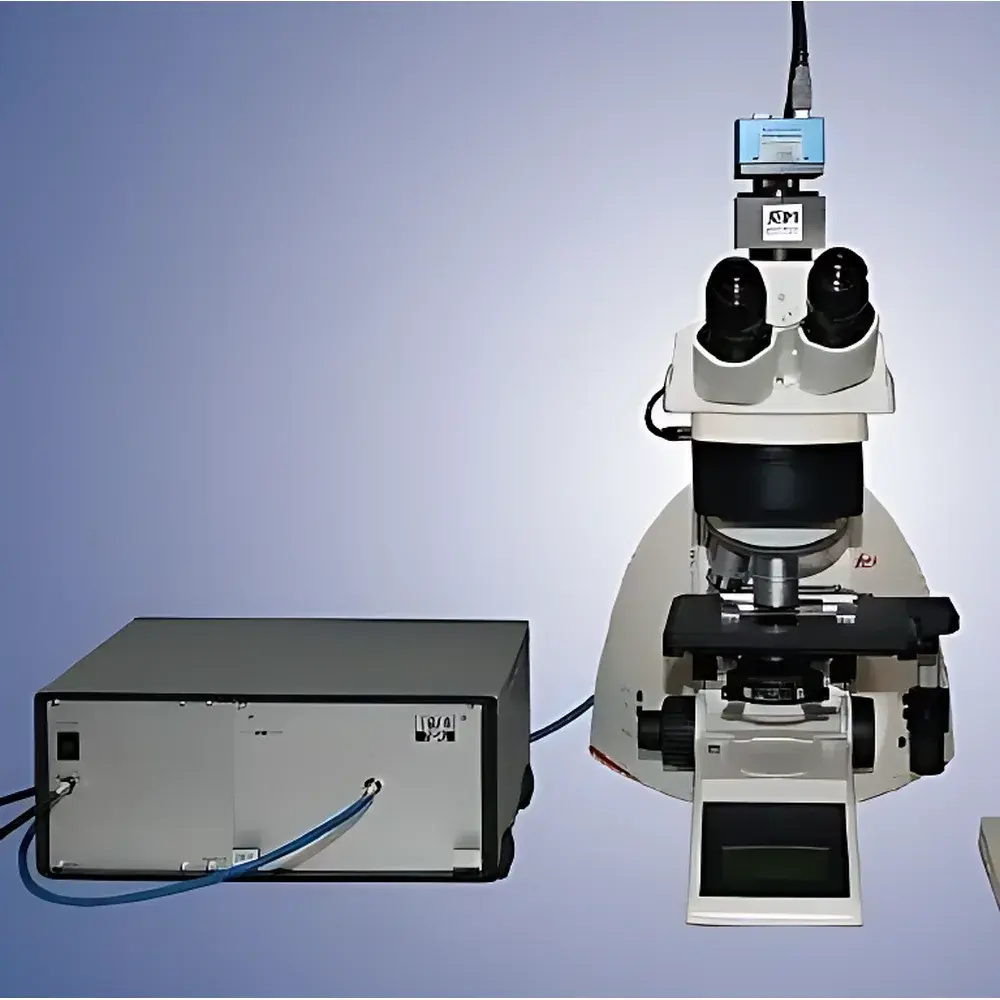
J&M MSP-400 Microspectrophotometer
| Brand | J&M |
|---|---|
| Origin | Germany |
| Model | MSP-400 |
| Detector Type | Photodiode Array (PDA) |
| Wavelength Range | 400–800 nm |
| Wavelength Accuracy | ±1 nm |
| Spectral Bandwidth | 1 nm |
| Stray Light | 0.001% T |
| Automation Level | Automatic Wavelength Scanning |
| Compatibility | Integrates with microscope camera tubes via TIDA interface |
Overview
The J&M MSP-400 Microspectrophotometer is a high-precision, research-grade microspectroscopic instrument engineered for non-destructive, spatially resolved spectral analysis of microscopic samples. Operating on the principle of transmission and reflectance microspectrophotometry, the MSP-400 couples a compact, thermally stabilized diode array spectrometer with optical interfaces compatible with standard upright and inverted microscopes equipped with camera tubes. Its core measurement architecture utilizes a fixed-grating monochromator and a 2048-element photodiode array detector, delivering rapid acquisition of full UV-Vis spectra (400–800 nm) from sub-micron sample regions without scanning mechanisms. Designed for quantitative absorbance, transmittance, and reflectance measurements at diffraction-limited spatial resolution, the system supports trace-level characterization of thin films, semiconductor features, biological tissue sections, pigment particles, forensic fibers, and archival materials—where conventional bulk spectrophotometry fails due to sample heterogeneity or size constraints.
Key Features
- Integrated PDA-based spectrometer with 1 nm spectral bandwidth and ±1 nm wavelength accuracy, traceable to NIST-certified standards
- Modular optical coupling via TIDA (Tubular Interface for Diode Array) mount—enables seamless integration with Olympus, Zeiss, Leica, and Nikon microscope camera tubes
- Interchangeable field-of-view apertures (10–100 µm diameter) for precise micro-area selection; optional fiber-coupled visible illumination (450–750 nm) for oblique or coaxial excitation
- Real-time dual-channel acquisition: simultaneous spectral data capture and live digital imaging synchronized at hardware level
- Thermal stabilization of optical path and detector to minimize baseline drift during extended acquisitions (e.g., time-resolved mapping)
- Rugged aluminum housing with EMI-shielded electronics, compliant with IEC 61326-1 for laboratory electromagnetic compatibility
Sample Compatibility & Compliance
The MSP-400 accommodates solid, semi-transparent, and reflective samples mounted on standard glass slides or silicon wafers—including polymer thin films, metallized layers, stained histological sections, ink-jet printed patterns, and mineral inclusions. No vacuum or cryogenic preparation is required. The system supports ASTM E2892–22 (Standard Practice for Microspectrophotometry of Single Fibers) and ISO 13660 (Optical Character Recognition – Measurement of Print Quality), and its data integrity framework aligns with GLP and GMP documentation requirements. Audit trail functionality, user access control, and electronic signature support are embedded in the software to satisfy FDA 21 CFR Part 11 readiness for regulated environments.
Software & Data Management
Controlled via J&M’s proprietary MSP Software Suite (v5.3+), the system runs natively on Windows 10/11 64-bit platforms with .NET Framework 4.8 and DirectX 12 acceleration. The software provides spectral preprocessing (baseline correction, smoothing, derivative calculation), multivariate analysis (PCA, cluster analysis), spectral library matching (NIST SRM databases, custom libraries), and GIS-style spectral mapping. All raw spectra are stored in vendor-neutral HDF5 format with embedded metadata (wavelength calibration, aperture ID, microscope magnification, objective NA). Export options include CSV, JCAMP-DX, and ASCII for third-party chemometric tools (e.g., MATLAB, Unscrambler X, Python SciPy workflows). Data backups, versioning, and role-based permissions are enforced through integrated SQLite database management.
Applications
- Materials science: Quantitative thickness and bandgap determination of transparent conductive oxides (e.g., ITO, AZO) on flexible substrates
- Forensics: Discrimination of dyed textile fibers and automotive paint layers based on spectral fingerprinting and peak-ratio analysis
- Life sciences: Mapping hemoglobin oxygenation states in frozen tissue sections using dual-wavelength ratio imaging (542/577 nm)
- Art conservation: Identification of historical pigments (e.g., vermilion vs. cadmium red) without sampling, per ISO 18562 guidelines
- Semiconductor QA: In-line verification of anti-reflective coating uniformity across 200 mm wafers using automated stage rastering
- Pharmaceutical development: Visual-spectral correlation of API crystallinity and polymorphic form distribution in tablet cross-sections
FAQ
Can the MSP-400 be used with confocal or Raman microscopes?
Yes—when configured with an external beam splitter and appropriate dichroic filters, the MSP-400 can operate in tandem with confocal laser scanning systems or as a complementary channel in hybrid Raman-microspectroscopy setups.
Is calibration verification documented per ISO/IEC 17025 requirements?
Yes—the instrument includes a built-in holmium oxide reference filter for periodic wavelength validation, and calibration certificates with uncertainty budgets are provided upon installation and annually during service.
What is the minimum resolvable spot size under 100× objective (NA 0.9)?
Approximately 0.5 µm lateral resolution (Abbe limit), subject to sample contrast, detector pixel binning, and optical alignment fidelity.
Does the system support kinetic spectral acquisition?
Yes—time-resolved mode enables triggered acquisition at up to 100 spectra/second over defined wavelength windows, suitable for monitoring photochemical reactions or thermal degradation kinetics.
Are OEM integration options available for custom automation?
Yes—J&M provides DLL-based SDK (C/C++, Python bindings) and LabVIEW drivers for integration into automated metrology platforms and inline process control systems.




